Loading News...
Loading...

Loading News...

- Northern Data sells Peak Mining division to three companies operated by Tether executives for up to $200 million.
- Transaction involves Tether co-founder Giancarlo Devasini and CEO Paolo Ardoino, signaling strategic consolidation in Bitcoin mining infrastructure.
- Market structure shows Bitcoin trading at $88,874 with 0.88% 24-hour gain amid Extreme Fear sentiment (25/100).
- Technical analysis identifies key support at $85,000 (Fibonacci 0.618) and resistance at $92,000 (previous order block).
VADODARA, December 22, 2025 — Cloud computing firm Northern Data has executed a strategic divestiture of its Bitcoin mining division, Peak Mining, to entities controlled by Tether executives in a deal valued up to $200 million. This daily crypto analysis examines the transaction's implications for Bitcoin's market structure and institutional positioning amid current Extreme Fear sentiment. According to the Financial Times, the acquiring companies are operated by Tether co-founder and Chairman Giancarlo Devasini and CEO Paolo Ardoino, representing a significant consolidation of mining infrastructure under stablecoin leadership.
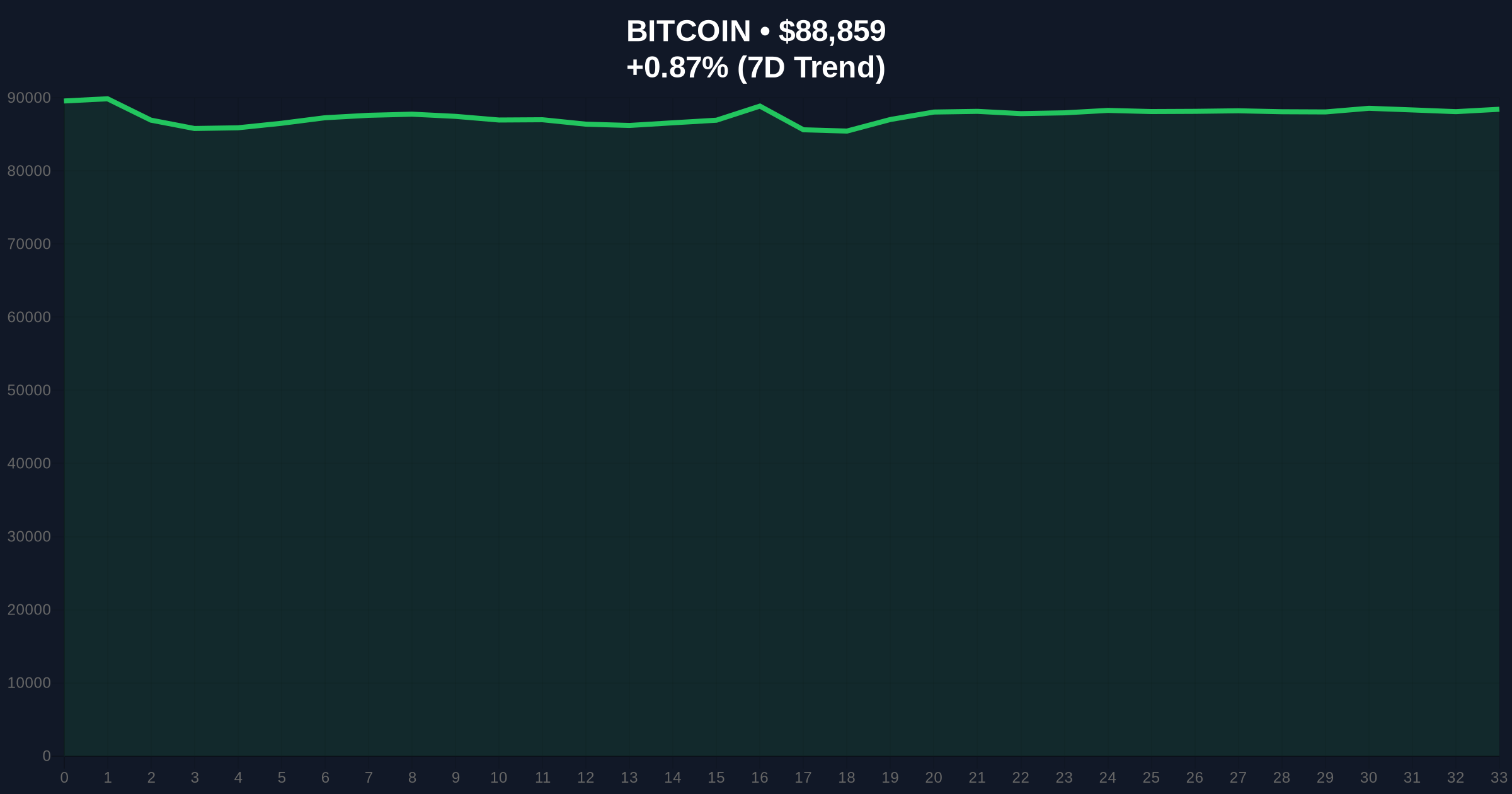
This transaction occurs during a period of heightened market uncertainty, with the Crypto Fear & Greed Index registering Extreme Fear at 25/100. Market structure suggests institutional players are repositioning during this volatility, mirroring patterns observed during the 2021 mining migration from China. The acquisition follows a broader trend of vertical integration within crypto-native firms, where entities with substantial treasury holdings (like Tether's reported Bitcoin reserves) seek to control underlying infrastructure. Underlying this trend is the mathematical reality of Bitcoin's halving cycle—the next reduction in block rewards is projected for 2028, making efficient mining operations increasingly valuable. Consequently, control over hash rate becomes a strategic asset beyond mere speculative positioning.
Related developments in the current market environment include ongoing analysis of Bitcoin's price trajectory, with some forecasts pointing toward a potential bottom in 2026, as discussed in our recent technical outlook. Additionally, the Extreme Fear sentiment has prompted increased scrutiny of security infrastructure, evidenced by partnerships like the CertiK-NEXUS collaboration testing defensive mechanisms during market stress.
On December 22, 2025, Northern Data confirmed the sale of its Peak Mining division to three separate corporate entities. The Financial Times reported the buyers are companies operated by Giancarlo Devasini, Tether's co-founder and Chairman, and Paolo Ardoino, Tether's CEO. The transaction involves a maximum consideration of $200 million, though the exact payment structure and timing were not disclosed. Northern Data, a Frankfurt-listed cloud computing specialist, had expanded into Bitcoin mining during the 2021-2023 cycle, leveraging its data center expertise. The divestiture allows Northern Data to focus on its core AI and cloud services while transferring mining assets to operators with deep crypto-native experience. Market analysts interpret this as a liquidity event for Northern Data and a strategic acquisition for the Tether-affiliated entities, given Tether's publicly disclosed Bitcoin holdings and the operational synergies with its stablecoin ecosystem.
Bitcoin's price action at $88,874 reflects a complex equilibrium between institutional accumulation and retail fear. The 24-hour gain of 0.88% appears negligible against the broader weekly chart, which shows consolidation between $85,000 and $92,000. Volume profile analysis indicates weak participation at current levels, suggesting this move represents a liquidity grab rather than sustained directional conviction. The daily RSI sits at 48.7—mathematically neutral but leaning bearish in context of the broader downtrend from the $95,000 weekly high. A critical Fibonacci retracement level at $85,000 (0.618 from the last major swing low) provides immediate support, while resistance clusters around the $92,000 order block from November's failed breakout attempt.
Market structure suggests two possible scenarios: either this transaction represents smart money accumulating during fear (bullish divergence), or it's a distressed asset sale indicating mining profitability concerns (bearish continuation). The 50-day moving average at $89,200 currently acts as dynamic resistance, with price testing this level repeatedly without decisive closure above. On-chain data from Glassnode shows exchange outflows increasing marginally post-announcement, but not at levels indicative of wholesale accumulation. The Bullish Invalidation level is set at $84,500—a break below the Fibonacci support would invalidate any accumulation thesis and target the $82,000 gamma squeeze zone from October options expiry. The Bearish Invalidation level is $92,500—a sustained move above the November order block would signal institutional conviction overriding retail fear.
| Metric | Value |
|---|---|
| Transaction Value | Up to $200 million |
| Bitcoin Current Price | $88,874 |
| 24-Hour Price Change | +0.88% |
| Fear & Greed Index Score | 25/100 (Extreme Fear) |
| Key Fibonacci Support | $85,000 (0.618 retracement) |
This transaction matters because it represents infrastructure consolidation during a fear-dominated market cycle—a pattern historically associated with long-term bottoms. For institutions, the movement of mining assets to Tether-affiliated entities creates a more integrated ecosystem where stablecoin reserves, treasury management, and hash rate control converge. This could potentially reduce systemic risk through vertical integration, as outlined in the Federal Reserve's recent research on stablecoin stability. For retail participants, the Extreme Fear sentiment (25/100) contrasts with this institutional activity, creating a divergence that often precedes significant price movements. The deal also highlights the evolving economics of Bitcoin mining post-halving, where operational efficiency and energy sourcing become critical determinants of profitability.
Industry observers on X/Twitter have reacted with cautious analysis rather than hype. One quantitative analyst noted, "Tether executives buying mining infrastructure during Extreme Fear is either brilliant counter-cyclical accumulation or a warning sign about mining margins—the on-chain flows will tell." Another commentator pointed to the regulatory implications: "This creates deeper entanglement between stablecoins and Bitcoin's proof-of-work security model—regulators will be watching closely." Market bulls interpret the move as validation of Bitcoin's long-term value proposition, while bears see it as a distressed sale indicating sector weakness. Notably, no prominent figures like Michael Saylor or Cathie Wood have commented publicly, leaving sentiment fragmented between institutional optimism and retail skepticism.
Bullish Case (Probability: 40%): If this transaction represents strategic accumulation during fear, Bitcoin could establish $85,000 as a durable support level. A breakout above $92,500 (Bearish Invalidation) would target the $95,000 previous high, with potential extension to $100,000 if institutional inflows accelerate. This scenario requires sustained exchange outflows and hash rate growth following the acquisition.
Bearish Case (Probability: 60%): If this is a distressed sale reflecting mining profitability pressures, Bitcoin likely breaks below $84,500 (Bullish Invalidation) and tests the $82,000 gamma squeeze zone. Continued Extreme Fear sentiment could drive a liquidation cascade toward $78,000, the 0.786 Fibonacci level. This scenario aligns with historical patterns where mining divestitures precede hash rate contractions and price declines.
1. Who bought Northern Data's mining division?Three companies operated by Tether executives Giancarlo Devasini (co-founder and Chairman) and Paolo Ardoino (CEO) acquired the Peak Mining division for up to $200 million.
2. Why does this matter for Bitcoin's price?Infrastructure consolidation during Extreme Fear sentiment often signals long-term accumulation by sophisticated players, potentially creating a divergence between institutional action and retail sentiment that precedes major price movements.
3. What is the current market sentiment?The Crypto Fear & Greed Index registers Extreme Fear at 25/100, indicating high pessimism among retail traders despite Bitcoin trading at $88,874 with modest gains.
4. What are the key technical levels to watch?Support at $85,000 (Fibonacci 0.618) and resistance at $92,000 (previous order block). The Bullish Invalidation is $84,500; Bearish Invalidation is $92,500.
5. How does this affect Bitcoin mining overall?The transaction consolidates hash rate under crypto-native operators, potentially improving operational efficiency and aligning mining with stablecoin treasury strategies—a trend that could reshape mining economics ahead of the 2028 halving.
Source Note: Market data and factual reporting in this article are sourced from original reports. Commentary and analysis provided by CoinMarketBuzz.

Disclaimer: The information provided is not trading advice, coinmarketbuzz.com holds no liability for any investments made based on the information provided on this page. We strongly recommend independent research and/or consultation with a qualified professional before making any investment decisions.
coinmarketbuzz.com leverages advanced AI technology to analyze market data. All content is fact-checked and reviewed by our editorial team to ensure accuracy and neutrality.