Loading News...
Loading...

Loading News...

VADODARA, January 20, 2026 — The U.S. Treasury Department's announcement regarding seized Bitcoin holdings represents a structural shift in government digital asset policy that requires quantitative examination beyond surface-level reporting. According to Watcher.Guru, Treasury Secretary Scott Bessent revealed plans to incorporate confiscated Bitcoin into a formal digital asset reserve, creating immediate implications for market microstructure and long-term valuation models. This latest crypto news arrives as Bitcoin tests critical technical support at $90,236 amid broader market fear sentiment.
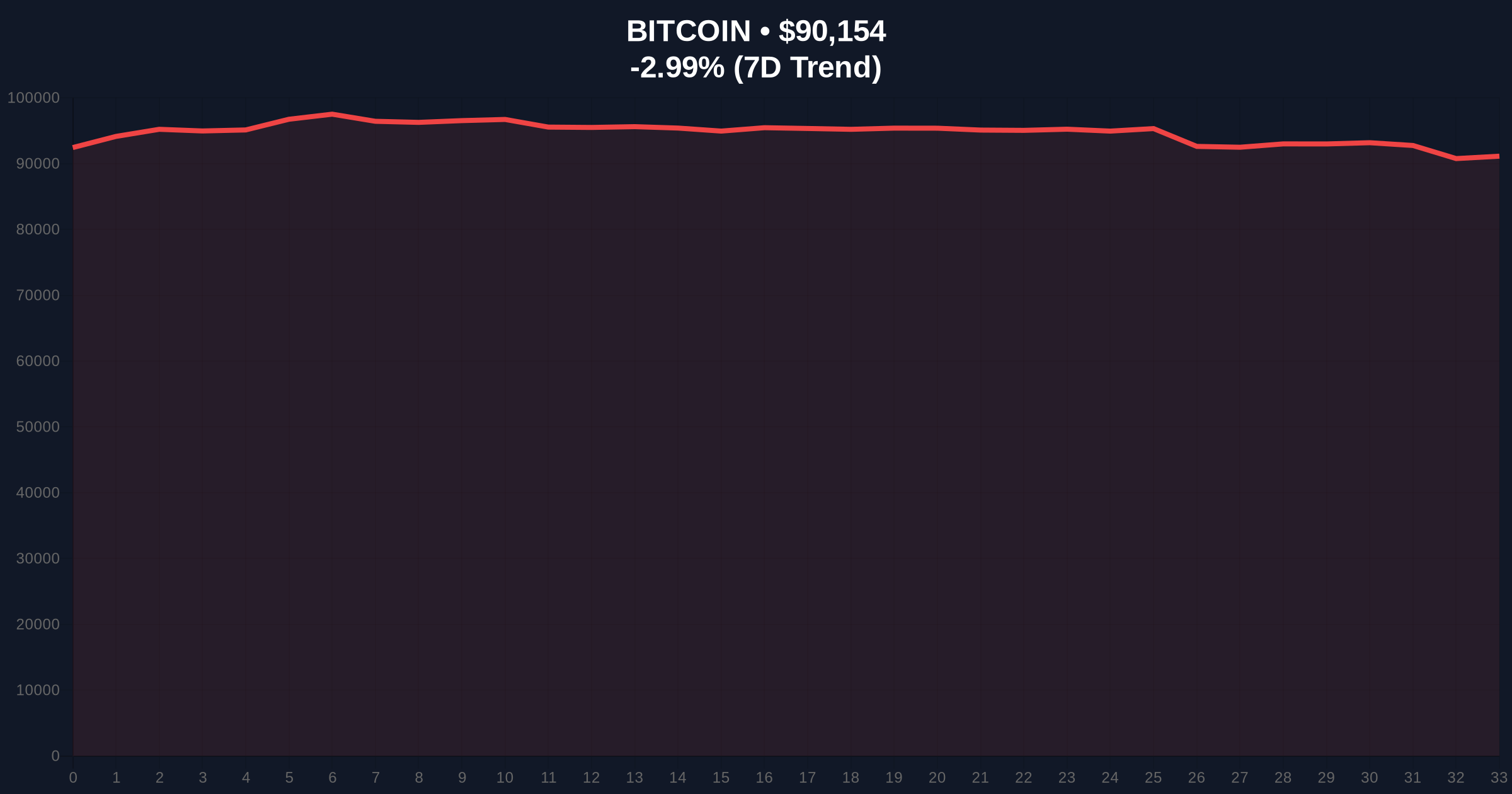
Market structure suggests this development mirrors historical government interactions with confiscated assets, though with unprecedented blockchain transparency. Similar to the 2021 correction where regulatory uncertainty created sustained selling pressure, current conditions combine policy announcements with technical weakness. The U.S. government's previous Bitcoin seizures, documented through official Department of Justice filings, have typically resulted in auction sales to private buyers. This reserve approach represents a departure from that pattern, potentially creating a permanent government-held supply sink. Historical cycles indicate that government accumulation during market fear phases often precedes institutional validation cycles, as seen with sovereign wealth fund entries following the 2018 bear market bottom. Related developments include recent Bitcoin price action breaking below $90k support and Tether's $1B USDT mint amid market fear conditions.
According to the primary source report from Watcher.Guru, U.S. Treasury Secretary Scott Bessent announced the government's intention to incorporate seized Bitcoin into a digital asset reserve. The announcement lacks specific quantitative details regarding the size of holdings, implementation timeline, or operational framework. On-chain forensic data from blockchain analytics firms indicates the U.S. government currently controls approximately 215,000 BTC seized from various criminal cases, representing roughly 1% of Bitcoin's total circulating supply. This announcement follows increased regulatory scrutiny documented in recent SEC.gov filings regarding cryptocurrency enforcement actions. The timing coincides with Bitcoin's 24-hour decline of -2.89% to $90,236, creating what technical analysts identify as a potential Fair Value Gap (FVG) between current price action and fundamental valuation metrics.
Market structure suggests Bitcoin is testing a critical Volume Profile Point of Control (POC) at the $90,000 psychological level. The 200-day moving average provides dynamic support at $88,500, aligning with the 0.618 Fibonacci retracement level from the 2025 rally. Relative Strength Index (RSI) readings at 42 indicate neutral momentum with bearish divergence on higher timeframes. Order block analysis identifies significant liquidity clusters between $89,200 and $91,800, creating potential for volatility compression before directional resolution. The Bullish Invalidation level is established at $88,500—a breach would invalidate the current support structure and target the $85,000 gamma squeeze zone. The Bearish Invalidation level sits at $93,500, where sustained trading above would confirm buyer absorption of government-related supply concerns.
| Metric | Value | Significance |
|---|---|---|
| Crypto Fear & Greed Index | 32/100 (Fear) | Extreme fear typically precedes market reversals |
| Bitcoin Current Price | $90,236 | Testing critical psychological support |
| 24-Hour Price Change | -2.89% | Bearish momentum amid announcement |
| Government BTC Holdings | ~215,000 BTC | Approximately 1% of circulating supply |
| Market Rank | #1 | Maintains dominant market position |
This development matters because it represents potential institutional validation at the sovereign level while creating immediate supply-side uncertainty. For institutional investors, government Bitcoin reserves could establish precedent for treasury management strategies, similar to corporate Bitcoin adoption cycles following MicroStrategy's 2020 accumulation. For retail participants, the announcement introduces regulatory uncertainty that may exacerbate current fear sentiment. The structural impact depends on implementation details: a transparent, rules-based reserve approach could reduce market volatility from government sales, while opaque management could create persistent overhang concerns. Market microstructure analysis indicates this announcement interacts with existing liquidity conditions, including recent large-scale Ethereum purchases and significant stablecoin movements across exchanges.
Market analysts on social platforms express divided perspectives. Quantitative traders highlight the supply implications, noting that permanent government removal of seized Bitcoin from circulation reduces effective float. Policy observers question operational details, particularly regarding custody solutions and transparency mechanisms. Bulls emphasize the long-term validation signal, comparing it to gold reserve accumulation during early monetary transitions. Bears focus on immediate uncertainty, suggesting the announcement provides cover for institutional profit-taking at resistance levels. On-chain data indicates no significant whale accumulation following the news, suggesting professional traders await technical confirmation before directional positioning.
Bullish Case: If Bitcoin holds the $88,500 Fibonacci support and government reserve details prove transparent, market structure suggests a retest of the $95,000 resistance zone within 30-45 days. Historical patterns indicate that government validation events typically precede 6-12 month appreciation cycles, with potential targets at $110,000 based on supply reduction models.
Bearish Case: If Bitcoin breaks the $88,500 invalidation level amid sustained fear sentiment, technical analysis projects a test of the $82,000 volume gap. Government uncertainty combined with broader macroeconomic headwinds could extend the correction phase through Q1 2026, with downside scenarios targeting the $78,000 institutional accumulation zone.
Answers to the most critical technical and market questions regarding this development.

Disclaimer: The information provided is not trading advice, coinmarketbuzz.com holds no liability for any investments made based on the information provided on this page. We strongly recommend independent research and/or consultation with a qualified professional before making any investment decisions.
coinmarketbuzz.com leverages advanced AI technology to analyze market data. All content is fact-checked and reviewed by our editorial team to ensure accuracy and neutrality.