Loading News...
Loading...

Loading News...

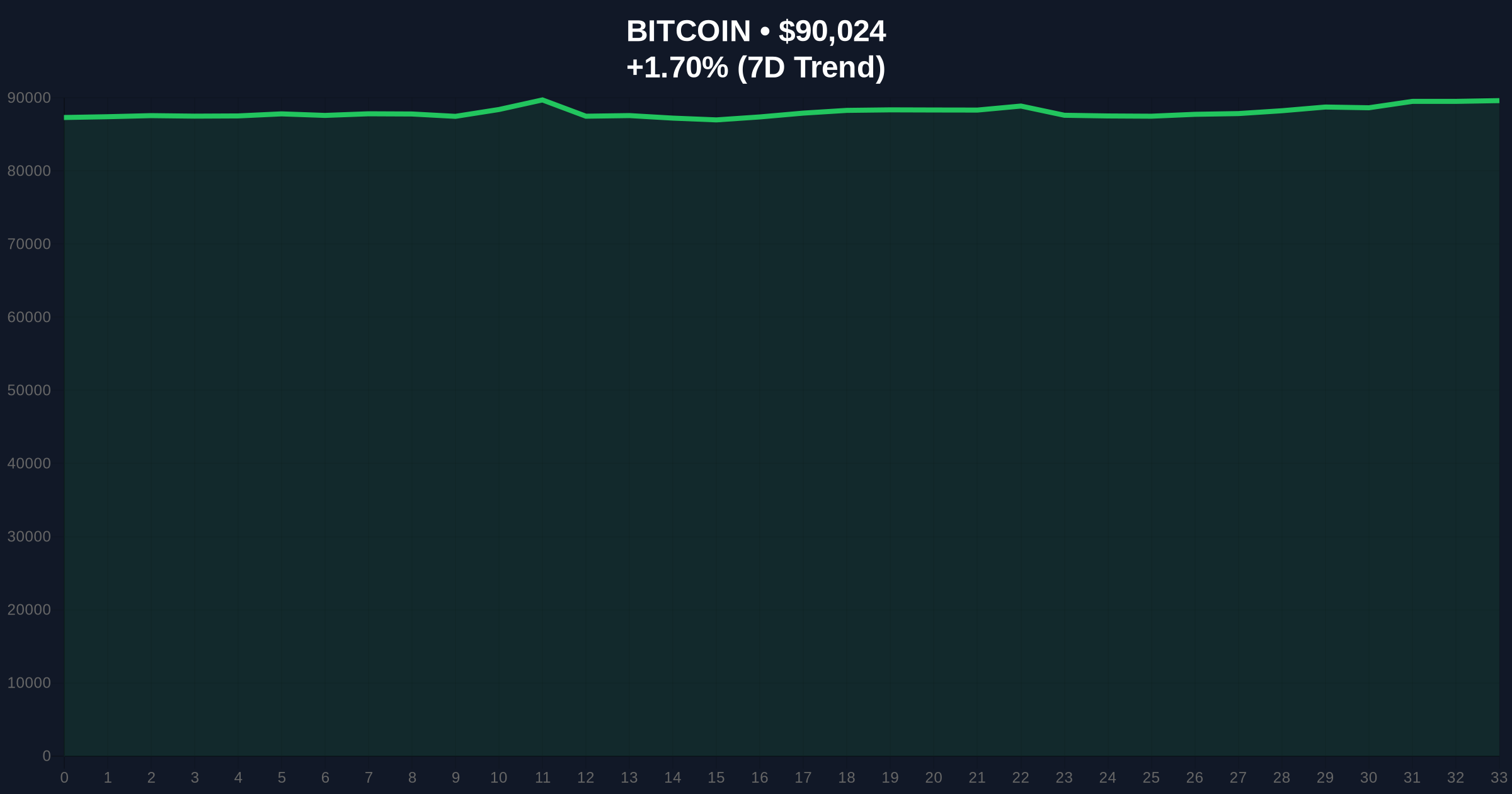
VADODARA, January 3, 2026 — A critical daily crypto analysis reveals that apparent Bitcoin whale accumulation signals are largely data distortions caused by exchange wallet reorganization, according to CryptoQuant senior analyst Julio Moreno. Market structure suggests this creates a deceptive liquidity trap as BTC trades at $90,020 with a Fear & Greed Index reading of 29, indicating underlying bearish pressure masked by noisy on-chain metrics.
Historical cycles suggest that whale accumulation phases typically precede major price rallies, making accurate data filtering essential for institutional positioning. The current market environment mirrors late-2021 conditions where exchange-led UTXO consolidation created false accumulation signals before the subsequent correction. Underlying this trend is the growing influence of spot Bitcoin ETFs, whose holdings now represent a significant portion of addresses in the 100-1,000 BTC range. Consequently, failure to isolate genuine whale activity from custodial movements distorts volume profile analysis and Fair Value Gap identification. Related developments include recent liquidity events such as the 250 million USDC mint that sparked liquidity grab fears and PEPE's memecoin surge testing liquidity levels, highlighting broader market fragility.
According to on-chain data from CryptoQuant, Julio Moreno identified that most circulating Bitcoin transaction metrics fail to filter exchange holdings, creating artificial whale accumulation signals. He explained that exchange wallet reorganization processes—where custodians consolidate UTXOs for operational efficiency—appear as large-scale address accumulation in raw data feeds. Moreno emphasized that when exchange addresses are excluded, the data actually indicates a decrease in BTC holdings by genuine whales. This trend extends to the 100-1,000 BTC cohort that includes ETF custodial wallets, suggesting institutional distribution rather than accumulation. In a statement to investors, Moreno previously stated his belief that Bitcoin has already passed its cycle high and is heading toward a low, a view supported by the adjusted on-chain forensic data.
Market structure suggests BTC's current price action at $90,020 represents a critical order block testing the 0.382 Fibonacci retracement level from the 2025 all-time high. The 50-day moving average at $91,200 acts as immediate resistance, while the 200-day MA at $87,800 provides dynamic support. RSI readings at 42 indicate neutral momentum with bearish divergence on higher timeframes. The Bullish Invalidation level is set at $88,500—a breach would confirm the data distortion thesis and target the $85,000 volume profile node. Conversely, the Bearish Invalidation level stands at $93,500, where a breakout would negate distribution patterns and suggest genuine accumulation despite data noise. This technical setup aligns with the Federal Reserve's current monetary policy stance detailed on FederalReserve.gov, where higher-for-longer interest rates continue to pressure risk assets.
| Metric | Value | Implication |
|---|---|---|
| Crypto Fear & Greed Index | 29/100 (Fear) | Extreme fear suggests capitulation risk |
| Bitcoin Current Price | $90,020 | Testing key Fibonacci support |
| 24-Hour Price Change | +1.70% | Minor rebound within bearish structure |
| Market Rank | #1 | Dominance at 52% indicates altcoin weakness |
| Whale Address Trend (Ex-Exchange) | Decreasing | Genuine distribution underway |
For institutional investors, this data distortion creates significant counterparty risk in gamma squeeze strategies that rely on accurate whale positioning signals. Retail traders face liquidity grab scenarios where false accumulation narratives trigger bullish entries just before distribution phases. The technical impact extends to derivative markets where options open interest at $92,000 strikes may be mispriced due to flawed underlying data. Long-term, this highlights the need for standardized on-chain data protocols similar to Ethereum's EIP-4844 blob transactions that improve data availability and filtering.
Market analysts on X/Twitter express divided views. Bulls point to exchange net flows showing minor inflows as accumulation signals, while bears emphasize Moreno's adjusted data indicating distribution. One quantitative trader noted, "When exchange wallets are filtered, the whale cohort shows net outflows of 15,000 BTC over the past month—this isn't accumulation, it's stealth distribution." This sentiment aligns with concerns about centralization risks in protocols, as discussed in Aave's revenue share plan facing scrutiny.
Bullish Case: If BTC holds above the $88,500 invalidation level and breaks $93,500, genuine accumulation could emerge targeting $98,000 resistance. This scenario requires ETF net inflows exceeding 5,000 BTC weekly to offset whale distribution.
Bearish Case: Breakdown below $88,500 confirms the data distortion thesis, triggering a liquidity grab toward the $85,000 volume node and potentially $82,000 support. This aligns with Moreno's cycle high assessment and would validate the Fear & Greed Index's extreme reading.
Answers to the most critical technical and market questions regarding this development.

Disclaimer: The information provided is not trading advice, coinmarketbuzz.com holds no liability for any investments made based on the information provided on this page. We strongly recommend independent research and/or consultation with a qualified professional before making any investment decisions.
coinmarketbuzz.com leverages advanced AI technology to analyze market data. All content is fact-checked and reviewed by our editorial team to ensure accuracy and neutrality.