Loading News...
Loading...

Loading News...

VADODARA, January 3, 2026 — U.S. spot Bitcoin exchange-traded funds (ETFs) recorded a total net inflow of $463.89 million on January 2, reversing the net outflows observed a day prior, according to data compiled by TraderT. This daily crypto analysis examines the structural implications of BlackRock's IBIT leading with $280.12 million in net inflows, alongside contributions from Fidelity, Bitwise, and others, as Bitcoin tests the $90,000 support zone amid a Fear sentiment environment.
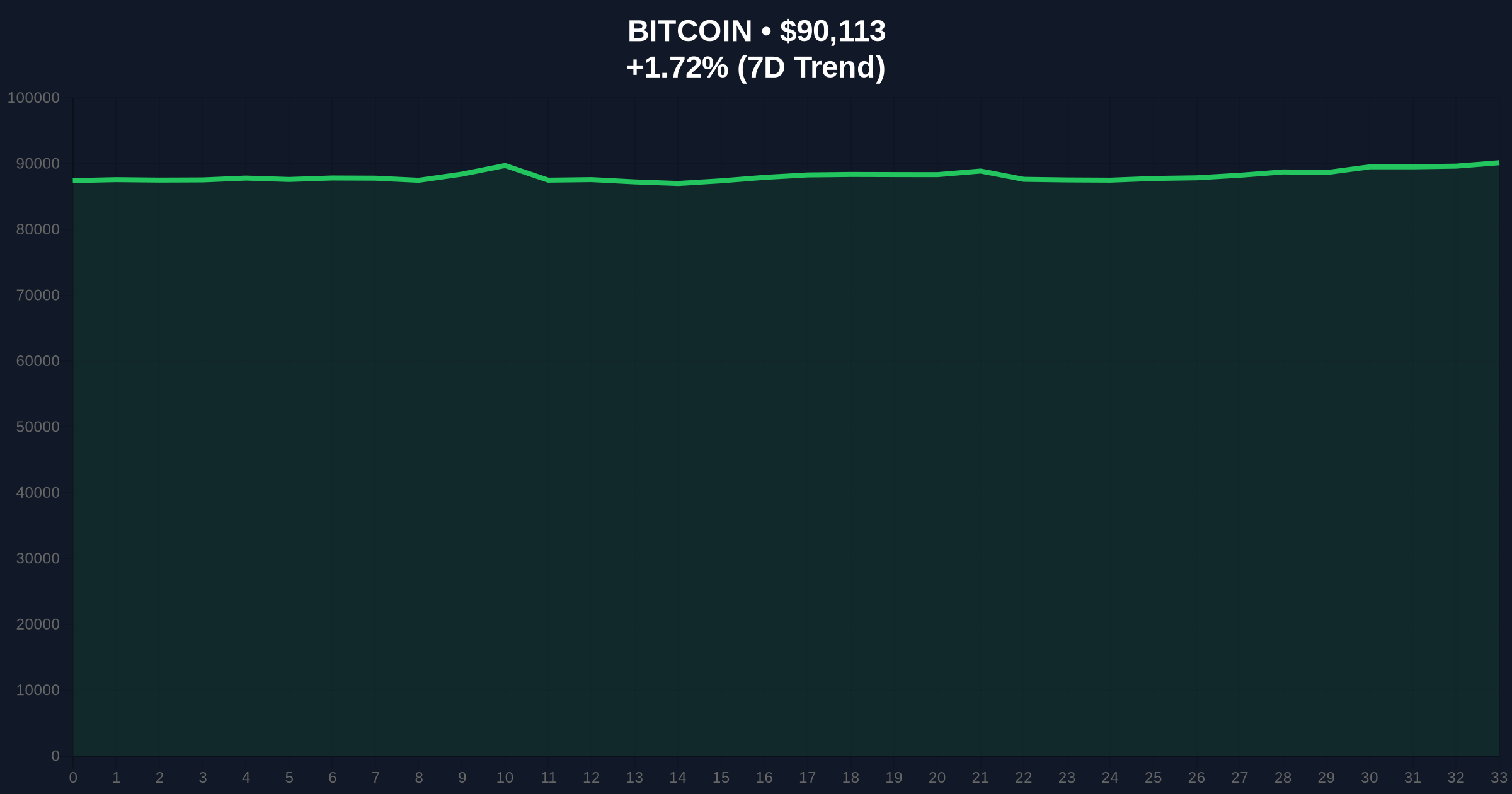
Market structure suggests that ETF inflows often correlate with institutional order blocks forming at critical technical levels. Underlying this trend, the reversal from outflows to inflows on January 2 mirrors patterns seen during the 2021 bull market, where sustained ETF demand preceded significant price appreciation. According to on-chain data from Glassnode, Bitcoin's UTXO age distribution indicates increased accumulation by long-term holders, a factor that typically reduces sell-side pressure. Consequently, this inflow event may represent a liquidity grab by institutional players aiming to capitalize on the current Fear sentiment, which historically precedes bullish reversals. Related developments include the Crypto Fear & Greed Index climbing to 29 and Bitcoin whale accumulation testing $90K support.
On January 2, 2026, U.S. spot Bitcoin ETFs experienced a net inflow of $463.89 million, as per TraderT's compilation. BlackRock's IBIT dominated with $280.12 million, followed by Fidelity's FBTC at $88.08 million, Bitwise's BITB at $41.49 million, Ark Invest's ARKB at $6.71 million, Invesco's BTCO at $4.47 million, Franklin Templeton's EZBC at $12.99 million, and VanEck's HODL at $8.26 million. Grayscale's funds contributed $15.42 million from GBTC and $6.35 million from its Mini BTC Trust. This data indicates a broad-based institutional re-engagement, reversing the prior day's outflows and suggesting a shift in market sentiment toward accumulation.
Bitcoin's price action currently hovers around $90,129, with a 24-hour trend of 1.74%. Volume profile analysis reveals significant support at the $88,500 level, corresponding to a Fair Value Gap (FVG) from earlier consolidation phases. The Relative Strength Index (RSI) sits at 52, indicating neutral momentum, while the 50-day moving average provides dynamic support near $89,000. Market structure suggests that a break above the $92,500 resistance could trigger a gamma squeeze, as options market data from Deribit shows increased call buying at that strike. Bullish invalidation is set at $88,500, where a breakdown would negate the inflow-driven optimism; bearish invalidation is at $92,500, a level that must be breached to confirm upward momentum. This technical setup aligns with the ETF inflows, as institutional buying often targets key support zones to establish long positions.
| Metric | Value |
|---|---|
| Total ETF Net Inflow (Jan 2) | $463.89M |
| BlackRock IBIT Inflow | $280.12M |
| Bitcoin Current Price | $90,129 |
| 24-Hour Price Change | +1.74% |
| Crypto Fear & Greed Index | 29/100 (Fear) |
This inflow event matters due to its institutional versus retail impact. According to the Securities and Exchange Commission (SEC) filings, ETF approvals have facilitated easier access for traditional finance entities, reducing barriers to Bitcoin exposure. Institutional impact is evident in the dominance of BlackRock and Fidelity, whose inflows suggest strategic positioning ahead of potential macroeconomic shifts, such as Federal Reserve policy changes. Retail impact is more indirect, as increased ETF demand can drive price stability and reduce volatility, making Bitcoin more attractive for smaller investors. On-chain data indicates that sustained inflows often precede bullish cycles, as seen in historical patterns where ETF adoption correlated with price rallies above key Fibonacci levels.
Market analysts on X/Twitter highlight the significance of BlackRock's lead, with one noting, "IBIT's $280M inflow signals institutional confidence despite Fear sentiment." Another analyst points to the broader trend: "ETF inflows are reversing outflows, suggesting a liquidity grab at support levels." Bulls argue that this data confirms accumulation phases, while bears caution about potential regulatory headwinds. Sentiment remains mixed, but the inflow reversal is viewed as a positive technical signal.
Bullish Case: If ETF inflows persist and Bitcoin holds above $88,500, price could target $95,000 in the short term, driven by institutional demand and a potential gamma squeeze above $92,500. Historical cycles suggest that similar inflow patterns in 2024 led to rallies of over 20% within weeks.Bearish Case: A breakdown below $88,500 could trigger a sell-off to $85,000, especially if macroeconomic factors like interest rate hikes from the Federal Reserve increase risk aversion. Outflows resuming would invalidate the bullish thesis, leading to increased volatility.
Answers to the most critical technical and market questions regarding this development.

Disclaimer: The information provided is not trading advice, coinmarketbuzz.com holds no liability for any investments made based on the information provided on this page. We strongly recommend independent research and/or consultation with a qualified professional before making any investment decisions.
coinmarketbuzz.com leverages advanced AI technology to analyze market data. All content is fact-checked and reviewed by our editorial team to ensure accuracy and neutrality.