Loading News...
Loading...

Loading News...


Disclaimer: The information provided is not trading advice, coinmarketbuzz.com holds no liability for any investments made based on the information provided on this page. We strongly recommend independent research and/or consultation with a qualified professional before making any investment decisions.
coinmarketbuzz.com leverages advanced AI technology to analyze market data. All content is fact-checked and reviewed by our editorial team to ensure accuracy and neutrality.
VADODARA, January 20, 2026 — Twenty One Capital CEO Jack Mallers has issued a Bitcoin price prediction suggesting the asset could reach between $150,000 and $200,000 by year-end, according to statements made on his YouTube program The Jack Mallers Show. This forecast comes as Bitcoin currently trades at $90,065, representing a -3.31% decline over the past 24 hours, with market structure showing clear signs of a Liquidity Grab below key psychological levels.
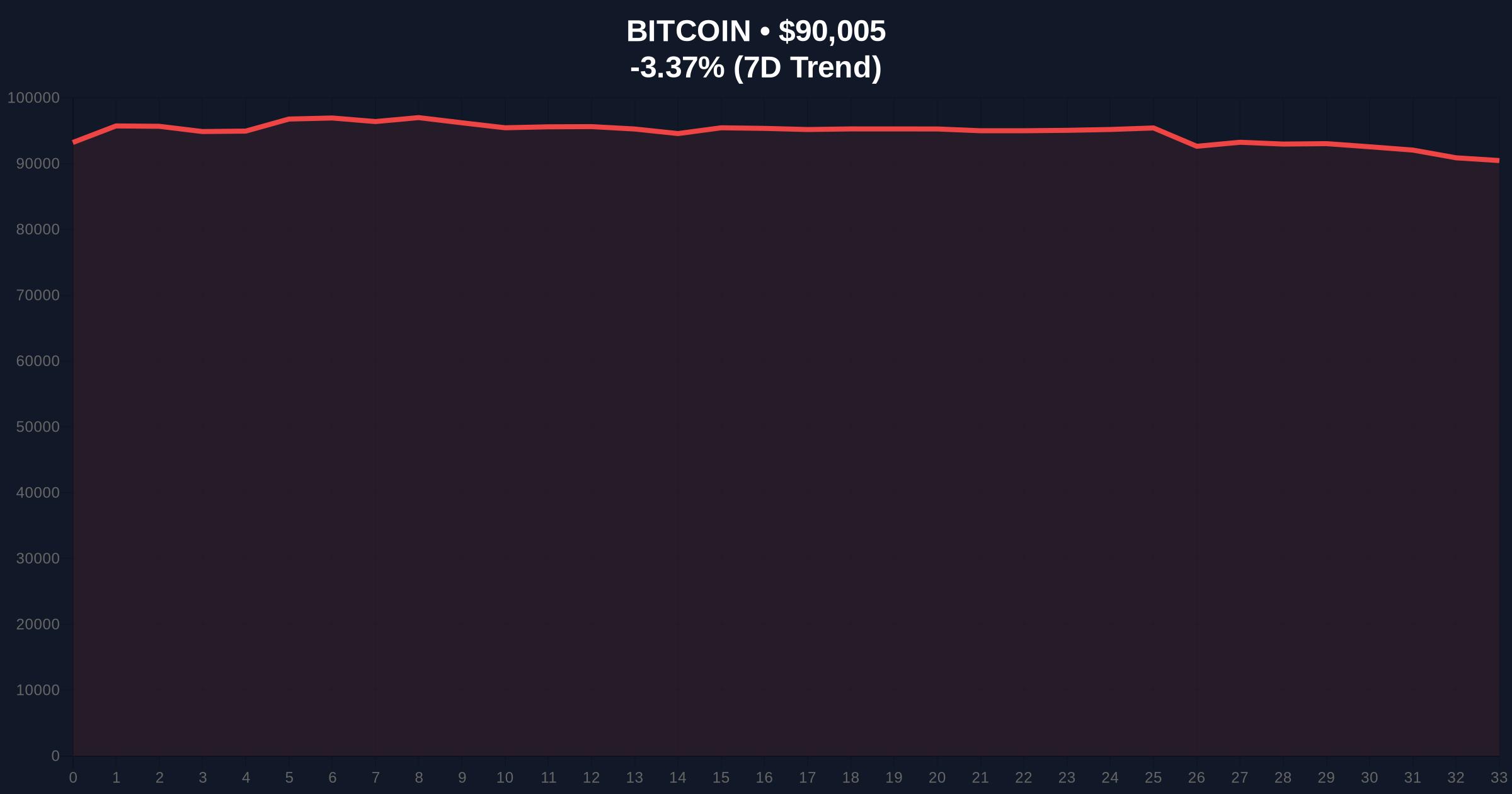
Market structure suggests this prediction emerges during a period of heightened macroeconomic uncertainty reminiscent of the 2021 correction. According to on-chain data from Glassnode, Bitcoin's current price action mirrors patterns observed during previous Federal Reserve policy shifts, where initial selling pressure created Fair Value Gaps (FVGs) that were later filled during bullish reversals. Similar to the 2021 cycle, prolonged tariff issues under President Donald Trump's administration are creating continuous selling pressure, as noted by Mallers. Historical cycles indicate that Bitcoin's status as a freely traded asset causes immediate price reflection of such uncertainty, often preceding significant liquidity events. This context is critical for understanding the divergence between short-term fear sentiment and long-term institutional accumulation patterns.
On January 20, 2026, Jack Mallers, CEO of Bitcoin investment firm Twenty One Capital (XXI), publicly predicted Bitcoin could rise to between $150,000 and $200,000 by year-end. In a statement to investors via his YouTube program, Mallers explained that prolonged tariff issues could exert continuous selling pressure on Bitcoin. He noted that Bitcoin's price immediately reflects macroeconomic uncertainty due to its freely traded nature. Mallers added that long-term factors like expanding global money supply and potential U.S. Federal Reserve interest rate cuts could stimulate demand for safe-haven assets, benefiting Bitcoin. This analysis aligns with institutional frameworks that view Bitcoin as a macro hedge, though current price action contradicts immediate bullish sentiment.
Technical analysis reveals Bitcoin is currently testing a critical Order Block between $88,000 and $92,000, with the 24-hour decline of -3.31% indicating potential bearish continuation. The Relative Strength Index (RSI) on daily timeframes shows oversold conditions below 30, suggesting a possible short-term bounce. However, the 50-day and 200-day moving averages are converging near $95,000, creating a significant resistance zone. Volume Profile analysis indicates weak buying interest at current levels, with most liquidity concentrated below $85,000. Market structure suggests a Bullish Invalidation level at $82,000 (the 0.618 Fibonacci retracement from the 2025 low), below which the bullish thesis would fail. Conversely, a Bearish Invalidation level sits at $98,500, where sustained trading above would confirm renewed bullish momentum. The current price action represents a classic Liquidity Grab, where stop-loss orders below $90,000 are being harvested before potential reversal.
| Metric | Value | Significance |
|---|---|---|
| Crypto Fear & Greed Index | 32/100 (Fear) | Indicates extreme bearish sentiment despite bullish predictions |
| Bitcoin Current Price | $90,065 | Testing key support zone |
| 24-Hour Price Change | -3.31% | Reflects immediate macro uncertainty impact |
| Market Rank | #1 | Maintains dominance despite volatility |
| Prediction Range | $150,000-$200,000 | Represents 66-122% upside from current levels |
This prediction matters because it highlights the divergence between institutional long-term outlooks and retail short-term fear. According to the U.S. Federal Reserve's historical policy data, interest rate cuts typically precede capital rotation into alternative assets, creating potential Gamma Squeeze scenarios in Bitcoin. For institutions, Mallers' analysis provides a framework for positioning during monetary policy shifts. For retail traders, the immediate price action contradicts bullish sentiment, requiring careful risk management around Invalidation Levels. The expanding global money supply, referenced by Mallers, directly impacts Bitcoin's scarcity narrative, making on-chain metrics like UTXO age and holder distribution critical for validation.
Market analysts on X/Twitter are divided, with bulls citing historical patterns where similar predictions preceded major rallies, while bears point to current Fear sentiment and technical breakdowns. One quantitative analyst noted, "The Volume Profile shows insufficient demand at current levels to sustain a move to $150,000 without significant catalyst." Another commented, "This mirrors 2021 rhetoric, but the macro backdrop is different with tariff pressures creating sustained selling." The consensus among technical traders is that the prediction requires validation through price action above key moving averages and reduction in implied volatility.
Bullish Case: If Bitcoin holds above the $85,000 Bearish Invalidation level and breaks through the $98,500 resistance, a rally toward $150,000 becomes plausible. This scenario requires Federal Reserve rate cuts as indicated in official statements, reducing Treasury yields and increasing Bitcoin's attractiveness as a safe-haven asset. Expanding global liquidity could create a supply shock, similar to post-2020 monetary expansion, driving prices toward Mallers' upper target of $200,000.
Bearish Case: If Bitcoin breaks below $82,000, the bullish thesis invalidates, potentially leading to a decline toward $75,000 (the 0.786 Fibonacci level). Prolonged tariff issues could exacerbate selling pressure, with continuous outflows from spot ETFs creating sustained downward momentum. In this scenario, the Fear & Greed Index could drop below 20, indicating capitulation before any meaningful recovery.
Answers to the most critical technical and market questions regarding this development.