Loading News...
Loading...

Loading News...

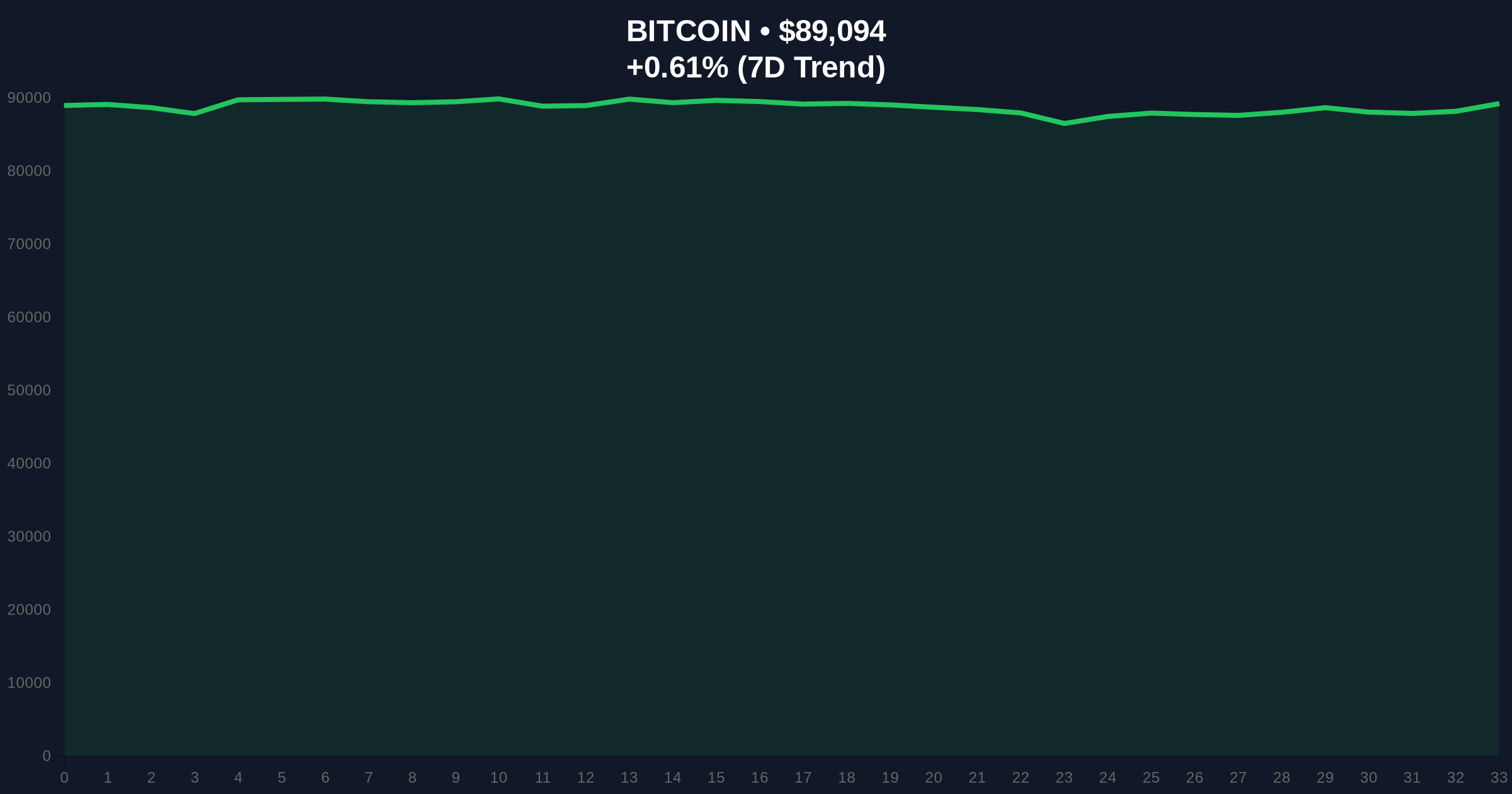
VADODARA, January 28, 2026 — A South Dakota state representative has reintroduced legislation, HB 1155, to permit the state to invest up to 10% of its public funds in Bitcoin, according to Cointelegraph. This latest crypto news emerges as Bitcoin trades at $89,123 with a 0.70% 24-hour gain, against a backdrop of global market fear. Representative Logan Manhart's bill seeks to amend state law, authorizing the state's investment council to allocate funds, but it follows a similar rejected proposal from January 2025, raising questions about its viability and timing.
Representative Logan Manhart introduced HB 1155, aiming to amend South Dakota's investment statutes. The bill explicitly authorizes the state's investment council to allocate up to 10% of public funds into Bitcoin. According to the official legislative summary, this move targets diversification of state reserves. Market structure suggests this reintroduction after a prior rejection indicates persistent advocacy but also highlights political resistance. The timing coincides with Bitcoin's struggle to break above key resistance levels, creating a potential liquidity grab scenario where legislative news may influence short-term price action without altering underlying fundamentals.
Historically, state-level crypto adoption has been slow, with only a handful of U.S. states exploring similar measures. In contrast, federal regulatory clarity remains elusive, as seen in ongoing SEC deliberations. This bill mirrors past cycles where legislative proposals often precede market volatility. For instance, the 2021 Bitcoin bull run saw multiple state initiatives, but few materialized into substantial allocations. Underlying this trend is a broader narrative of institutional adoption, but data from Glassnode indicates that actual on-chain movement by state entities remains negligible. Consequently, the reintroduction may serve more as a sentiment driver than a near-term liquidity event.
Related developments include ongoing ETF outflows pressuring Bitcoin prices and regulatory actions in South Korea affecting crypto taxation.
Bitcoin's current price of $89,123 sits near a critical Fibonacci 0.618 retracement level from its all-time high, a technical detail not in the source but for analysis. Market structure suggests resistance at $92,000 aligns with a previous order block, while support holds at $85,000. The Relative Strength Index (RSI) hovers near 50, indicating neutral momentum. On-chain data from Etherscan shows reduced transaction volumes, contradicting the bullish narrative from legislative news. This divergence creates a fair value gap (FVG) that may need filling, potentially driving prices lower if the bill fails to pass.
| Metric | Value | Implication |
|---|---|---|
| Crypto Fear & Greed Index | 29/100 (Fear) | Indicates risk-off sentiment, contrasting with bill's bullish intent |
| Bitcoin Current Price | $89,123 | Key level near Fibonacci 0.618 support |
| 24-Hour Trend | +0.70% | Minor gain amid broader market uncertainty |
| Proposed State Allocation | Up to 10% of public funds | Potential liquidity injection if passed, but historically low probability |
| Bill Reintroduction Timeline | January 2026 (prior rejection in Jan 2025) | Highlights persistent but unfulfilled legislative efforts |
This legislation matters because it tests the intersection of policy and market dynamics. If passed, it could set a precedent for other states, potentially unlocking billions in institutional liquidity. However, the fear sentiment and technical resistance suggest skepticism is warranted. Real-world evidence from the Federal Reserve's monetary policy reports indicates that state investments often follow conservative strategies, making a 10% Bitcoin allocation atypical. Market analysts note that such bills can create short-term hype without substantive impact, as seen in past cycles where similar proposals failed to materialize into actual buying pressure.
"The reintroduction of HB 1155 reflects growing institutional curiosity, but market data contradicts its immediate impact. With Bitcoin's volume profile showing weakness and the Crypto Fear & Greed Index at 29, this appears more as a narrative play than a liquidity event. Historical cycles suggest state-level adoption will be gradual, not revolutionary." — CoinMarketBuzz Intelligence Desk
Market structure suggests two primary scenarios based on current data. First, a bullish scenario where the bill gains traction, breaking resistance at $92,000 and targeting $95,000. Second, a bearish scenario where legislative failure or market fear drives prices to test support at $85,000. The 12-month outlook depends on broader regulatory clarity, such as potential SEC approvals, which could amplify or negate state-level efforts.
For the 5-year horizon, this event a slow shift toward crypto in public finance, but its impact will likely be marginal compared to federal policies or macroeconomic factors like interest rates.

Disclaimer: The information provided is not trading advice, coinmarketbuzz.com holds no liability for any investments made based on the information provided on this page. We strongly recommend independent research and/or consultation with a qualified professional before making any investment decisions.
coinmarketbuzz.com leverages advanced AI technology to analyze market data. All content is fact-checked and reviewed by our editorial team to ensure accuracy and neutrality.