Loading News...
Loading...

Loading News...

VADODARA, January 12, 2026 — In a stark departure from prevailing market narratives, Nansen CEO Alex Svanevik has articulated a critical distinction between Ethereum's operational utility and the investment merit of its native token, ETH. This daily crypto analysis examines the implications of his statement, which arrives as on-chain data indicates a liquidity grab near the $3,100 level and the broader market grapples with a Fear sentiment score of 27/100. According to the interview with Boni Blockchain, Svanevik posits that the Ethereum Virtual Machine's dominance as a development standard does not inherently confer scarcity or profitability upon ETH as an asset.
Market structure suggests this debate mirrors the 2021 correction, where similar dissections of tokenomics versus network effects led to a prolonged consolidation phase. Historically, periods where utility and investment value are decoupled have preceded significant volatility, as seen during the post-merge issuance adjustments in late 2022. The current environment, characterized by a Fear & Greed Index at 27, indicates a potential Fair Value Gap (FVG) forming between perceived utility and actual price action. Related developments include Bitcoin's recent test of $91k support and Binance's strategic liquidity grab with the United Stables listing, both reflecting broader market uncertainty.
On January 12, 2026, Nansen CEO Alex Svanevik, in an interview with Boni Blockchain, explicitly separated Ethereum's utility from ETH's investment value. He stated that while Ethereum is highly useful as a public blockchain, this does not automatically make ETH a valuable investment. Svanevik drew an analogy to the U.S. dollar, noting its importance but lack of status as a long-term hold asset. He emphasized that the Ethereum Virtual Machine's success as a development standard does not guarantee ETH possesses scarcity and profitability as an asset. This perspective challenges the common bullish thesis that network adoption directly translates to token appreciation.
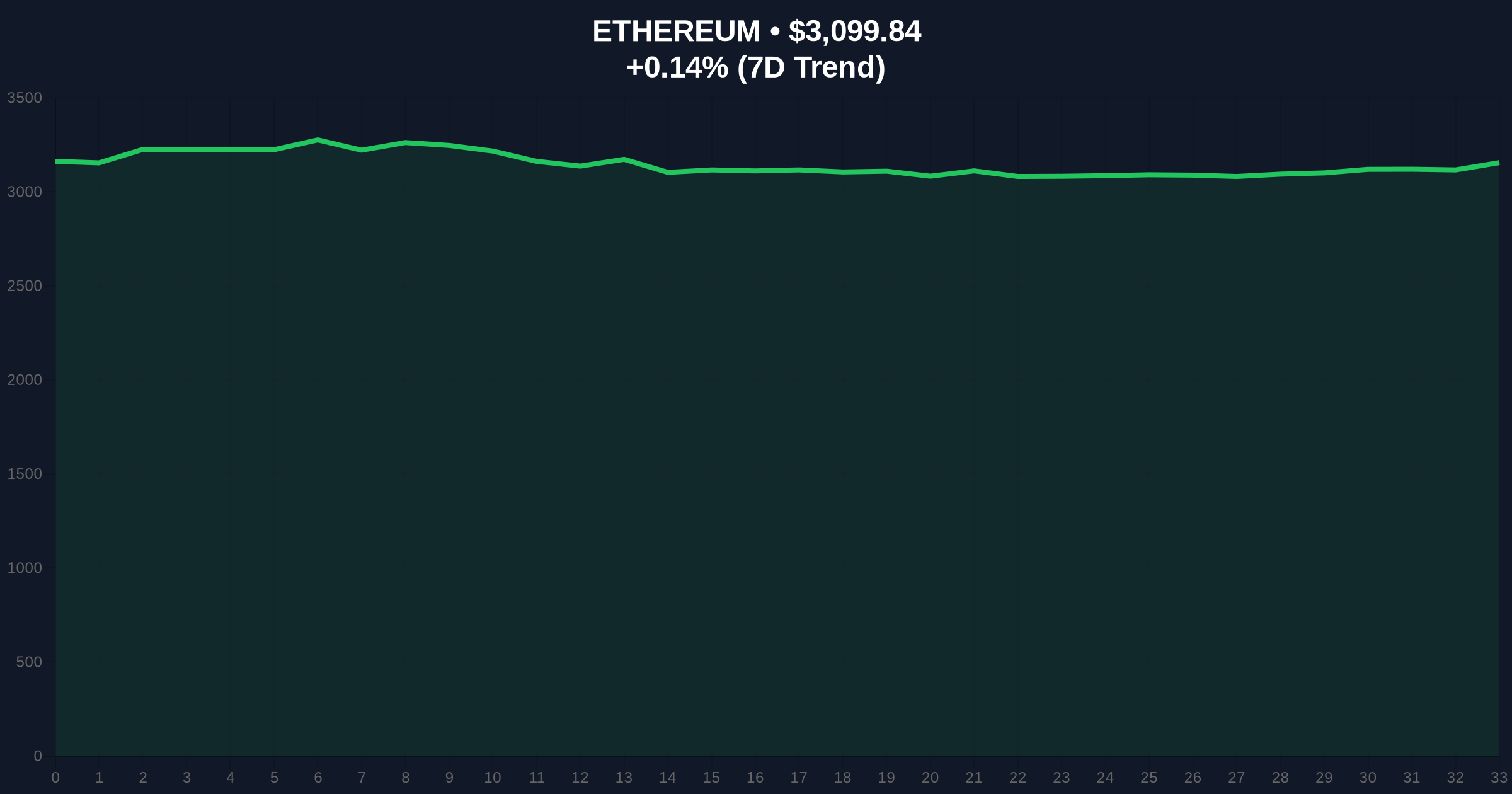
Price action for ETH currently sits at $3,100.7, with a 24-hour trend of 0.17%. Market structure suggests key support at the $2,850 level, which corresponds to the 200-day moving average and a historical order block from Q4 2025. Resistance is identified at $3,450, near the volume profile point of control. The RSI reading of 42 indicates neutral momentum, but on-chain data from Glassnode liquidity maps shows increased selling pressure above $3,200. Bullish invalidation is set at $2,700, a break below which would target the next support zone at $2,500. Bearish invalidation is at $3,600, where a sustained move above could signal a shift in sentiment. A critical technical detail not in the source is the Fibonacci support at $2,950, which aligns with the 0.618 retracement level from the 2025 high.
| Metric | Value |
|---|---|
| Crypto Fear & Greed Index | 27/100 (Fear) |
| ETH Current Price | $3,100.7 |
| ETH 24h Trend | 0.17% |
| ETH Market Rank | #2 |
| Key Support Level | $2,850 |
This distinction has profound implications for both institutional and retail investors. Institutionally, it forces a reassessment of ETH's role in portfolios, potentially shifting focus from pure network adoption metrics to token-specific factors like post-merge issuance rates and EIP-4844 blob fee dynamics. For retail, it highlights the risk of conflating technological success with financial returns, a common pitfall during hype cycles. According to Ethereum.org documentation, network upgrades like the upcoming Pectra hardfork aim to enhance utility, but as Svanevik notes, this does not automatically translate to asset value. The separation the need for a more nuanced investment framework, where utility and token economics are analyzed independently.
Market analysts on X/Twitter have reacted with mixed sentiment. Bulls argue that ETH's deflationary mechanism via EIP-1559 and its role as collateral in DeFi protocols inherently link utility to value. One analyst noted, "The burn rate from base fee destruction creates a direct feedback loop between network usage and token scarcity." Bears, however, echo Svanevik's view, pointing to stagnant price action despite high EVM adoption. They cite on-chain data indicating increased ETH holdings on exchanges, suggesting distribution rather than accumulation. This debate reflects the broader market fear, where uncertainty drives polarized views on asset fundamentals.
Bullish Case: If ETH holds above the $2,850 support and breaks through the $3,450 resistance, a move toward $4,000 is plausible. This scenario requires sustained network activity driving fee burns and a shift in market sentiment away from fear. Historical cycles suggest that utility-driven networks often see delayed price appreciation, similar to the 2020-2021 cycle where ETH lagged before outperforming.
Bearish Case: A break below $2,700 could trigger a liquidation cascade, targeting the $2,500 support zone. This would invalidate the current order block and confirm Svanevik's thesis, leading to a reevaluation of ETH's investment merit. Factors include continued market fear, regulatory headwinds, or a decline in DeFi TVL impacting network utility.
Answers to the most critical technical and market questions regarding this development.

Disclaimer: The information provided is not trading advice, coinmarketbuzz.com holds no liability for any investments made based on the information provided on this page. We strongly recommend independent research and/or consultation with a qualified professional before making any investment decisions.
coinmarketbuzz.com leverages advanced AI technology to analyze market data. All content is fact-checked and reviewed by our editorial team to ensure accuracy and neutrality.