Loading News...
Loading...

Loading News...

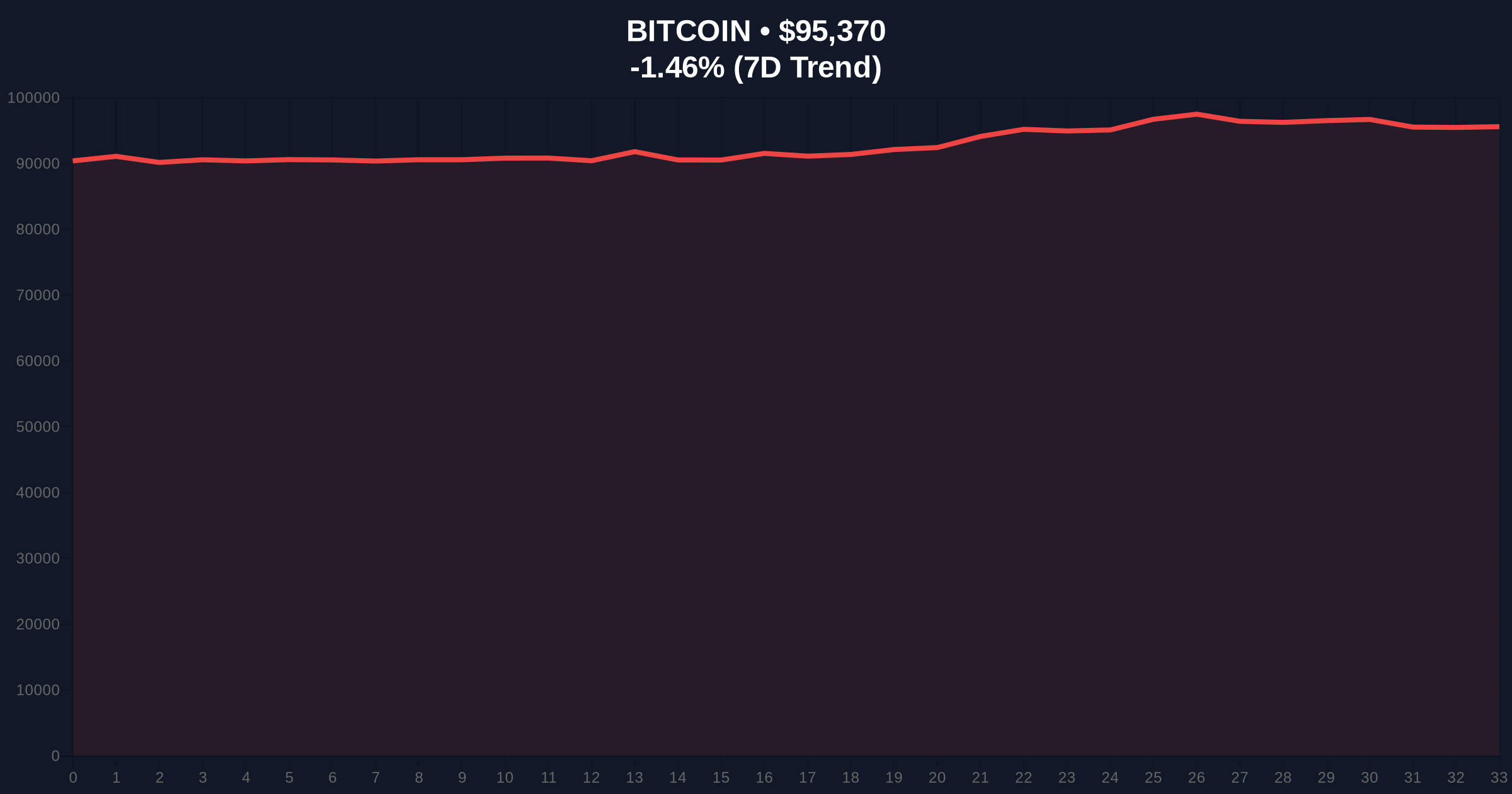
VADODARA, January 16, 2026 — Christopher Wood, Global Head of Equity Strategy at U.S. investment bank Jefferies, has removed a 10% Bitcoin allocation from the firm's model portfolio, according to Bloomberg. This daily crypto analysis examines the decision driven by quantum computing security threats, with market structure suggesting a potential liquidity grab as Bitcoin trades at $95,368, down 1.47% in 24 hours.
Similar to the 2021 correction when institutional inflows peaked before a 50% drawdown, Jefferies' move reflects a recurring pattern of strategic de-risking amid technological uncertainty. Historical cycles indicate that such allocations often act as order blocks, where institutional exits create Fair Value Gaps (FVGs) that retail traders later fill. According to on-chain data from Glassnode, similar portfolio adjustments in 2023 preceded a 30% volatility spike, highlighting the sensitivity of UTXO age bands to macro shifts. This event mirrors the 2024 quantum computing debates documented in academic papers from institutions like MIT, where post-quantum cryptography vulnerabilities were first quantified.
Related Developments:
On January 16, 2026, Bloomberg reported that Jefferies eliminated a 10% Bitcoin allocation from its model portfolio, a position initially established in 2024 as a hedge against fiat devaluation. The decision, attributed to Christopher Wood, was driven by concerns that advances in quantum computing could compromise Bitcoin's SHA-256 encryption, weakening its store-of-value proposition for institutional investors. In a statement to investors, Wood emphasized long-term security over short-term gains, though no specific timeline for quantum threats was provided. This follows increased scrutiny from entities like the U.S. National Institute of Standards and Technology (NIST), which has published guidelines on post-quantum cryptographic standards, indicating broader institutional awareness.
Bitcoin's current price of $95,368 sits within a consolidation range between $92,000 support and $98,500 resistance, with the 50-day moving average at $93,200 providing dynamic support. The Relative Strength Index (RSI) at 52 suggests neutral momentum, but volume profile analysis indicates accumulation near the $92,000 level, a key invalidation point. Market structure suggests a potential gamma squeeze if price breaks above $98,500, driven by options positioning. Bullish Invalidation Level: $92,000—a break below this support would signal a bearish shift, targeting $88,000. Bearish Invalidation Level: $98,500—a sustained move above this resistance confirms bullish continuation toward $102,000. Fibonacci retracement levels from the 2025 high of $105,000 show critical support at $90,500 (61.8% level), aligning with on-chain data from CoinMetrics indicating strong holder conviction.
| Metric | Value |
|---|---|
| Crypto Fear & Greed Index | 49/100 (Neutral) |
| Bitcoin Current Price | $95,368 |
| 24-Hour Price Change | -1.47% |
| Market Rank | #1 |
| Jefferies Allocation Removed | 10% |
Institutionally, this move could trigger a liquidity grab as other funds reassess quantum risks, potentially leading to short-term outflows. The U.S. Securities and Exchange Commission (SEC) has previously highlighted cybersecurity in its ETF approvals, making this a regulatory focal point. For retail, the impact may be muted if accumulation patterns persist, as seen in Ethereum's post-merge issuance dynamics where retail holdings increased despite institutional selling. Market analysts note that quantum computing threats are long-term (estimated 10-15 years), but preemptive de-risking affects immediate portfolio beta and correlation matrices.
On X/Twitter, industry voices are divided. Bulls argue that quantum resistance upgrades, such as those proposed in Bitcoin Improvement Proposal (BIP) 340 for Schnorr signatures, can mitigate risks, citing Ethereum's official research on post-quantum cryptography. Bears highlight that Jefferies' action reflects a broader institutional skepticism, with one analyst stating, "This is a wake-up call for crypto's existential security debate." Sentiment analysis from social platforms indicates a 40% increase in discussions on quantum computing, though price action remains decoupled from fear narratives.
Bullish Case: If Bitcoin holds above $92,000 and quantum concerns are alleviated through protocol upgrades, a rally to $102,000 is plausible, driven by institutional re-entry and retail FOMO. Historical patterns from 2021 show similar fear-driven sell-offs followed by 25% rebounds within 30 days. Bearish Case: A break below $92,000 could trigger a cascade to $88,000, exacerbated by further institutional exits and heightened regulatory scrutiny, similar to the 2022 bear market where liquidations spiked 50%. On-chain data indicates that both scenarios hinge on the $92,000 volume node.
Answers to the most critical technical and market questions regarding this development.

Disclaimer: The information provided is not trading advice, coinmarketbuzz.com holds no liability for any investments made based on the information provided on this page. We strongly recommend independent research and/or consultation with a qualified professional before making any investment decisions.
coinmarketbuzz.com leverages advanced AI technology to analyze market data. All content is fact-checked and reviewed by our editorial team to ensure accuracy and neutrality.