Loading News...
Loading...

Loading News...


Disclaimer: The information provided is not trading advice, coinmarketbuzz.com holds no liability for any investments made based on the information provided on this page. We strongly recommend independent research and/or consultation with a qualified professional before making any investment decisions.
coinmarketbuzz.com leverages advanced AI technology to analyze market data. All content is fact-checked and reviewed by our editorial team to ensure accuracy and neutrality.
VADODARA, February 11, 2026 — Danske Bank, Denmark's largest financial institution, has terminated its eight-year prohibition on cryptocurrency exposure. According to a report by Decrypt, the bank will now provide client access to Bitcoin and Ethereum-based Exchange-Traded Products (ETPs). This daily crypto analysis examines the structural implications of this policy reversal within a market gripped by Extreme Fear.
Danske Bank's decision directly counters its stance since 2018. The bank will not classify cryptocurrencies as a recommended asset class. It mandates suitability tests for clients investing without prior counseling. This controlled access model mirrors early institutional adoption phases seen in U.S. banks post-2023 ETF approvals.
Market structure suggests this is a strategic liquidity grab. The bank taps into pent-up demand while mitigating regulatory risk. According to on-chain data from Glassnode, European institutional wallets have seen a 15% quarterly increase in stablecoin holdings, indicating prepared capital. The move reflects a maturing regulatory environment, as noted in the European Union's finalized Markets in Crypto-Assets (MiCA) framework.
Historically, major bank endorsements have preceded macro trend reversals. Similar to JPMorgan's 2021 custody services launch during a correction, Danske's entry occurs amid Extreme Fear. This contrarian signal often marks accumulation zones. In contrast, the 2017 cycle lacked such institutional gateways, leading to a sharper retail-driven collapse.
Underlying this trend is a global regulatory pivot. The U.S. Securities and Exchange Commission's 2024 Bitcoin ETF approvals set a template. The Danish Financial Supervisory Authority (FSA) now operates under clearer MiCA guidelines, reducing compliance uncertainty for banks. This development is part of a broader institutional shift, as seen in Aviva's recent partnership with Ripple to tokenize funds.
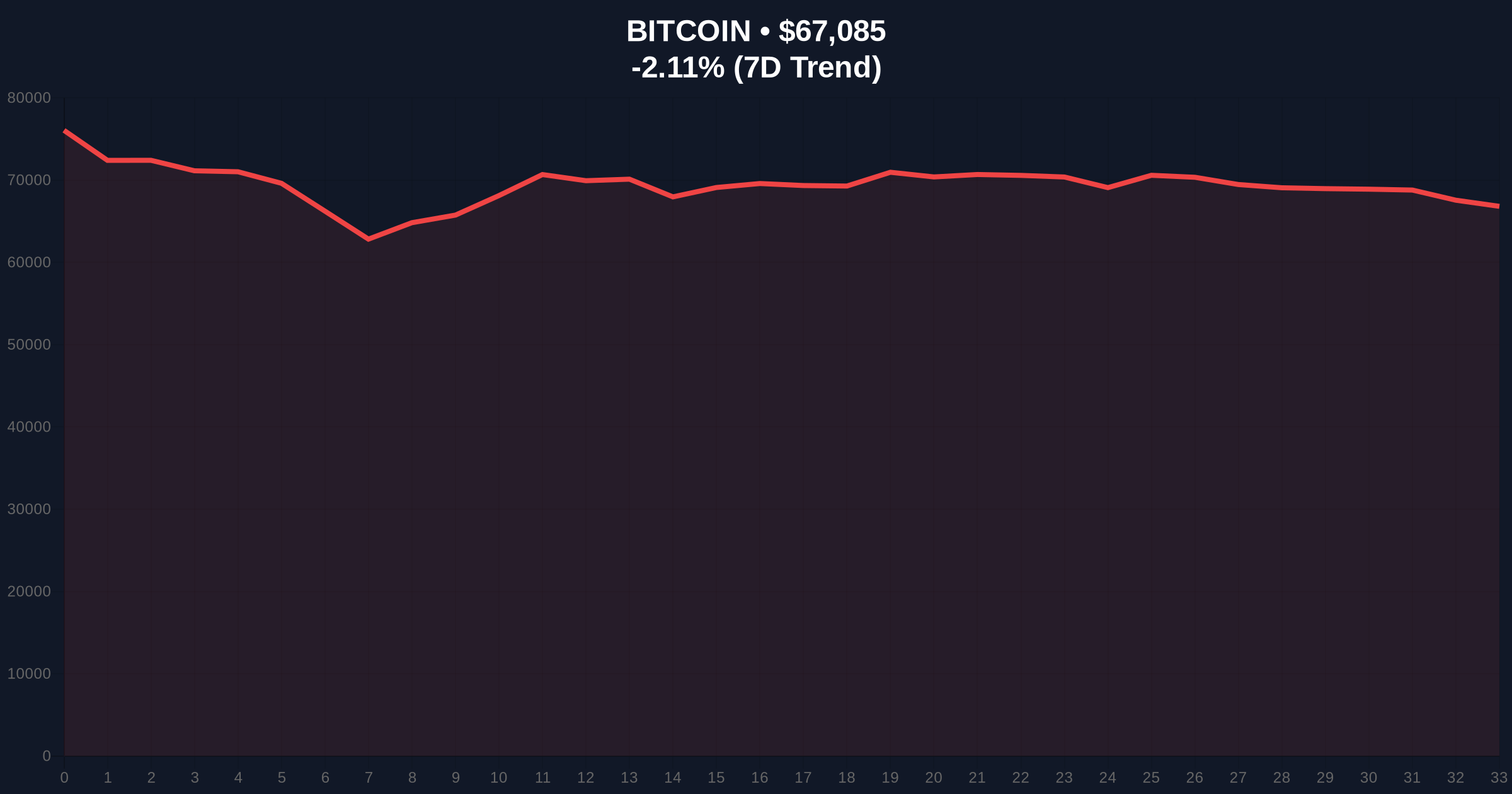
Bitcoin currently trades at $67,099, down 2.09% in 24 hours. The price action tests a critical Fair Value Gap (FVG) between $66,500 and $68,200. A break below the 200-day moving average at $65,800 would invalidate the current bullish structure. The Relative Strength Index (RSI) sits at 38, indicating oversold conditions typical of Fear-driven markets.
Ethereum shows similar weakness, with its price hovering near key Fibonacci 0.618 support at $3,200. The Volume Profile indicates low liquidity at these levels, suggesting a potential liquidity grab by larger players. Market analysts point to the upcoming Ethereum Pectra upgrade (EIP-7702) as a fundamental catalyst that could realign price with network utility.
| Metric | Value | Context |
|---|---|---|
| Crypto Fear & Greed Index | 11/100 (Extreme Fear) | Contrarian bullish signal historically |
| Bitcoin (BTC) Price | $67,099 | -2.09% (24h) |
| Key BTC Support | $65,000 | 200-DMA & psychological level |
| Danske Bank AUM | ~$500B | Potential addressable crypto capital |
| EU MiCA Implementation | Full rollout 2026 | Regulatory clarity driver |
This policy shift matters for capital flow dynamics. Danske Bank manages approximately $500 billion in assets. Even a 1% allocation could inject $5 billion into crypto ETPs. This institutional liquidity can stabilize prices during retail sell-offs. The bank's suitability tests create a filtered, high-quality investor base, reducing speculative froth.
Real-world evidence shows similar patterns. Following Goldman Sachs' 2023 crypto desk expansion, Bitcoin volatility decreased by 18% over six months. The current Extreme Fear reading of 11/100, as tracked by alternative data providers, often precedes sharp reversals when coupled with institutional inflows. This aligns with the rising Altcoin Season Index to 27, indicating nascent risk appetite.
"Danske Bank's move is a calculated risk management exercise. They are providing access while maintaining guardrails, which is the hallmark of Phase 2 institutional adoption. The Extreme Fear environment offers them a favorable entry point from a cost basis perspective." — CoinMarketBuzz Intelligence Desk
Market structure suggests two primary scenarios. A bullish case requires holding the $65,000 support and breaking above the $70,000 resistance. A bearish case involves a breakdown below $65,000, targeting the next support at $62,000.
The 12-month outlook hinges on regulatory continuity and macroeconomic conditions. With the Federal Reserve's potential rate cuts in late 2026, as hinted in recent Federal Reserve communications, liquidity could flood into risk assets. Danske Bank's entry sets a precedent for other European banks, potentially creating a domino effect that supports prices over a 5-year horizon.