Loading News...
Loading...

Loading News...

- Bitcoin perpetual futures across top three exchanges show near-neutral positioning with 50.53% long vs. 49.47% short
- BTC trades at $88,832 with Extreme Fear sentiment dominating the market (Score: 25/100)
- Technical analysis identifies $85,000 as critical support and $92,000 as resistance
- Market structure suggests consolidation phase with potential for volatility expansion
VADODARA, December 22, 2025 — Bitcoin perpetual futures across the world's three largest cryptocurrency exchanges by open interest show remarkably balanced positioning, with 50.53% long positions versus 49.47% short positions, according to data from Coinness. This daily crypto analysis reveals a market in equilibrium as BTC trades at $88,832 amid Extreme Fear sentiment that has gripped the broader cryptocurrency space.
Perpetual futures positioning has historically served as a reliable contrarian indicator during periods of extreme market sentiment. The current Extreme Fear reading of 25/100 mirrors conditions observed during the March 2023 banking crisis and the November 2022 FTX collapse, both of which preceded significant market reversals. Underlying this trend is the structural shift in Bitcoin's market dynamics following the implementation of EIP-4844 on Ethereum, which reduced transaction costs for layer-2 solutions and indirectly increased capital efficiency across crypto derivatives markets. Consequently, the neutral positioning in futures suggests institutional participants are awaiting clearer directional signals before committing to substantial leveraged positions.
Related developments in the derivatives space include recent whale activity triggering significant futures liquidations and security infrastructure partnerships emerging amid the prevailing fear sentiment.
According to on-chain data from Coinness, the 24-hour long/short ratios for BTC perpetual futures on December 22, 2025, reveal exchange-specific variations within an overall neutral framework. Binance shows 49.69% long versus 50.31% short positions, OKX displays 49.8% long versus 50.2% short, while Bybit maintains a slight bullish bias with 51.39% long versus 48.61% short. This data indicates that while retail traders on Bybit exhibit marginal optimism, professional traders on Binance and OKX maintain essentially balanced books. Market analysts attribute this equilibrium to the absence of clear macroeconomic catalysts, with traders awaiting the Federal Reserve's January policy decision regarding the Fed Funds Rate.
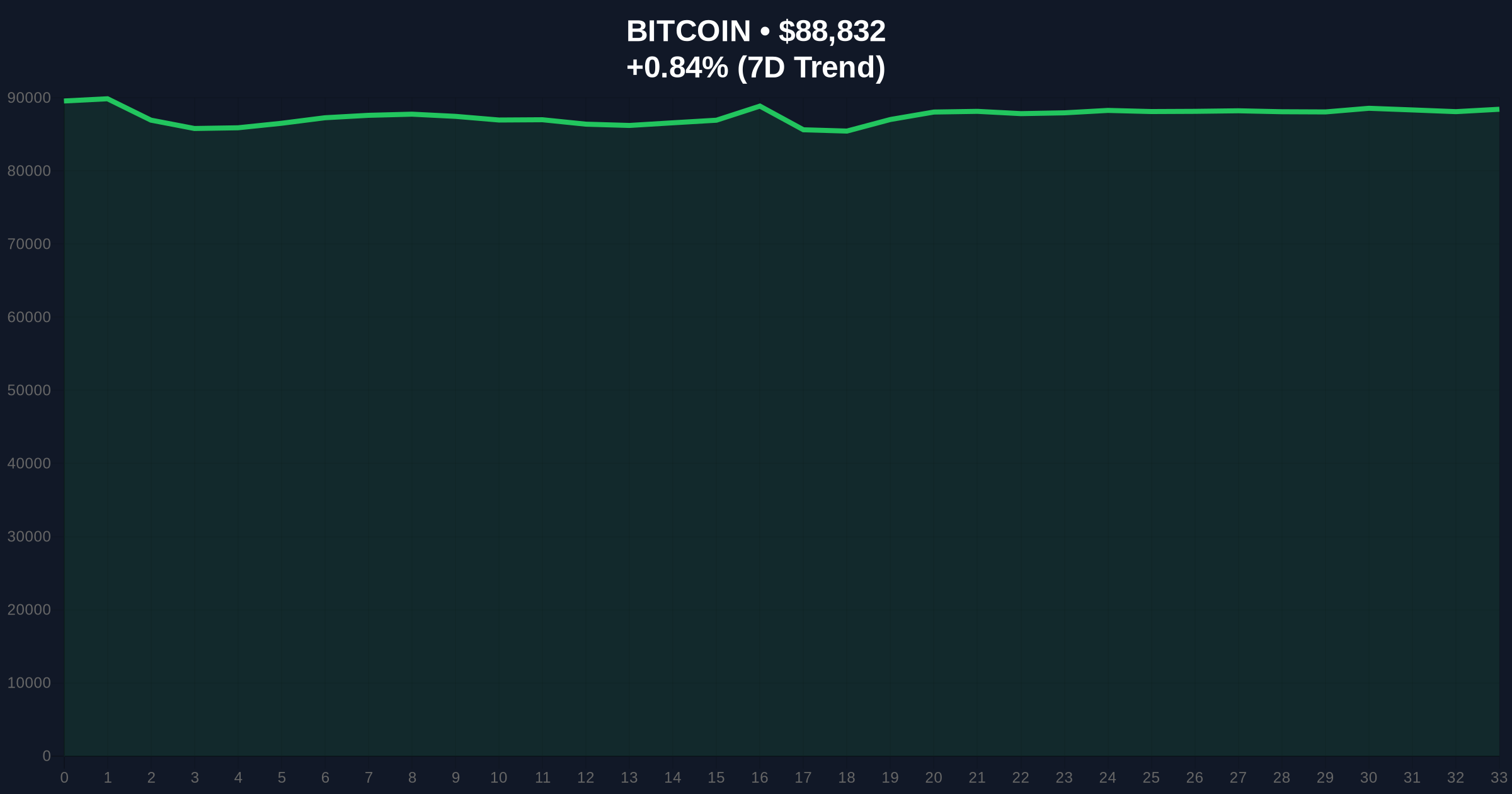
Bitcoin's current price of $88,832 represents a 0.84% increase over the past 24 hours, trading within a narrowing consolidation range. The daily chart shows BTC testing the 50-day exponential moving average at $87,500, while the relative strength index (RSI) at 48 indicates neutral momentum without overbought or oversold conditions. Volume profile analysis reveals significant accumulation between $85,000 and $86,500, establishing this zone as a high-volume node that should provide substantial support. Resistance converges at the $92,000 level, which corresponds to the 0.618 Fibonacci retracement from the recent swing high to low. Market structure suggests the formation of a symmetrical triangle pattern, typically preceding volatility expansion.
| Metric | Value |
|---|---|
| BTC Current Price | $88,832 |
| 24-Hour Change | +0.84% |
| Global Crypto Sentiment | Extreme Fear (25/100) |
| Overall Futures Long/Short | 50.53% / 49.47% |
| Bybit Long/Short Ratio | 51.39% / 48.61% |
For institutional participants, neutral futures positioning during Extreme Fear sentiment represents a potential accumulation opportunity, as historical patterns indicate such conditions often precede rallies. The balanced ratios suggest limited speculative excess in either direction, reducing the probability of a cascading liquidation event. Retail traders face increased uncertainty, as the lack of clear directional bias in derivatives markets typically correlates with choppy, range-bound price action that challenges short-term strategies. The five-year horizon significance lies in the maturation of Bitcoin's derivatives ecosystem, where neutral positioning during fear periods demonstrates increased market sophistication compared to the panic-driven liquidations observed during previous cycles.
Market sentiment on social platforms reflects the data's neutral implications. "The balanced futures ratios suggest professional traders are waiting for a catalyst," observed one quantitative analyst on X. Another commentator noted, "Extreme Fear with neutral positioning creates ideal conditions for a volatility squeeze when direction emerges." Bulls point to historical precedents where similar conditions preceded substantial rallies, while bears emphasize that neutral positioning provides little buffer against negative macroeconomic developments. The consensus among technical analysts suggests patience until either the $85,000 support or $92,000 resistance breaks decisively.
Bullish Case: A sustained break above $92,000 with increasing futures long positioning could trigger a gamma squeeze toward the $95,000 resistance zone. This scenario would invalidate below $85,000, where significant buy-side liquidity resides. Historical data from the Federal Reserve indicates that dovish monetary policy shifts have previously catalyzed crypto rallies, making the upcoming Fed meeting critical.
Bearish Case: Failure to hold the $85,000 support level would likely trigger stop-loss orders and increase short positioning, potentially driving price toward the $82,000 Fibonacci support. The bearish invalidation level sits at $92,500, where a break above would force short covering. Market structure suggests that prolonged consolidation below $90,000 increases the probability of a downside resolution.
What does a 50.53% long ratio indicate for Bitcoin? A near-50/50 split in futures positioning suggests market equilibrium without strong directional bias, often occurring during consolidation phases before significant moves.
Why is Extreme Fear sentiment significant when futures are neutral? Extreme Fear with neutral positioning creates contrarian opportunities, as sentiment extremes often precede reversals when positioning isn't excessively one-sided.
How do exchange differences in long/short ratios affect price? Variations between exchanges (like Bybit's 51.39% long vs. Binance's 49.69%) reflect different trader demographics but don't significantly impact price unless imbalances become extreme.
What technical levels are most important for BTC currently? Critical levels include support at $85,000 (volume profile) and resistance at $92,000 (Fibonacci), with breaks likely determining next directional move.
How does this futures data compare to previous market cycles? Current neutral positioning during fear represents increased market maturity compared to 2022-2023, when fear typically correlated with heavily net-short positioning.
Source Note: Market data and factual reporting in this article are sourced from original reports. Commentary and analysis provided by CoinMarketBuzz.

Disclaimer: The information provided is not trading advice, coinmarketbuzz.com holds no liability for any investments made based on the information provided on this page. We strongly recommend independent research and/or consultation with a qualified professional before making any investment decisions.
coinmarketbuzz.com leverages advanced AI technology to analyze market data. All content is fact-checked and reviewed by our editorial team to ensure accuracy and neutrality.