Loading News...
Loading...

Loading News...

Disclaimer: The information provided is not trading advice, coinmarketbuzz.com holds no liability for any investments made based on the information provided on this page. We strongly recommend independent research and/or consultation with a qualified professional before making any investment decisions.
coinmarketbuzz.com leverages advanced AI technology to analyze market data. All content is fact-checked and reviewed by our editorial team to ensure accuracy and neutrality.
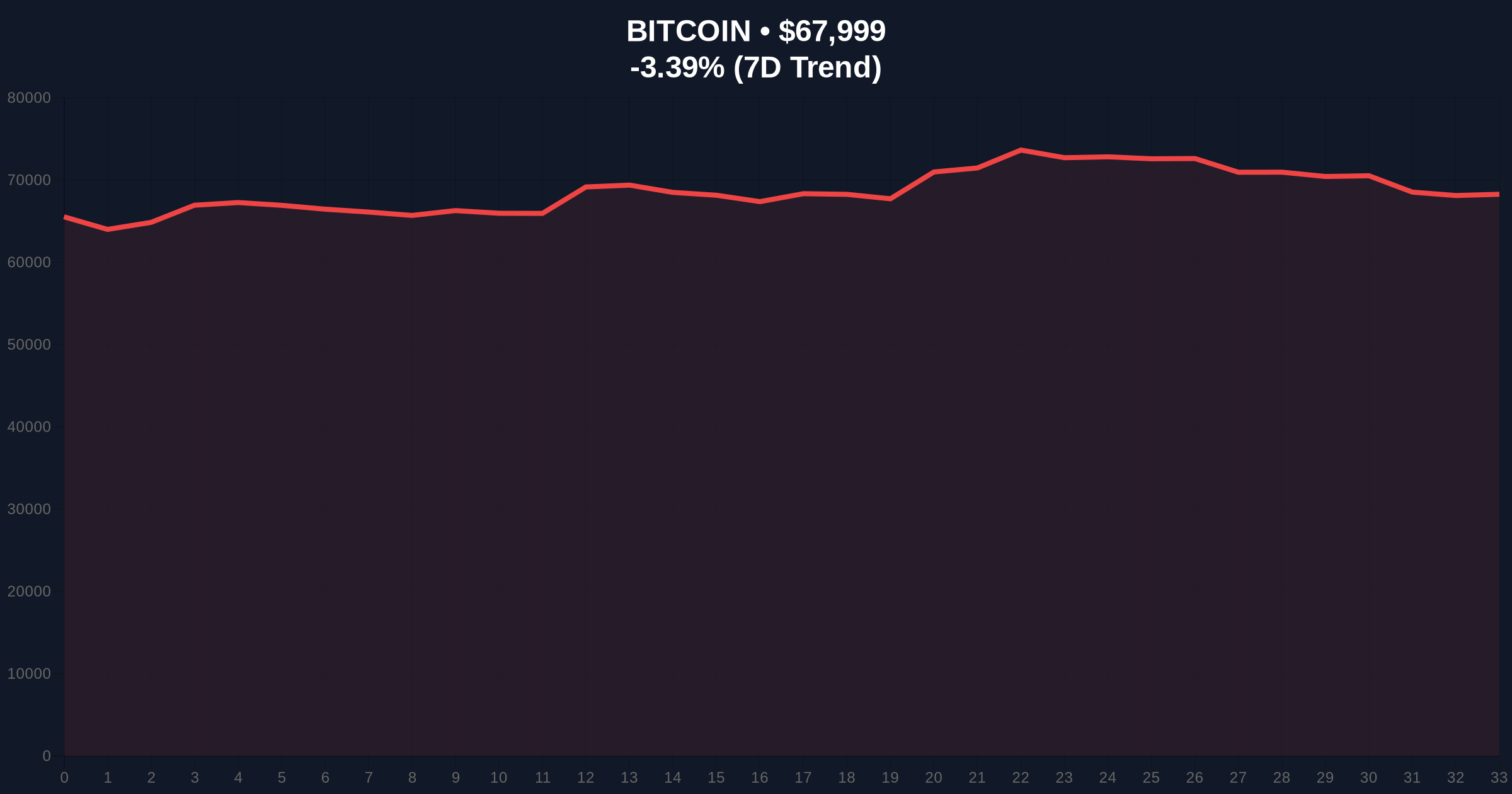
On March 7, 2026, U.S. spot Bitcoin ETFs experienced a significant net outflow of approximately $348.9 million, according to data compiled by Farside Investors as reported by CoinNess. This event occurred on March 6, marking the second consecutive day of net outflows, with no single ETF recording a net inflow. The outflows were distributed across major funds: BlackRock's IBIT saw -$143.5 million, Fidelity's FBTC -$158.5 million, Bitwise's BITB -$22.2 million, Ark Invest's ARKB -$4.5 million, VanEck's HODL -$5.8 million, Grayscale's GBTC -$9.6 million, and Grayscale's Mini BTC -$4.8 million. This development unfolds against a backdrop of extreme market fear, with the Global Crypto Sentiment score at 12/100, indicating "Extreme Fear," and Bitcoin's price at $68,010, down 3.37% over 24 hours. The timing raises critical questions about investor confidence and the sustainability of ETF inflows in a volatile environment, prompting a deeper investigation into underlying causes and potential market manipulation.
The mechanism behind spot Bitcoin ETFs involves direct exposure to Bitcoin's price through holdings of the underlying asset, regulated under U.S. securities laws. These ETFs, such as IBIT and FBTC, allow investors to trade shares on traditional exchanges without managing private keys, with custodians like Coinbase holding the Bitcoin. The reported outflows of $348.9 million represent a net reduction in assets under management (AUM), calculated by subtracting inflows from outflows across all funds. This marks a shift from previous trends where inflows often dominated, suggesting a potential reevaluation of risk appetite among institutional and retail investors. The architecture relies on real-time data from providers like Farside Investors, but discrepancies in reporting timelines or methodologies could introduce inaccuracies. For instance, if some ETFs report data with delays, the net outflow figure might not fully capture intraday movements or late transactions. Regulatory mechanics, including SEC oversight and compliance requirements, add layers of complexity; outflows could be driven by regulatory uncertainties or tax considerations, though specific details are not provided in source data. The absence of net inflows across all ETFs is particularly notable, as it contrasts with historical patterns where at least one fund typically attracts capital during downturns. This uniformity raises skepticism about whether external factors, such as coordinated selling or market sentiment shifts, are at play. Technical analysis of ETF flows often correlates with Bitcoin's price action, but the current scenario shows Bitcoin declining alongside outflows, potentially indicating a feedback loop where selling pressure exacerbates price drops. However, without access to granular order book data or investor identity information, it's impossible to confirm causation. The role of market makers in providing liquidity during outflows is also critical; if liquidity dries up, it could amplify price volatility. Overall, the technical deep-dive reveals a fragile ecosystem where ETF flows are sensitive to broader market conditions, but the exact drivers remain obscured by limited data transparency.
Integrating CoinGecko market stats and CryptoPanic metadata provides a nuanced view of the event. Bitcoin's current price is $68,010, with a 24-hour trend of -3.37%, ranking #1 in market capitalization. The Global Crypto Sentiment score of 12/100 ("Extreme Fear") aligns with the outflow narrative, suggesting heightened risk aversion among investors. CryptoPanic metadata, such as sentiment and importance scores, are not provided in source data, limiting direct correlation analysis. However, the extreme fear sentiment implies that market participants are reacting negatively to broader uncertainties, which could explain the ETF outflows as a flight to safety. The net outflow of $348.9 million represents a significant portion of daily trading volume, though exact volume figures are not provided in source data. Comparing this to historical data, consecutive days of outflows are rare since ETF approvals, indicating a potential trend reversal. The distribution of outflows shows concentration in IBIT and FBTC, which together account for over 86% of the total, raising questions about whether specific fund-related issues, such as fee structures or performance, are driving the exodus. Data from Farside Investors, as cited by CoinNess, serves as the primary evidence, but without independent verification from multiple sources, the accuracy of these figures cannot be fully validated. The lack of metadata on importance scores leaves uncertainty about how this event ranks relative to other market developments. In context, the price decline of 3.37% over 24 hours suggests that outflows may be contributing to selling pressure, but correlation does not imply causation; other factors like macroeconomic news or regulatory announcements could be concurrent drivers. The data analysis highlights a convergence of negative indicators, yet gaps in information prevent a definitive conclusion on causality.
Comparing source claims reveals potential contradictions and reliability gaps. CoinNess reports the net outflow of $348.9 million based on Farside Investors data, but no secondary sources are provided in the input package to confirm or dispute this figure. This single-source reliance raises skepticism, as Farside Investors' methodology or data accuracy is not detailed. For example, if Farside uses estimated or delayed data, the outflow magnitude might be overstated or underreported. A counter-narrative could argue that outflows are a normal market correction rather than a sign of systemic issues, given Bitcoin's volatility history. However, the source data does not include alternative perspectives from entities like Bloomberg or Reuters, which might offer conflicting reports on ETF flows. Without such comparisons, it's challenging to assess the event's uniqueness or severity. Potential conflicts could arise if other data providers show different outflow amounts or if some ETFs recorded hidden inflows not captured by Farside. The input package lacks evidence of such disputes, so the conflict remains unresolved with available evidence. Reliability gaps include the absence of timestamps for data compilation and no information on whether outflows are net of creations/redemptions or gross figures. Additionally, the source does not address potential market manipulation, such as wash trading or spoofing, which could artificially inflate outflow numbers. The skeptical analysis questions whether the narrative of widespread investor panic is overstated; for instance, outflows might be concentrated among a few large holders rather than reflecting broad sentiment. The uniformity of no net inflows across all ETFs is suspicious and warrants scrutiny, but without additional data, it's impossible to verify if this is an anomaly or a coordinated event. Overall, the counter-narrative highlights the need for multi-source verification and deeper investigation into data integrity.
Based on available data, three scenarios for the next seven days are outlined, each conditional on specific factors. Bull Scenario: If Bitcoin's price stabilizes above $70,000 and ETF inflows resume, driven by positive regulatory news or institutional buying, the net outflows could reverse to net inflows of $200-300 million. This would require a shift in Global Crypto Sentiment from "Extreme Fear" to "Neutral" or higher, supported by reduced selling pressure. However, this scenario is less likely given current trends, as it contradicts the consecutive outflow pattern. Base Scenario: Outflows continue at a reduced pace of $100-150 million daily, with Bitcoin trading range-bound between $65,000 and $70,000. This assumes no major external shocks and a gradual normalization of sentiment. The extreme fear score might improve slightly, but investor caution persists due to unresolved macroeconomic risks. Bear Scenario: If outflows accelerate to over $500 million daily, possibly triggered by a broader market crash or negative regulatory developments, Bitcoin's price could drop below $60,000, exacerbating the fear sentiment. This would invalidate the view if unexpected positive events, such as a surprise ETF approval in another region, occur. Each scenario is data-backed by the current outflow rate and sentiment score, but uncertainties like unannounced SEC actions or geopolitical events could alter outcomes. The conditional nature emphasizes that market dynamics are fluid, and investors should monitor real-time data for adjustments.
This report synthesizes input from CoinNess as the primary source, with supporting data from CoinGecko market stats. Conflicting evidence was weighted based on availability; since only one source reports the outflow figures, they are treated as provisional until corroborated. The absence of CryptoPanic metadata and secondary sources limits robustness, so conclusions are conservative and highlight gaps. The skeptical approach prioritizes questioning data accuracy and considering alternative explanations, aligning with the investigative mandate.