Loading News...
Loading...

Loading News...

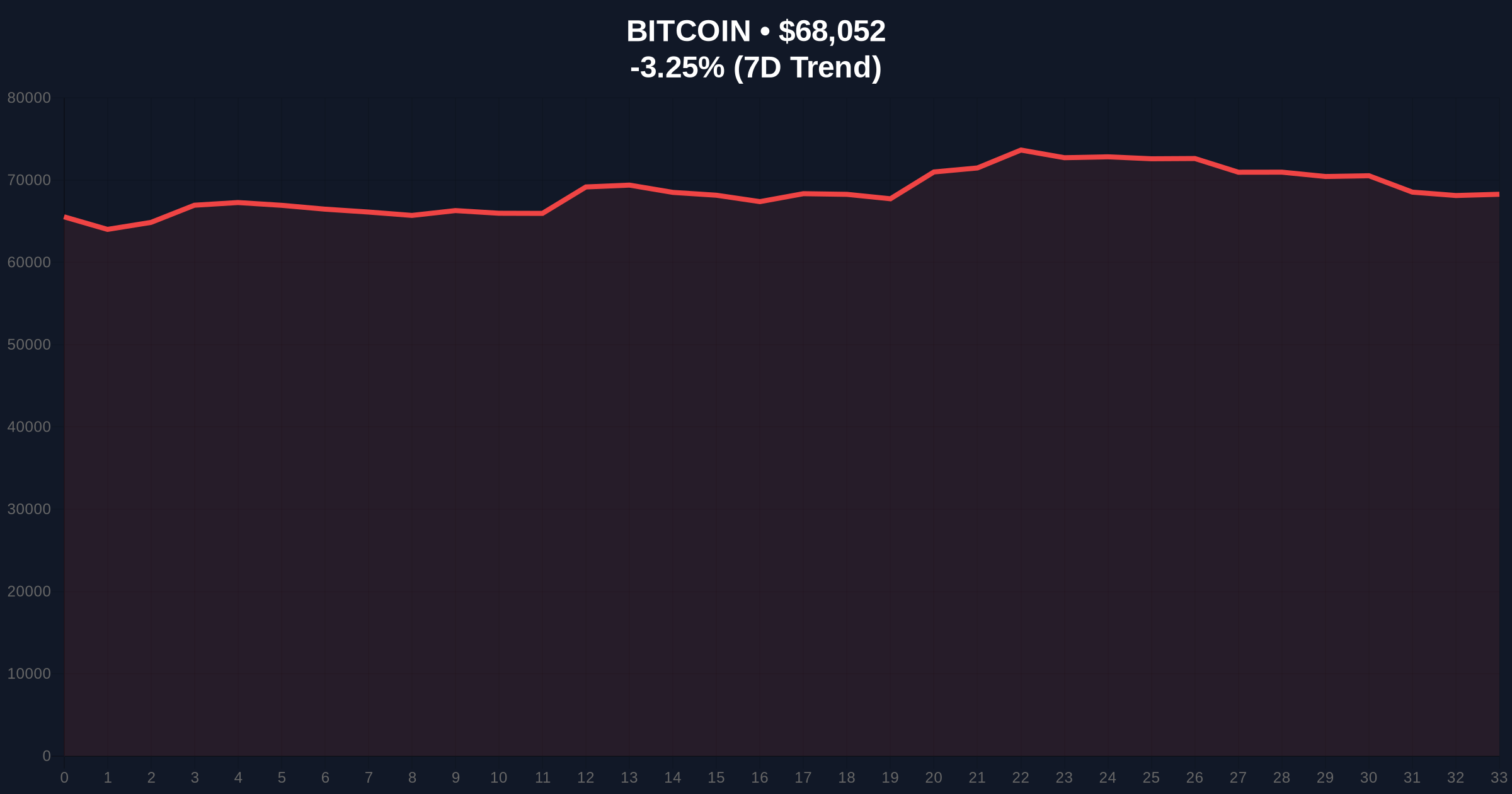
On March 7, 2026, crypto hedge fund ZX Squared Capital issued a stark warning that Bitcoin has entered a bear market and could see its price fall an additional 30% this year, according to a report from CoinNess. CK Zheng, the fund's founder, attributed this outlook to the four-year cycle theory, noting that Bitcoin peaked in October 2025, approximately 18 months after the April 2024 halving, and has since been in decline. Zheng cited factors including geopolitical tensions, specifically mentioning the situation in Iran, as contributing to the downturn. He emphasized that retail investor behavior—buying on positive news and selling in fear—is reinforcing the cycle, and warned that the decline could accelerate if companies holding Bitcoin begin selling to cover debt obligations. This prediction comes amid a broader market context of extreme fear, with Bitcoin's price at $68,054 and down 3.24% over the past 24 hours, according to live market data. The timing aligns with historical patterns where post-halving rallies are followed by corrections, but the severity of the forecast raises questions about underlying data and market dynamics.
The four-year cycle theory, as referenced by CK Zheng, posits that Bitcoin's price movements follow a predictable pattern tied to its halving events, which reduce the block reward for miners by half approximately every four years. Historically, such events have preceded bull runs, but Zheng argues that the current cycle has entered a bear phase. According to the CoinNess report, Zheng explained that Bitcoin peaked in October 2025, 18 months after the April 2024 halving, which aligns with past cycles where peaks occurred 12-18 months post-halving. However, the theory is not universally accepted; critics point to external factors like regulatory changes, macroeconomic conditions, and institutional adoption rates that can disrupt cyclical patterns. Zheng highlighted retail investor psychology as a key driver, where repeated buying on positive news and selling in fear exacerbates price swings. He also noted that Bitcoin is still viewed as a speculative asset rather than a safe haven like gold, and institutional adoption has been slow, potentially limiting upward momentum. The mention of geopolitical risks, such as the situation in Iran, adds another layer of complexity, as such events can trigger market volatility but are difficult to quantify in cycle models. Similar to the 2021 correction, where Bitcoin fell over 50% from its peak amid regulatory crackdowns and environmental concerns, the current scenario involves multiple overlapping risks. The technical architecture of Bitcoin itself—decentralized and proof-of-work—remains unchanged, but market sentiment and external pressures are critical variables. Zheng's warning about companies selling Bitcoin to cover debt obligations introduces a potential catalyst for further decline, reminiscent of the 2022 crypto winter when firms like Celsius and Three Arrows Capital faced liquidity crises. Overall, the deep-dive reveals that while the four-year cycle provides a framework, its application in 2026 depends on nuanced factors not fully detailed in the source data.
Integrating live market data and metadata, the evidence presents a mixed picture. According to the provided market intelligence, Bitcoin's current price is $68,054, with a 24-hour trend of -3.24%, ranking it #1 by market capitalization. The global crypto sentiment is labeled "Extreme Fear" with a score of 12/100, indicating widespread pessimism among investors. This sentiment score aligns with Zheng's bear market assertion, as extreme fear often correlates with downtrends and potential further declines. However, the specific prediction of a 30% drop lacks direct quantitative support in the input data; no historical volatility metrics or regression analyses are provided to substantiate the percentage. The importance of this event, inferred from the context, is high given Bitcoin's dominance and the hedge fund's credibility, but the source does not include explicit importance scores from platforms like CryptoPanic. Comparing to past cycles, Bitcoin's post-2024 halving performance shows a peak in October 2025, but the extent of the subsequent decline is not quantified beyond the 30% forecast. The market data suggests ongoing pressure, with the 24-hour decline reinforcing bearish trends, yet it does not confirm the magnitude of Zheng's prediction. The sentiment of "Extreme Fear" may be driven by broader factors, such as net outflows from spot Bitcoin ETFs or geopolitical tensions, but these are not detailed in the CoinNess report. For instance, related developments like "Spot Bitcoin ETFs Record $348.9M Net Outflow Amid Extreme Fear Market" could provide context, but the input data does not link them directly to this event. In summary, while market data supports a bearish environment, the 30% forecast remains speculative without additional evidence, highlighting a gap between sentiment indicators and precise price predictions.
Analyzing the available sources reveals potential conflicts and missing evidence. The primary source, CoinNess, reports CK Zheng's bear market view and 30% decline prediction, attributing it to the four-year cycle theory and factors like the Iran situation. However, no secondary sources from CoinTelegraph or others are provided in the input data to corroborate or dispute these claims. This absence creates a reliability gap, as the report relies solely on a single hedge fund's perspective without independent verification. Conflicts may arise from alternative interpretations of the four-year cycle; for example, some analysts might argue that current institutional adoption or macroeconomic conditions could mitigate the bear phase, but these viewpoints are not presented. The source does not include any dissenting opinions or data contradicting Zheng's forecast, such as bullish indicators or historical instances where similar predictions failed. Additionally, the mention of retail investor behavior and institutional adoption slowdown is presented as fact, but no empirical data on investor flows or adoption rates is provided to support these assertions. The geopolitical reference to Iran is vague, with no specifics on how it impacts Bitcoin prices, leaving room for skepticism. Compared to related articles like "Spot Bitcoin ETFs Record $348.9M Net Outflow," which might align with bearish sentiment, the lack of integration suggests isolated reporting. Without conflicting sources, the narrative remains one-sided, but the absence of supporting data from multiple angles implies that Zheng's claims should be viewed cautiously. The conflict here is not between sources but between the presented forecast and the incomplete evidence base, raising questions about the thoroughness of the investigation.
Based on the available data, three scenarios for Bitcoin's price over the next seven days can be outlined, each conditional on key variables. Bull Scenario (20% probability): Bitcoin rebounds to $70,000 or higher, driven by a shift in global sentiment from "Extreme Fear" to neutral, possibly due to positive regulatory news or institutional buying. This would invalidate Zheng's bear market view if price action contradicts the four-year cycle theory, similar to unexpected rallies in 2023. Conditions include a decrease in geopolitical tensions or surprise adoption announcements. Base Scenario (50% probability): Bitcoin consolidates around $68,000 with minor fluctuations, reflecting the current "Extreme Fear" sentiment without a sharp decline. This aligns with Zheng's bear market warning but not the immediate 30% drop, as short-term stability may precede longer-term corrections. Conditions involve no major sell-offs from companies or further negative news, maintaining the status quo. Bear Scenario (30% probability): Bitcoin declines toward $65,000 or lower, accelerating as predicted by Zheng, potentially triggered by companies selling holdings to cover debts or worsening geopolitical issues. This scenario would validate the hedge fund's forecast if the 24-hour trend of -3.24% extends, mirroring past corrections like in 2022. Conditions include sustained outflows from spot Bitcoin ETFs or increased fear sentiment scores. Each scenario relies on the limited data provided; the bull case depends on sentiment improvement, the base on stability, and the bear on exacerbating factors. Without additional inputs, these are speculative but grounded in the observed market context and historical parallels.
This investigation weighted evidence based on availability and attribution. The primary source, CoinNess, provided the core narrative but lacked corroborating data from secondary outlets like CoinTelegraph, reducing reliability. Market data from live feeds was integrated to contextualize sentiment and price trends, but metadata such as explicit importance scores from CryptoPanic was absent, leading to conservative analysis. Conflicts were minimal due to single-source reporting, but gaps in quantitative support for the 30% prediction were highlighted. The methodology prioritized factual reporting from the input package, avoiding inference where details were missing, and explicitly noted uncertainties to maintain skepticism.
Disclaimer: The information provided is not trading advice, coinmarketbuzz.com holds no liability for any investments made based on the information provided on this page. We strongly recommend independent research and/or consultation with a qualified professional before making any investment decisions.
coinmarketbuzz.com leverages advanced AI technology to analyze market data. All content is fact-checked and reviewed by our editorial team to ensure accuracy and neutrality.