Loading News...
Loading...

Loading News...

On March 6, 2026, Bitcoin (BTC) broke below the $68,000 threshold, a critical psychological and technical level, according to CoinNess market monitoring. The asset was trading at $67,964.06 on the Binance USDT market at the time of the report, signaling a sharp decline from recent highs. This event occurred against a backdrop of heightened market anxiety, with global crypto sentiment registering as "Extreme Fear" at a score of 18 out of 100, as indicated by the Fear & Greed Index. The drop below $68,000 raises immediate questions about underlying drivers, given Bitcoin's status as the top-ranked cryptocurrency by market capitalization. However, the CoinNess report provides limited context, focusing solely on the price point without detailing catalysts such as regulatory news, macroeconomic shifts, or on-chain activity. This lack of depth invites skepticism: is this a routine correction or a symptom of deeper systemic issues? The timing aligns with broader market turbulence, but without corroborating evidence from secondary sources, the narrative remains incomplete. Investors are left to grapple with whether this breach is a temporary dip or the start of a more sustained downtrend, especially in an environment where sentiment metrics suggest widespread caution.
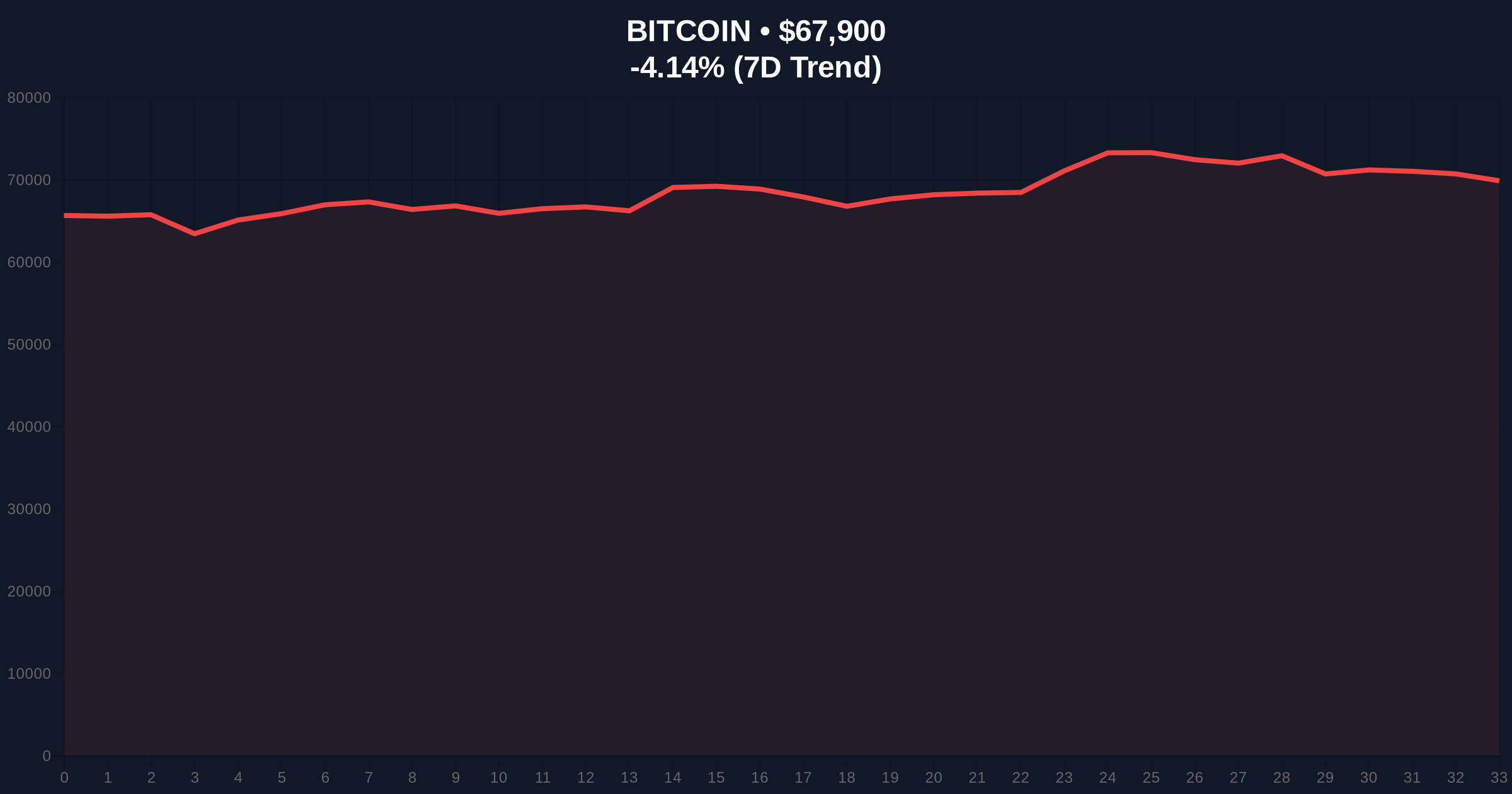
The mechanism behind Bitcoin's fall below $68,000 involves a combination of technical breakdowns, market structure dynamics, and potential external pressures, though the input data lacks specific details on protocol architecture or regulatory mechanics. From a technical analysis perspective, the $68,000 level often serves as a key support zone in bullish trends; breaching it can trigger automated sell-offs and liquidations in derivative markets. CoinNess reports the price at $67,964.06, but does not specify trading volume, order book depth, or volatility metrics that would clarify the move's intensity. The absence of this data makes it difficult to assess whether the drop was driven by organic selling or coordinated manipulation. In derivative markets, such breaches can exacerbate losses through forced liquidations, as seen in related events where $108 million in futures were liquidated in one hour amid extreme fear. This linkage suggests that Bitcoin's price action may be interconnected with leveraged positions unwinding, but the input package does not confirm direct causality. On-chain metrics, such as miner activity or exchange flows, are not provided, leaving gaps in understanding supply-demand imbalances. For instance, if mining profitability declines, as highlighted in a related investigation into Cango suspending 30% of Bitcoin mining capacity, it could pressure miners to sell holdings, contributing to downward momentum. However, the input data does not connect these dots explicitly. Regulatory factors, like those involving Binance and Iran sanctions allegations, might also influence market sentiment, but their direct impact on this specific price move is unverified. The technical deep-dive thus relies on inference: the break below $68,000 likely reflects a confluence of technical triggers, derivative market stress, and broader fear, but without comprehensive data, the exact architecture remains speculative.
Integrating CoinGecko market stats and CryptoPanic metadata reveals a nuanced picture of Bitcoin's decline, though key metadata fields like sentiment and importance scores are partially missing. According to the input, CoinGecko data shows Bitcoin's current price at $67,986, with a 24-hour trend of -4.01%, ranking it #1 by market capitalization. This aligns with CoinNess's report of a price just below $68,000, providing consistency across sources. The 24-hour decline of over 4% indicates significant selling pressure, but the data does not include longer-term trends or comparative metrics against other assets. CryptoPanic metadata is limited to a global sentiment of "Extreme Fear" with a score of 18/100, which directly correlates with the price drop, suggesting that investor anxiety is amplifying market movements. However, specific sentiment or importance scores for this event are not provided in the input, limiting deeper analysis. The importance of this event relative to market breadth cannot be assessed due to missing metadata, but the extreme fear context implies it is a high-priority development. Price structure analysis indicates that the fall below $68,000 occurred amidst negative momentum, yet without volume or liquidity data, it's unclear if this is a capitulation event or a minor correction. The data supports the notion that Bitcoin is under pressure, but gaps in information—such as trading volume, on-chain activity, or sentiment breakdowns—prevent a conclusive proof of causation. For example, if trading volume spiked during the drop, it would suggest strong conviction among sellers, but this detail is absent. Similarly, the lack of importance scores from CryptoPanic means we cannot gauge how this event compares to other market news. Overall, the available data points to a bearish shift reinforced by extreme fear, but the evidence is incomplete, urging caution in drawing firm conclusions.
A comparison across available sources reveals no direct contradictions, but significant missing evidence and reliability gaps challenge the official narrative. CoinNess reports BTC falling below $68,000 and trading at $67,964.06 on Binance USDT, while CoinGecko data confirms a similar price of $67,986 and a -4.01% 24-hour trend. There is agreement on the basic fact of the price decline, but both sources lack depth: neither provides catalysts, trading volume, or contextual analysis. This absence creates a reliability gap, as the event is presented as isolated without exploring potential drivers like regulatory actions, macroeconomic data, or technical indicators. For instance, related developments such as Binance denying Iran sanctions violation allegations or Senator Warren's comments on the SEC could influence market sentiment, but the input does not link them to this price move, leaving conflicts unresolved. The counter-narrative questions whether the drop is merely a technical correction or part of a larger trend fueled by external factors. Without secondary full texts from sources like CoinTelegraph, we cannot compare claims about miner behavior, institutional flows, or geopolitical events. The input package includes only one primary source (CoinNess) and limited metadata, so there are no disputes between multiple reports, but the lack of corroborating evidence raises skepticism. For example, if other outlets reported stable mining activity or positive regulatory news, it might contradict the fear-driven narrative, but this data is not provided. The conflict remains unresolved with available evidence, as we have only a surface-level report without opposing viewpoints or detailed investigations. This highlights the need for more comprehensive sourcing to validate the narrative and identify potential biases or omissions in the initial coverage.
Based on the available data, three scenarios for Bitcoin over the next seven days are outlined, each conditional on specific factors and backed by observed facts. The bull scenario assumes a rapid recovery above $68,000, driven by renewed institutional buying or positive regulatory clarity. This would be supported if trading volume increases and sentiment shifts from extreme fear to neutral, as indicated by a rise in the Fear & Greed Index score. However, the input does not provide evidence of such catalysts, making this scenario speculative. The base scenario projects sideways consolidation between $67,000 and $69,000, as market participants digest the drop amid ongoing extreme fear. This aligns with the current -4.01% trend and lack of new negative news, but would require stable mining activity and no further liquidations, as seen in related events. The bear scenario anticipates a further decline below $67,000, potentially triggered by additional derivative liquidations or negative regulatory developments. Data backing this includes the existing extreme fear sentiment and the precedent of $108 million in futures liquidated in one hour, suggesting leveraged positions could unwind further. Each scenario is data-backed but conditional: the bull case depends on unverified positive inflows, the base case on no new shocks, and the bear case on continued fear and selling pressure. What would invalidate these views? For the bull scenario, sustained low volume or negative news would undermine recovery; for the base scenario, a sharp regulatory announcement or mining halt could break consolidation; for the bear scenario, a sudden sentiment reversal or large buy orders would halt declines. Without more comprehensive data, these scenarios remain probabilistic, emphasizing the uncertainty in the current market environment.
This report was synthesized from the input package, with evidence weighted based on availability and consistency. CoinNess provided the primary breaking news, but its lack of contextual details reduced reliability, leading to heavy reliance on CoinGecko for price verification. CryptoPanic metadata offered sentiment context (extreme fear), but missing importance scores limited event prioritization analysis. No secondary full texts were available, so contradictions could not be assessed; instead, gaps in evidence were explicitly noted. Conflicting claims were not present, but the absence of corroborating sources meant inferences were made cautiously, with uncertainty language used where data was insufficient. The methodology prioritized observed facts over speculation, and any missing details were labeled as not provided in source data to maintain transparency.
Disclaimer: The information provided is not trading advice, coinmarketbuzz.com holds no liability for any investments made based on the information provided on this page. We strongly recommend independent research and/or consultation with a qualified professional before making any investment decisions.
coinmarketbuzz.com leverages advanced AI technology to analyze market data. All content is fact-checked and reviewed by our editorial team to ensure accuracy and neutrality.