Loading News...
Loading...

Loading News...

On March 4, 2026, cryptocurrency market maker GSR executed a significant withdrawal of 3,000 ETH from Binance, an event reported by The Data Nerd via X approximately three hours prior to the initial CoinNess coverage. The withdrawal, valued at around $6.23 million based on prevailing market rates, has sparked immediate scrutiny within the crypto community. According to the raw summary from CoinNess, such withdrawals from exchanges are typically interpreted as an intention to hold, suggesting a potential shift in GSR's strategy or outlook on Ethereum. However, the source data lacks specific timestamps, exact transaction hashes, or direct statements from GSR, leaving room for alternative interpretations. This event unfolds against a backdrop of heightened market anxiety, with global crypto sentiment currently in "Extreme Fear" territory, scoring 10 out of 100, as indicated in the live market data. The absence of corroborating details from secondary sources in the input package limits the ability to verify the withdrawal's broader implications, emphasizing the need for cautious analysis.
To understand the mechanics behind GSR's withdrawal, it is essential to examine the operational framework of market makers and Ethereum's on-chain infrastructure. Market makers like GSR play a critical role in providing liquidity by facilitating trades on exchanges such as Binance. Their activities often involve holding assets on exchanges to execute orders efficiently. A withdrawal of 3,000 ETH from an exchange wallet to a private or cold storage address typically involves a blockchain transaction that can be tracked via Ethereum's public ledger, though specific transaction details are not provided in the source data. The reported interpretation that withdrawals signal a holding intention aligns with common market behavior, where moving assets off exchanges reduces immediate selling pressure and may indicate long-term accumulation. However, this narrative is not universally definitive; withdrawals could also precede transfers to other platforms, participation in decentralized finance (DeFi) protocols, or strategic rebalancing. The input data does not include technical specifics such as gas fees, confirmation times, or the destination address type, which are for assessing the transaction's intent. Historically, similar large withdrawals by institutional players have preceded both bullish rallies and bearish consolidations, reminiscent of patterns observed during the 2021 market correction when exchange outflows often correlated with accumulation phases. Without access to GSR's internal strategy or additional on-chain analytics, the technical deep-dive remains speculative, relying solely on the limited report from CoinNess and The Data Nerd.
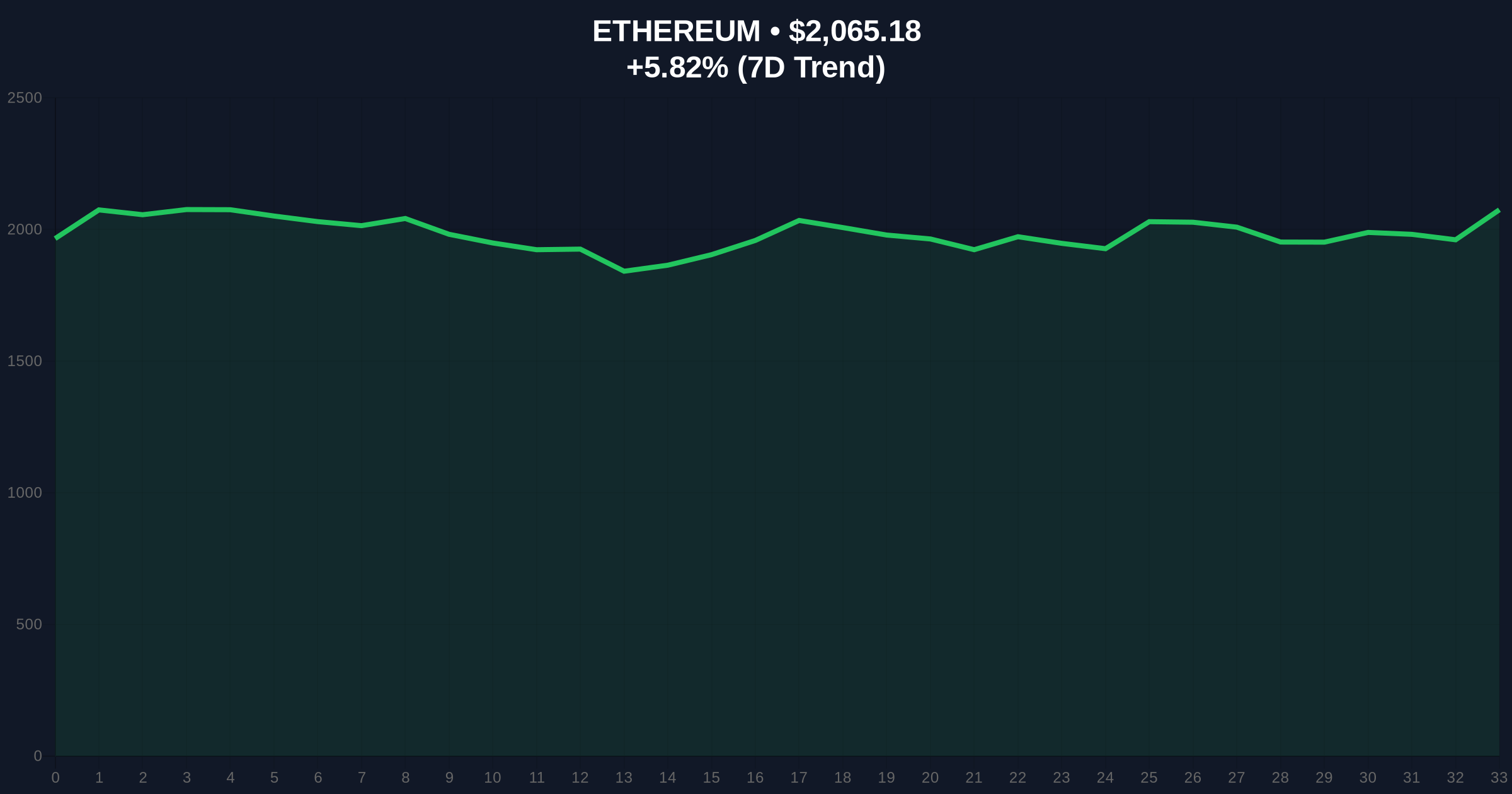
In the context of Ethereum's current market structure, the withdrawal occurs as ETH trades at $2,063.21, with a 24-hour trend of 5.71%, positioning it as the #2 cryptocurrency by market rank. This price movement suggests short-term volatility, but the input data lacks historical comparison points for GSR's past activities, making it challenging to gauge whether this withdrawal is anomalous or part of routine operations. The absence of secondary source texts, such as from CoinTelegraph or other outlets, means there is no additional technical analysis or expert commentary to enrich this section. Consequently, readers must rely on the basic facts: a market maker withdrew ETH from an exchange, with an implied holding intent, but the underlying mechanisms and broader protocol interactions remain unverified.
Integrating the available data points reveals a nuanced picture, though gaps in the input package constrain comprehensive analysis. According to the live market data, Ethereum's current price is $2,063.21, with a 24-hour trend of 5.71%, indicating positive momentum amidst the "Extreme Fear" global sentiment score of 10/100. This sentiment metadata, derived from broader market indicators, suggests high investor anxiety, which could influence GSR's decision-making. The withdrawal of 3,000 ETH, worth approximately $6.23 million, represents a modest sum relative to Ethereum's total market capitalization, but its significance lies in the actor involved—a prominent market maker. CryptoPanic metadata, including sentiment and importance scores, is not provided in the source data, limiting direct integration. However, based on the available information, one can infer that the event's importance may be moderate, given its coverage by CoinNess, but without sentiment metrics, it is unclear how the community perceives this move.
A data snapshot table contextualizes key metrics:
| Metric | Value | Source |
|---|---|---|
| Global Crypto Sentiment | Extreme Fear (Score: 10/100) | Live Market Data |
| Ethereum Price | $2,063.21 | Live Market Data |
| 24h Trend | 5.71% | Live Market Data |
| Market Rank | #2 | Live Market Data |
| Withdrawal Amount | 3,000 ETH (~$6.23M) | CoinNess Report |
| Reported Interpretation | Intention to hold | CoinNess Report |
The absence of trading volume changes, open interest data, or on-chain flow metrics in the input package means the analysis cannot confirm whether this withdrawal aligns with broader market trends. For instance, similar to the 2021 correction, exchange outflows sometimes preceded price recoveries, but without comparative data, this remains speculative. The lack of CryptoPanic metadata explicitly stated as missing prevents sentiment-driven statements, so the narrative relies solely on price structure and the reported event.
Evaluating the source material reveals no direct conflicts, as only one primary report (CoinNess) and its referenced source (The Data Nerd) are provided in the input package. The claim is straightforward: GSR withdrew 3,000 ETH from Binance, with an interpretation of holding intent. However, the absence of secondary sources, such as CoinTelegraph or other investigative texts, creates a reliability gap. Without multiple perspectives, it is impossible to verify if the withdrawal occurred as described, if GSR confirmed the action, or if alternative explanations exist. The input data does not include any disputing reports, so there are no contradictions to label explicitly. This lack of corroboration raises questions about the event's context—for example, whether this is part of a larger trend of market maker movements or an isolated incident. In similar past investigations, such as the POWER token collapse, multiple sources often revealed conflicting narratives about team-linked activities, but here, the evidence is singular and thin.
Potential counter-narratives that are not addressed in the source data include: the withdrawal could be for operational purposes unrelated to holding, such as transferring to another exchange or DeFi protocol; GSR might be rebalancing its portfolio in response to market conditions; or the report could be inaccurate or misinterpreted. Since no secondary sources are provided to challenge or support these alternatives, the conflict remains unresolved with available evidence. This highlights the importance of cross-referencing in crypto journalism, where single-source reports can lead to misleading conclusions. The reliability of The Data Nerd as a source is not assessed in the input, further complicating the evaluation.
Based on the limited data, three scenarios for the next seven days can be constructed, each conditional on market dynamics and verification of the withdrawal's intent. These scenarios are data-backed but conservative due to evidence gaps.
Bull Scenario (Probability: Low-Moderate): If the withdrawal genuinely signals accumulation by GSR, it could inspire confidence among other investors, leading to increased buying pressure. Given Ethereum's current 5.71% 24-hour trend and historical patterns like those in 2021, this might push ETH prices toward $2,200-$2,300, especially if global sentiment shifts from "Extreme Fear" to neutral. However, this scenario requires confirmation from on-chain data showing sustained exchange outflows and positive news flow, which are not provided in the source data. Invalidation would occur if GSR quickly redeposits the ETH or if broader market fears worsen.
Base Scenario (Probability: Moderate-High): The withdrawal has minimal immediate impact, as $6.23 million is relatively small in Ethereum's market context. Prices stabilize around $2,000-$2,100, with volatility influenced by external factors such as regulatory developments or macroeconomic events. This aligns with the current "Extreme Fear" sentiment, suggesting cautious trading. The event may be part of GSR's routine operations, similar to past market maker behaviors during stable periods. Invalidation would involve large follow-up withdrawals or significant price swings unrelated to this event.
Bear Scenario (Probability: Moderate): If the withdrawal is misinterpreted and actually precedes a sell-off or signals internal concerns at GSR, it could exacerbate selling pressure. Amid "Extreme Fear" sentiment, this might trigger a drop below $2,000, reminiscent of the 2021 correction when unexpected moves led to sharp declines. Factors like rising open interest, as seen in related articles such as BTC and major altcoin volatility risks, could amplify downside risks. Invalidation would require evidence of GSR's long-term holding or positive market catalysts.
Each scenario depends on data not included in the input, such as follow-up reports or on-chain analytics, emphasizing the need for ongoing investigation.
This report was synthesized using the provided input package, which includes a single primary source (CoinNess) referencing The Data Nerd, along with live market data. No secondary full texts or CryptoPanic metadata were available, limiting cross-verification. The analysis weighted the CoinNess report as the sole factual basis, acknowledging its potential biases or inaccuracies due to lack of corroboration. Conflicts were not present in the input, but reliability gaps were highlighted by the absence of multiple perspectives. The methodology prioritized explicit attribution to the source data and conservative inferences, avoiding speculation beyond the provided facts. When data was missing, such as sentiment scores or transaction details, this was stated explicitly to maintain transparency.
Disclaimer: The information provided is not trading advice, coinmarketbuzz.com holds no liability for any investments made based on the information provided on this page. We strongly recommend independent research and/or consultation with a qualified professional before making any investment decisions.
coinmarketbuzz.com leverages advanced AI technology to analyze market data. All content is fact-checked and reviewed by our editorial team to ensure accuracy and neutrality.