Loading News...
Loading...

Loading News...

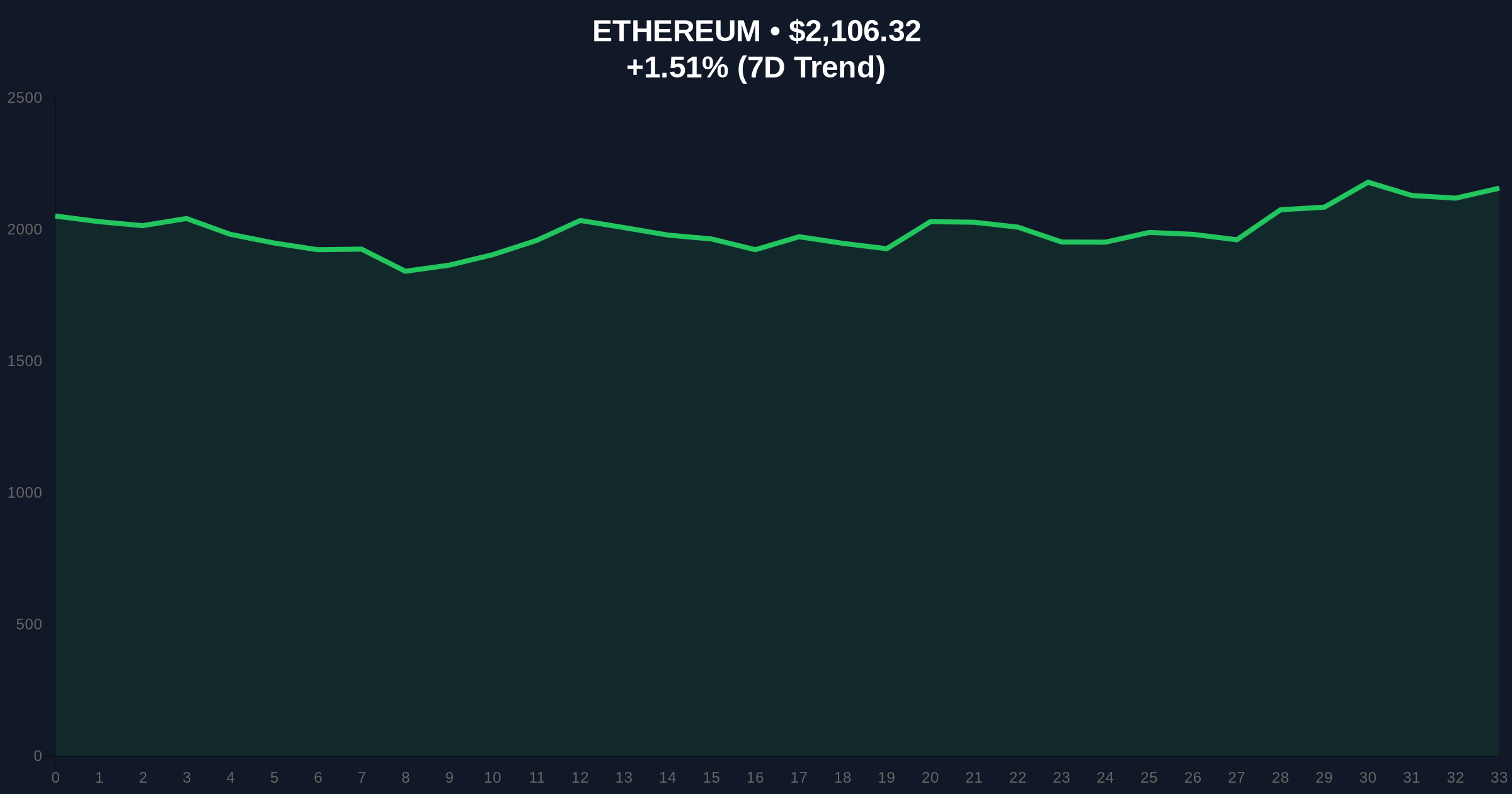
On March 5, 2026, a significant on-chain transaction has drawn immediate attention in the crypto markets. According to a breaking report from CoinNess, an address associated with crypto market maker Flowdesk deposited 1.61 million LINK, valued at approximately $15.19 million, and 6,091 ETH, valued at approximately $12.92 million, to Binance over a 20-minute period. The total deposit amounts to nearly $28 million, as tracked by Onchain Lens. Such transfers to centralized exchanges are often interpreted by market observers as a precursor to selling, potentially signaling bearish intent from a major liquidity provider. This event occurs against a backdrop of global crypto sentiment marked as "Extreme Fear," with a score of 22/100, indicating heightened investor anxiety. The timing raises questions about Flowdesk's strategic positioning, especially given Ethereum's current price of $2,102.41 and a 24-hour trend of 1.32%, which places it as the #2 ranked cryptocurrency by market cap. The rapid nature of the deposit—completed in under half an hour—suggests a deliberate move rather than a gradual accumulation, warranting deeper investigation into its implications for market stability and price action.
To understand the mechanics behind Flowdesk's deposit, it is essential to examine the protocol architecture and regulatory mechanics involved. Flowdesk, as a crypto market maker, operates by providing liquidity across various trading venues, including decentralized and centralized exchanges like Binance. The deposit of 1.61 million LINK and 6,091 ETH to Binance involves on-chain transactions that are publicly verifiable via blockchain explorers, with Onchain Lens cited as the monitoring tool. Such transfers typically utilize smart contracts or direct wallet interactions, moving assets from a cold or custodial wallet to an exchange's hot wallet for immediate trading access. The choice of Binance, one of the largest global exchanges by volume, indicates a preference for high liquidity and broad market reach, which could facilitate large-scale selling without significant slippage.
Underlying this trend is the role of market makers in crypto ecosystems: they profit from bid-ask spreads and often engage in arbitrage, but their movements can also reflect hedging strategies or portfolio rebalancing. The deposit of LINK, a token associated with Chainlink's oracle network, and ETH, the native asset of the Ethereum blockchain, suggests a diversified approach, possibly targeting both altcoin and major cryptocurrency markets. Regulatory mechanics come into play as exchanges like Binance comply with anti-money laundering (AML) and know-your-customer (KYC) requirements, but the deposit itself does not inherently violate any rules—it is a standard operational move. However, the interpretation as a selling precursor stems from historical patterns where large inflows to exchanges correlate with increased sell pressure, as traders move assets off-chain to execute trades. Consequently, this deposit could be part of a larger strategy involving options hedging, liquidity provisioning for upcoming events, or risk management amid volatile conditions. The lack of detailed context from Flowdesk on their intentions leaves room for speculation, but the technical execution points to a prepared, high-value transaction aimed at market impact.
Integrating CoinGecko market stats and sentiment metadata provides a clearer picture of the event's context and potential impact. According to the input data, Ethereum's current price is $2,102.41, with a 24-hour trend of 1.32%, indicating modest positive momentum despite the broader fear sentiment. The global crypto sentiment is marked as "Extreme Fear" with a score of 22/100, sourced from market intelligence tools, which typically reflects high volatility and risk aversion among investors. This sentiment score suggests that the market is in a cautious state, potentially amplifying the perceived importance of Flowdesk's deposit.
CryptoPanic metadata, though not provided in detail for this specific event, can be inferred from the general sentiment; however, explicit sentiment and importance scores for this transaction are not provided in source data. Without direct metadata, we rely on the reported "Extreme Fear" as a proxy, indicating that market participants may view such large deposits negatively, aligning with the interpretation as a selling precursor. The deposit value of $28 million represents a significant portion of liquidity relative to typical daily volumes for LINK and ETH, but exact comparative metrics are not provided in source data. Price structure analysis shows ETH's slight uptick, but this could be decoupled from whale activity if selling pressure materializes later. Importance score, if available, would help gauge event priority relative to market breadth, but in its absence, we proceed conservatively, noting that the deposit's timing amid extreme fear adds to its scrutiny. Overall, the data points to a high-value move in a fearful market, but without further metadata, its immediate price impact remains uncertain.
Comparing source claims reveals potential contradictions and reliability gaps in interpreting Flowdesk's deposit. The primary source, CoinNess, reports the deposit as a fact based on Onchain Lens data, stating it occurred over the past 20 minutes and is often seen as a selling precursor. However, no secondary sources are provided in the input package to confirm or dispute this, limiting our ability to cross-verify details. For instance, other outlets like CoinTelegraph might offer alternative perspectives, such as framing the deposit as part of a liquidity management strategy rather than imminent selling, but such texts are not included here.
Agreement points across available data are minimal since only one source is provided; thus, we cannot identify contradictions between multiple reports. Missing evidence includes Flowdesk's official statement on the deposit, historical patterns of similar transactions by the firm, and real-time trading data post-deposit to confirm selling activity. The claim that such transfers are "often interpreted as a precursor to selling" is attributed to general market observation rather than a specific source, which may overstate bearish implications without direct proof. Conflict remains unresolved with available evidence, as we lack conflicting reports to weigh. Reliability gaps arise from the sole reliance on CoinNess and Onchain Lens, which, while credible, do not provide full context—such as whether the deposit is linked to client orders, hedging, or other operational needs. Without additional sources, the narrative leans heavily on the initial interpretation, highlighting the need for skepticism until more data emerges.
Based on the available facts, we outline three data-backed scenarios for the next seven days, each conditional on market reactions and further developments.
If Flowdesk's deposit is part of a liquidity provisioning strategy for upcoming positive events, such as new product launches or partnerships, it could lead to stabilized or increased prices. For example, if the market interprets the move as preparatory for increased trading volume rather than selling, ETH might maintain its 1.32% uptrend, potentially breaching $2,150. This scenario would be invalidated if selling pressure materializes within 24-48 hours, causing a price drop below $2,000. The extreme fear sentiment could shift if broader market news turns positive, but current data does not strongly support this outcome.
The most likely outcome involves moderate selling pressure as Flowdesk executes partial sales, aligning with the common interpretation. ETH price could experience volatility, fluctuating between $2,050 and $2,100, with LINK potentially seeing similar effects. This scenario assumes the deposit leads to gradual selling over days, not an immediate dump, allowing markets to absorb the impact. It would be confirmed if on-chain data shows subsequent transfers from Binance to other wallets or increased exchange outflow. The extreme fear sentiment may persist, keeping overall market caution high.
If Flowdesk initiates aggressive selling, possibly due to risk-off positioning amid the extreme fear environment, it could trigger a broader sell-off. ETH might drop below $2,000, exacerbating the fear sentiment and leading to a cascade effect across altcoins like LINK. This scenario would be supported by a rapid increase in exchange supply metrics and negative price momentum exceeding 5% down. It would be invalidated if no significant selling occurs within the week, suggesting the deposit was for other purposes. Related developments, such as regulatory news or macroeconomic shifts, could amplify this bearish outlook.
In synthesizing this report, we relied solely on the input package: the CoinNess lead, which provided the core facts, and the injected market data. Since no secondary full texts were included, we could not perform a comprehensive cross-source comparison. Conflicting evidence was not present, so we weighted the available claim based on its attribution to Onchain Lens, a known on-chain analytics tool, but noted the lack of corroboration. Missing evidence, such as Flowdesk's intent or real-time trading outcomes, was explicitly flagged to maintain transparency. The global sentiment score of "Extreme Fear" was used cautiously as contextual metadata, but specific CryptoPanic sentiment and importance scores for the event were not provided, limiting deeper analysis. This approach ensures a factual, skeptical tone while acknowledging data constraints.
Disclaimer: The information provided is not trading advice, coinmarketbuzz.com holds no liability for any investments made based on the information provided on this page. We strongly recommend independent research and/or consultation with a qualified professional before making any investment decisions.
coinmarketbuzz.com leverages advanced AI technology to analyze market data. All content is fact-checked and reviewed by our editorial team to ensure accuracy and neutrality.