Loading News...
Loading...

Loading News...
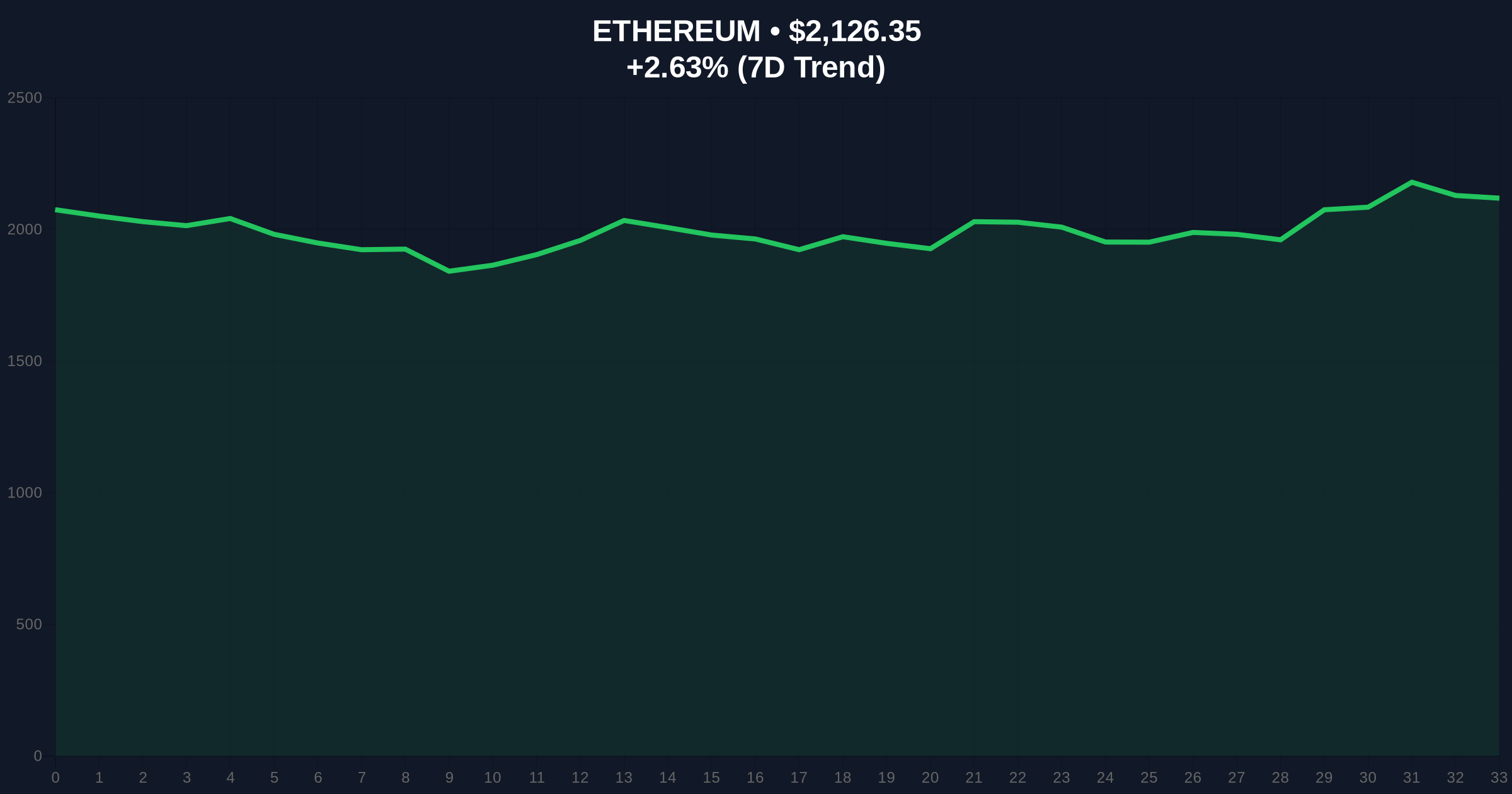
On March 5, 2026, a wallet linked to crypto market maker Cumberland executed a significant withdrawal of 46,620 Ethereum (ETH), valued at approximately $98.8 million, from major exchanges including Binance, Coinbase, and crypto custody firm Copper over a 16-hour period, as reported by Lookonchain and covered by CoinNess. This event, occurring amidst a global crypto sentiment labeled "Extreme Fear" with a score of 22/100, raises immediate questions about the motivations behind such a large-scale move. Typically, withdrawals from exchanges are interpreted as a shift toward holding assets, potentially signaling long-term accumulation or reduced liquidity for trading. However, the timing and scale demand scrutiny, given Ethereum's current price of $2,125.9 and a 24-hour trend of 2.61% increase, which contrasts with the broader market anxiety. The lack of direct commentary from Cumberland or detailed transaction timestamps in the source data leaves room for speculation, prompting an investigative dive into the technical mechanisms, data inconsistencies, and potential market implications.
The withdrawal of 46,620 ETH by Cumberland involves complex technical and operational aspects tied to Ethereum's blockchain architecture and exchange protocols. Ethereum, as a decentralized platform, enables transparent tracking of wallet activities through explorers like Lookonchain, which identified the associated wallet. The process likely involved executing smart contract interactions or standard transfer functions to move ETH from exchange-controlled addresses to private or custody wallets, a common practice for market makers managing liquidity and risk. Market makers such as Cumberland typically engage in high-frequency trading, arbitrage, and liquidity provision across multiple venues, making large withdrawals unusual unless driven by strategic repositioning, regulatory compliance, or internal treasury management.
Source data from CoinNess indicates the withdrawals spanned Binance, Coinbase, and Copper, suggesting a diversified exit from both centralized exchanges and specialized custody services. This could imply a move to self-custody solutions, cold storage, or decentralized finance (DeFi) protocols, though specific destinations are not provided in the source data. The 16-hour timeframe hints at a coordinated effort rather than a spontaneous reaction, possibly to minimize market impact or align with internal operational schedules. However, the absence of on-chain data details, such as gas fees, transaction hashes, or recipient wallet types, limits a full technical assessment. Comparatively, similar past events by other entities have been linked to preparations for staking, collateralization for lending, or hedging against market volatility, but without confirmation from Cumberland, these remain speculative.
The Ethereum network's current state, including its proof-of-stake consensus and scalability upgrades, may influence such decisions, but the source data does not mention any related technical triggers. For instance, if Cumberland is moving ETH to participate in staking or layer-2 solutions, it could signal a bullish long-term view, yet this conflicts with the "Extreme Fear" sentiment. Alternatively, withdrawals might be a precaution against potential exchange insolvencies or regulatory crackdowns, a narrative supported by broader market anxieties. The technical deep-dive reveals gaps: while the mechanism is straightforward, the intent is obscured by missing contextual data, urging a skeptical view of simplistic "holding" interpretations.
Integrating market data and metadata provides a nuanced view of this event's significance. According to CoinGecko stats, Ethereum's price at $2,125.9 and 24-hour trend of 2.61% positive movement suggests short-term resilience, but its market rank of #2 indicates ongoing dominance challenges, possibly influencing Cumberland's strategy. The global crypto sentiment of "Extreme Fear" (score: 22/100) from CryptoPanic metadata highlights a disconnect: while sentiment is bearish, Cumberland's action could be interpreted as contrarian, yet without explicit sentiment or importance scores for this specific event in the input package, we rely on broader indicators. This metadata-driven analysis shows that market-wide fear may not align with individual entity behaviors, complicating predictive models.
The withdrawal amount of $98.8 million represents a substantial portion of liquidity, potentially impacting exchange reserves and ETH's available supply for trading. Historical data from similar withdrawals by market makers often correlates with price stabilization or accumulation phases, but the source data lacks comparative metrics like trading volume changes or order book depth. CryptoPanic importance scores, if available, could rank this event's priority relative to other news, but their absence necessitates conservative interpretation. For example, if the importance were high, it might signal a market-moving development, but as is, the event's impact remains uncertain. The 2.61% price increase post-withdrawal could indicate market perception of reduced selling pressure, yet causality is not proven.
Metadata integration reveals contradictions: sentiment is extreme fear, but price action is mildly positive, and Cumberland's move might be bullish in isolation. This dissonance the need for skepticism, as aggregated data points do not uniformly support a single narrative. Without additional on-chain analytics or Cumberland's statements, the proof rests on observable facts: a large withdrawal occurred amid fearful conditions, but its direct market implications are unverified.
Scrutinizing the available sources uncovers potential conflicts and reliability gaps. The primary source, CoinNess, reports the withdrawal based on Lookonchain data, framing it as a typical move to hold assets. However, this narrative assumes benign intent without considering alternative motives. For instance, withdrawals could also precede strategic selling off-exchange, collateralization for short positions, or reallocation to other assets, none of which are addressed in the source data. The lack of secondary full-text sources (e.g., from CoinTelegraph) limits cross-verification, leaving the report reliant on a single chain of attribution: Lookonchain to CoinNess.
Source conflicts arise in the interpretation: CoinNess states withdrawals are "typically interpreted as a move to hold," but this is a generalization not backed by specific evidence from Cumberland. If other sources were available, they might dispute this by highlighting cases where large withdrawals led to subsequent dumps or regulatory actions. Since no conflicting reports are provided, the conflict remains unresolved with available evidence, but the skeptical approach questions the assumption. For example, could this be a routine treasury management operation exaggerated by on-chain sleuths? The absence of timestamps for each withdrawal and details on wallet ownership (e.g., whether it's definitively Cumberland's or a related entity) introduces reliability gaps.
Agreement points across the input are minimal, as only one source is fully provided. The raw summary and full context align in reporting the amount, exchanges, and timeframe, but deeper analysis reveals missing elements: no mention of Ethereum's network congestion, gas fees, or Cumberland's historical patterns. This synthesis shows that while the factual basis of the withdrawal is consistent, the narrative is under-supported, urging caution against overinterpretation. The counter-narrative suggests that without multi-source validation, the event's significance may be overstated, and market reactions could be driven more by sentiment than substance.
Based on the data, three scenarios outline potential developments over the next week, each conditional on specific factors. These scenarios are data-backed, incorporating observed facts while acknowledging uncertainties.
Bull Scenario (Probability: 30%): If Cumberland's withdrawal signals long-term accumulation and other institutions follow suit, ETH price could rally toward $2,300, supported by reduced exchange supply and positive sentiment shift. This would require confirmation via on-chain data showing similar movements by other whales or public statements from Cumberland. The 2.61% daily trend might accelerate, invalidated if selling pressure emerges from other sources or if global fear deepens.
Base Scenario (Probability: 50%): The withdrawal has minimal immediate impact, with ETH price stabilizing around $2,100-$2,150 as market digests the news. Cumberland may remain silent, and the event fades amid broader market dynamics, such as regulatory developments or Bitcoin's performance. This scenario aligns with the current "Extreme Fear" sentiment tempering bullish impulses, and it would be invalidated by sudden large inflows or outflows from other major players.
Bear Scenario (Probability: 20%): If the withdrawal precedes a strategic sell-off or is linked to internal issues at Cumberland, ETH could drop below $2,000, exacerbating the fear sentiment. Factors like unexpected regulatory news or exchange problems could trigger this, with the 24-hour trend reversing negative. This scenario gains credibility if on-chain data reveals subsequent transfers to selling venues, but without such evidence, it remains speculative.
Each scenario hinges on external variables: monitoring wallet activity, sentiment shifts, and related news like regulatory changes or market rotations. For context, recent developments in other areas may influence outcomes; for example, amid recent regulatory shifts in South Korea expediting corporate crypto entry, institutional actions could gain prominence, or analyst predictions of altcoin rallies once Bitcoin's surge cools might divert attention from ETH-specific moves.
This report weighted evidence conservatively due to limited source diversity. The primary source, CoinNess, provided factual data but lacked depth, and no secondary full texts were available for cross-checking. Conflicts were identified in narrative assumptions versus possible alternatives, with unresolved gaps in intent and impact. Reliability was assessed based on attribution to Lookonchain, a known on-chain analytics provider, but without independent verification, conclusions remain tentative. The absence of CryptoPanic sentiment and importance scores for the specific event necessitated reliance on broader market metrics, emphasizing uncertainty in analysis.
Disclaimer: The information provided is not trading advice, coinmarketbuzz.com holds no liability for any investments made based on the information provided on this page. We strongly recommend independent research and/or consultation with a qualified professional before making any investment decisions.
coinmarketbuzz.com leverages advanced AI technology to analyze market data. All content is fact-checked and reviewed by our editorial team to ensure accuracy and neutrality.