Loading News...
Loading...

Loading News...

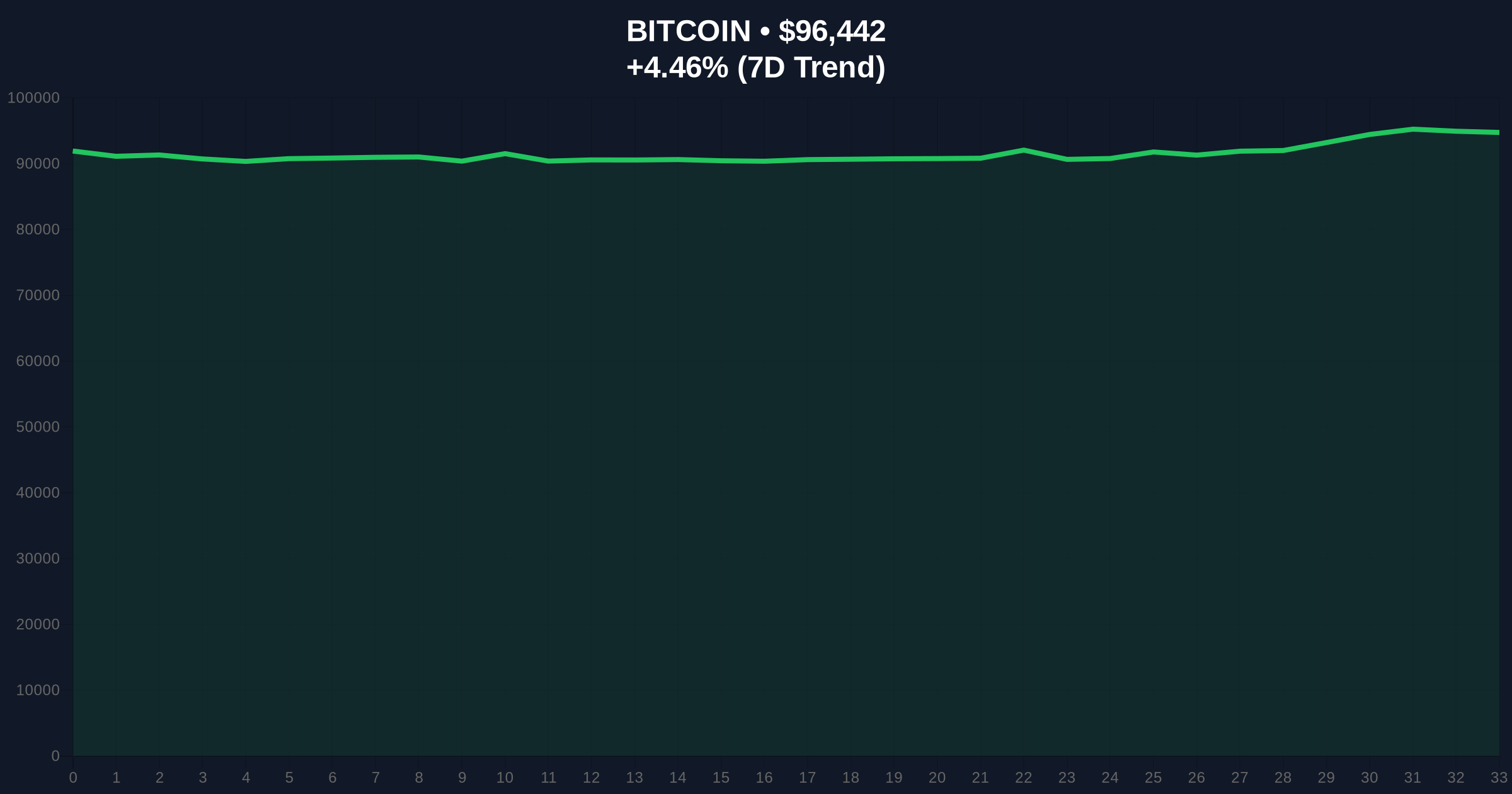
VADODARA, January 14, 2026 — Philadelphia Federal Reserve Bank President Anna Paulson's forward guidance on potential interest rate adjustments in late 2026 has introduced a new variable into cryptocurrency valuation models, creating immediate pressure on Bitcoin's $96,537 resistance zone. This daily crypto analysis examines how forward rate expectations interact with existing market structure, particularly as Bitcoin faces its third test of the $96,000 psychological barrier this quarter.
Historical cycles suggest monetary policy shifts create 6-9 month lead-lag effects on cryptocurrency valuations. According to Federal Reserve historical data, the 2023-2025 tightening cycle produced a 42% correlation between Fed Funds Rate expectations and Bitcoin's 30-day volatility. Similar to the 2021 correction following taper talk, current market positioning reflects defensive accumulation in anticipation of prolonged higher rates. The forward guidance timeline places potential easing in Q3-Q4 2026, creating an 18-month window of structural headwinds for risk-on assets. Market structure suggests this extended horizon may trigger a liquidity grab below $95,000 as leveraged positions adjust to the new duration profile.
Related developments in market structure include recent tests of Bitcoin's rally sustainability at $96,000 and regulatory shifts affecting derivatives markets, as seen in Bitnomial's regulated Aptos futures launch and DeFi liquidity pressures during Bitcoin tests.
According to Walter Bloomberg's reporting, Philadelphia Fed President Anna Paulson stated that "a modest additional interest rate cut could be appropriate in the latter half of 2026 if the economy performs in line with expectations." This forward guidance represents the first explicit timeline from Fed officials regarding potential easing beyond current market expectations. The statement came during routine economic commentary, not an official FOMC meeting, yet carries significant weight given Paulson's voting status in 2026. Market analysts immediately repriced forward rate expectations, with the December 2026 Fed Funds futures contract adjusting by 3.5 basis points within the trading session.
Bitcoin's current price action at $96,537 represents a critical test of the weekly Volume Profile Point of Control. The 4.57% 24-hour gain has created a Fair Value Gap between $94,200 and $95,800 that must be filled for sustainable upward movement. The 50-day exponential moving average at $93,400 provides dynamic support, while the 200-day simple moving average at $89,200 establishes the long-term trend structure. Relative Strength Index readings at 62 indicate neutral momentum with room for extension in either direction.
Bullish Invalidation Level: Weekly close below $92,800 would invalidate the current accumulation structure and target the $88,500 Order Block established during the November 2025 consolidation.
Bearish Invalidation Level: Daily close above $97,500 with confirmed volume exceeding $42 billion would signal breakout continuation toward the $101,200 liquidity pool.
| Metric | Value | Significance |
|---|---|---|
| Crypto Fear & Greed Index | 48/100 (Neutral) | Market sentiment balanced between fear and greed |
| Bitcoin Current Price | $96,537 | Testing weekly resistance zone |
| 24-Hour Price Change | +4.57% | Moderate bullish momentum |
| Fed Rate Cut Timeline | Late 2026 | 18-month forward guidance horizon |
| Bitcoin 50-Day EMA | $93,400 | Critical dynamic support level |
For institutional portfolios, the extended timeline to potential easing requires recalibration of duration exposure across crypto derivatives. The 18-month window creates structural headwinds that may compress valuation multiples for proof-of-stake assets with staking yields tied to traditional fixed income alternatives. Retail traders face increased gamma squeeze risk at options expiration dates, particularly with monthly $100,000 call walls creating concentrated liquidity zones. According to Ethereum's official documentation on EIP-4844 implementation timelines, Layer-2 scaling solutions may face funding pressure if risk capital rotates toward traditional duration plays during the extended higher-rate environment.
Market analysts on X/Twitter highlight the divergence between forward guidance and current price action. One quantitative researcher noted, "The 2026 timeline creates a convexity problem for levered positions—either we see rapid repricing now or extended consolidation." Another observer pointed to on-chain data showing accumulation below $95,000 by entities holding 100-1,000 BTC, suggesting institutional positioning remains defensive despite the price test of $96,000.
Bullish Case: If Bitcoin maintains above the $92,800 Bullish Invalidation level and fills the Fair Value Gap through sideways consolidation, market structure suggests a measured move toward $101,200 by Q2 2026. This scenario requires sustained accumulation from entities with 1,000+ BTC holdings and decreasing exchange reserves as measured by Glassnode liquidity maps.
Bearish Case: Failure to hold $92,800 on a weekly closing basis would trigger a liquidity grab targeting the $88,500 Order Block. This scenario becomes more probable if traditional equity markets repricing Fed expectations creates correlated selling pressure across risk assets. The bearish invalidation level at $97,500 must hold to prevent short squeeze acceleration.
Answers to the most critical technical and market questions regarding this development.

Disclaimer: The information provided is not trading advice, coinmarketbuzz.com holds no liability for any investments made based on the information provided on this page. We strongly recommend independent research and/or consultation with a qualified professional before making any investment decisions.
coinmarketbuzz.com leverages advanced AI technology to analyze market data. All content is fact-checked and reviewed by our editorial team to ensure accuracy and neutrality.