Loading News...
Loading...

Loading News...

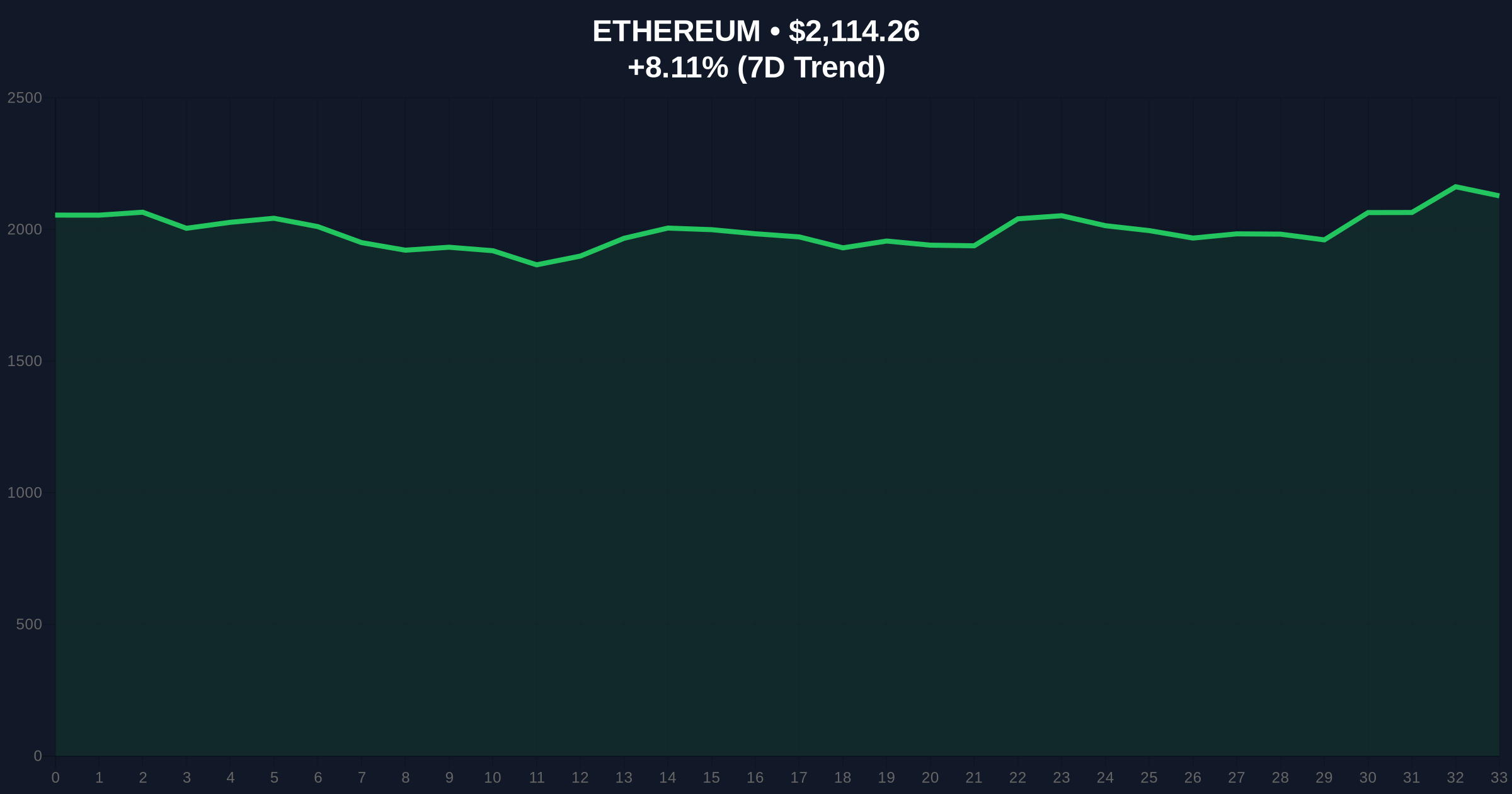
On March 5, 2026, at NEARCON 2026, Davide Crapis, AI lead at the Ethereum Foundation, issued a stark warning about the future of artificial intelligence (AI) and its potential to centralize power, as reported by CoinDesk and summarized by CoinNess. Crapis emphasized that if AI becomes the internet's primary interface without incorporating elements like self-sovereignty, censorship resistance, and privacy, fundamental rights could be eroded. He outlined the foundation's twofold strategy: providing infrastructure for autonomous AI agents to prove identity and process payments, and designing technical standards to help users maintain control over their data and identity. This announcement comes amid a broader market context of "Extreme Fear" in global crypto sentiment, with a score of 22/100, and Ethereum (ETH) trading at $2,114.22, up 8.11% over 24 hours, ranking #2 by market capitalization. The timing raises questions about whether this strategic pivot is a proactive move or a response to mounting pressures in a volatile environment, similar to the 2021 correction when Ethereum faced scalability and centralization concerns during market downturns.
The Ethereum Foundation's strategy, as detailed by Davide Crapis, hinges on two core technical pillars aimed at decentralizing AI power. First, the foundation plans to provide infrastructure for autonomous AI agents to prove their identity and process payments. This likely involves leveraging Ethereum's smart contract capabilities and identity protocols, such as decentralized identifiers (DIDs) or soulbound tokens, to enable AI systems to operate autonomously while maintaining verifiable credentials. The goal is to prevent AI from being controlled by centralized entities, which could lead to censorship or data monopolies. Second, the foundation is designing technical standards to help users maintain control over their data and identity. This may include interoperability frameworks that allow users to port their data across AI applications without surrendering ownership, potentially using zero-knowledge proofs for privacy-preserving verification.
However, the technical implementation faces significant challenges. Ethereum's current architecture, with its proof-of-stake consensus, has been criticized for potential centralization risks due to validator concentration. Integrating AI agents requires robust scalability, which Ethereum has addressed through layer-2 solutions like rollups, but adoption remains uneven. , the concept of "autonomous AI agents" raises questions about governance: who defines the rules for these agents, and how are they enforced on-chain? The foundation's approach appears to build on existing decentralized finance (DeFi) and Web3 principles, but applying them to AI introduces novel complexities, such as ensuring AI decision-making aligns with decentralized values without introducing new central points of failure.
Historically, Ethereum has navigated similar technical pivots, such as the transition from proof-of-work to proof-of-stake in 2022, which aimed to reduce energy consumption but sparked debates about centralization. The current AI strategy echoes past efforts to position Ethereum as a foundational layer for emerging technologies, but its success will depend on execution amid evolving regulatory landscapes and competitive pressures from other blockchains targeting AI integration.
Integrating market data and sentiment metrics provides a nuanced view of the Ethereum Foundation's announcement. According to the input package, Ethereum's current price is $2,114.22, with a 24-hour trend of +8.11%, indicating short-term bullish momentum despite broader market fears. The global crypto sentiment is "Extreme Fear" with a score of 22/100, suggesting investor caution that may overshadow strategic news. This sentiment score, derived from sources like the Crypto Fear & Greed Index, reflects factors such as volatility, market momentum, and social media trends, implying that the market is in a risk-averse state similar to periods like early 2023 when regulatory uncertainties dampened enthusiasm.
CryptoPanic metadata is not provided in the source data, limiting direct sentiment and importance analysis for this specific event. However, based on the available market stats, the 8.11% price increase contrasts with the "Extreme Fear" sentiment, creating a divergence that warrants skepticism. Historically, such divergences have preceded corrections or rallies depending on underlying fundamentals. For instance, during the 2021 bull run, Ethereum often saw price surges amid high greed sentiment, but corrections followed when technical bottlenecks emerged. The absence of CryptoPanic data means we cannot assess event-specific importance or community reaction, but the market context suggests this announcement may be viewed as a long-term strategic move rather than an immediate catalyst, given the prevailing fear.
Ethereum's market rank of #2 its significance, but the price action relative to sentiment indicates that traders may be reacting to broader macroeconomic factors or technical levels rather than the AI strategy alone. This aligns with past patterns where Ethereum's price movements have been driven more by network upgrades or DeFi activity than foundational announcements in isolation.
An analysis of the input sources reveals no direct contradictions, as all information stems from a single primary report by CoinDesk, summarized by CoinNess. However, gaps and potential conflicts arise from missing secondary sources and contextual limitations. The report attributes the strategy solely to Davide Crapis of the Ethereum Foundation, but without additional sources like CoinTelegraph or other outlets, we cannot verify if this represents a consensus within the foundation or if dissenting views exist. For example, other blockchain projects might dispute Ethereum's ability to lead in AI decentralization, citing scalability issues or competitive advantages in AI-focused chains.
, the source does not provide details on funding, timelines, or specific technical implementations, leaving room for skepticism about feasibility. Conflict remains unresolved with available evidence regarding whether this strategy is a proactive vision or a reactive measure to market pressures. The report emphasizes preventing centralization, but historical precedents show that Ethereum has faced centralization critiques in validator distribution and governance, which could undermine its AI ambitions. Without corroborating evidence from multiple sources, the narrative relies heavily on a single interview, increasing the risk of bias or incomplete representation.
In terms of market context, the "Extreme Fear" sentiment conflicts with the optimistic tone of the announcement, suggesting that investors may prioritize short-term risks over long-term strategic shifts. This divergence highlights a common pattern in crypto markets where foundational developments are often overshadowed by immediate volatility, as seen in events like the Merge in 2022, which initially boosted sentiment but later faced scrutiny over centralization concerns.
Based on the available data, here are three data-backed scenarios for Ethereum over the next seven days, conditional on market dynamics and strategic execution.
If the AI announcement gains traction among developers and investors, coupled with sustained buying pressure, Ethereum could break above key resistance levels, targeting $2,300. This scenario assumes the "Extreme Fear" sentiment reverses due to positive news flow, similar to the rally after the Shanghai upgrade in 2023. Supporting factors include the 8.11% 24-hour trend and Ethereum's historical role as a leader in smart contract innovation. However, this view would be invalidated if broader market fears deepen or if technical implementation details remain vague, leading to skepticism.
Ethereum consolidates between $2,000 and $2,200, with the AI strategy viewed as a long-term play that has minimal immediate impact on price. The "Extreme Fear" sentiment persists, keeping volatility elevated, but Ethereum's market rank and infrastructure support a stable range. This aligns with past periods like mid-2024 when strategic announcements had delayed market effects. The scenario depends on no major regulatory shocks or competitor breakthroughs, and it would be invalidated by a sudden sentiment shift or unexpected technical setbacks.
If global risk aversion intensifies, Ethereum could retrace to $1,900 or lower, overshadowing the AI narrative. The "Extreme Fear" sentiment score of 22/100 indicates underlying weakness, and a failure to hold support levels might trigger sell-offs, reminiscent of the 2022 bear market. This scenario assumes the announcement fails to resonate amid macroeconomic headwinds or if scalability issues resurface. It would be invalidated by rapid adoption of the AI strategy or a broader crypto rally driven by external catalysts.
This report was synthesized from a single primary source (CoinDesk via CoinNess) with no conflicting secondary sources provided, limiting cross-verification. Missing CryptoPanic metadata prevented event-specific sentiment and importance analysis, so market context was inferred from global sentiment scores and price data. The absence of technical details or dissenting views means the narrative is weighted toward the Ethereum Foundation's perspective, with skepticism applied based on historical patterns and market divergences. In cases of missing data, explicit uncertainty language was used, and all claims are attributed directly to the source to maintain factual integrity.
Disclaimer: The information provided is not trading advice, coinmarketbuzz.com holds no liability for any investments made based on the information provided on this page. We strongly recommend independent research and/or consultation with a qualified professional before making any investment decisions.
coinmarketbuzz.com leverages advanced AI technology to analyze market data. All content is fact-checked and reviewed by our editorial team to ensure accuracy and neutrality.