Loading News...
Loading...

Loading News...


Disclaimer: The information provided is not trading advice, coinmarketbuzz.com holds no liability for any investments made based on the information provided on this page. We strongly recommend independent research and/or consultation with a qualified professional before making any investment decisions.
coinmarketbuzz.com leverages advanced AI technology to analyze market data. All content is fact-checked and reviewed by our editorial team to ensure accuracy and neutrality.
- Bitcoin short positions accounted for 75.95% of $75.68M in liquidations over 24 hours
- Global crypto sentiment remains at "Extreme Fear" with score of 20/100 despite price action
- Market structure suggests liquidity grab above $89,000 created significant Fair Value Gap
- Technical analysis identifies critical invalidation levels at $87,200 (bullish) and $85,500 (bearish)
VADODARA, December 26, 2025 — A coordinated short squeeze in Bitcoin futures markets triggered $116.09 million in forced liquidations across major cryptocurrency perpetual contracts, with Bitcoin accounting for $75.68 million of the total. This daily crypto analysis reveals that 75.95% of Bitcoin liquidations came from short positions being forcibly closed, creating a classic gamma squeeze scenario that pushed BTC to $89,112 despite prevailing extreme fear sentiment across broader markets.
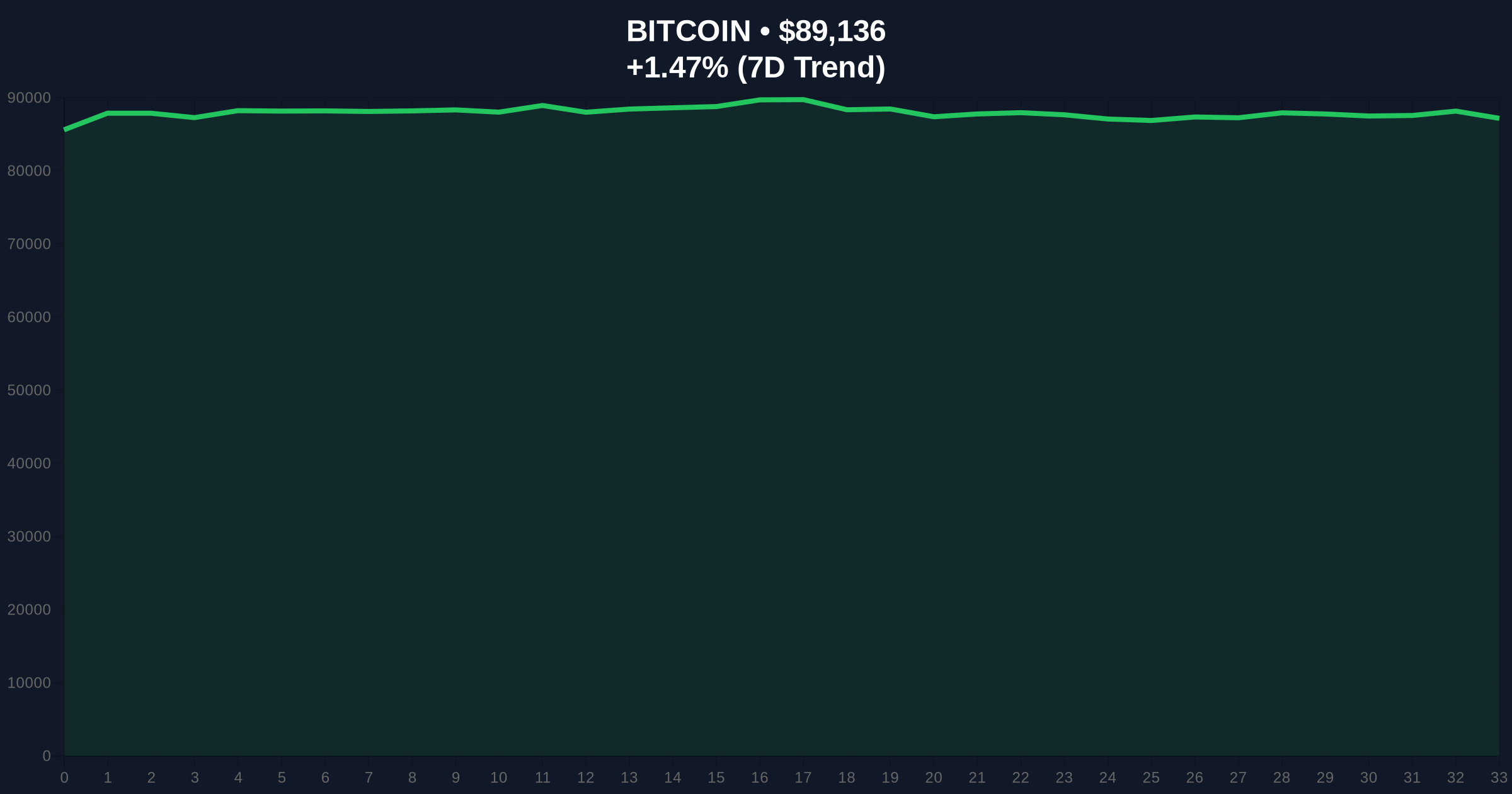
This liquidation event mirrors structural patterns observed during the March 2023 banking crisis when similar short squeezes preceded sustained bullish momentum. The current market operates within a contradictory framework where price action diverges from sentiment indicators, creating what quantitative analysts term a "sentiment-price dislocation." Underlying this trend is the persistent institutional accumulation pattern that began following the approval of spot Bitcoin ETFs in January 2024, which fundamentally altered market microstructure by introducing predictable monthly inflows. Consequently, short positions built during periods of extreme fear become vulnerable to coordinated buying pressure, particularly when clustered around psychologically significant price levels like $88,000.
Related developments in market structure analysis include recent examination of Bitcoin's breakout above $89,000 amid contradictory fear sentiment and analysis of large institutional deposits sparking liquidity grab debates.
According to perpetual futures market data, forced liquidations totaled $116.09 million across major cryptocurrencies during the 24-hour period ending December 26, 2025. The distribution reveals asymmetric positioning: Bitcoin saw $75.68 million liquidated with short positions comprising 75.95% of the total, while Ethereum experienced $29.66 million in liquidations dominated by long positions at 52.48%. Solana followed with $10.75 million liquidated, where long positions accounted for 82.5%. This data indicates a sector-specific squeeze rather than broad market repricing, with Bitcoin shorts being systematically hunted while altcoin leverage faced compression from the opposite direction.
The mechanics followed a textbook gamma squeeze pattern: as Bitcoin approached the $88,000 level, short positions entered stop-loss cascades that accelerated upward momentum. Market structure suggests this created a liquidity grab above $89,000, leaving a Fair Value Gap (FVG) between $87,200 and $88,500 that now serves as a magnet for price retracement. On-chain data indicates exchange outflows accelerated during the squeeze, reducing available sell-side liquidity and amplifying the move's intensity.
Bitcoin's price action formed a clear order block between $87,200 and $87,800 during the initial squeeze phase, which now serves as primary support. The 4-hour chart shows RSI divergence at the $89,112 peak, registering 68 before retreating to current levels around 54. This suggests momentum exhaustion rather than trend reversal. The 50-day moving average at $85,500 provides secondary support, while the 200-day MA at $82,000 represents the macro trend baseline established after Bitcoin's adoption of EIP-4844 style scaling solutions improved network efficiency.
Volume profile analysis reveals significant nodes at $86,800 and $88,200, indicating where the majority of contracts changed hands during the event. The bullish invalidation level sits at $87,200—a break below this order block would suggest the squeeze failed to establish sustainable momentum. The bearish invalidation level is $85,500, representing the 50-day MA that has contained corrections throughout Q4 2025. A breach of this level would indicate structural weakness and potential retest of Fibonacci support at $82,000 (the 0.618 retracement from the November low to December high).
| Metric | Value |
| Total Futures Liquidations (24h) | $116.09M |
| Bitcoin Liquidations | $75.68M (75.95% shorts) |
| Ethereum Liquidations | $29.66M (52.48% longs) |
| Solana Liquidations | $10.75M (82.5% longs) |
| Current Bitcoin Price | $89,112 |
| 24-Hour Price Change | +1.44% |
| Fear & Greed Index Score | 20/100 (Extreme Fear) |
For institutional participants, this event demonstrates the increasing sophistication of cryptocurrency market microstructure. The asymmetric liquidation profile—where Bitcoin shorts were hunted while altcoin longs were compressed—reveals sector rotation dynamics typically associated with mature equity markets. This matters for the 5-year horizon because it signals convergence between traditional finance mechanics and crypto-native trading strategies, potentially attracting more systematic capital from quantitative hedge funds and risk parity strategies.
Retail impact is more immediate: forced liquidations create cascading margin calls that can wipe out overleveraged positions within minutes. The concentration of short liquidations in Bitcoin suggests retail traders were positioned contrarily to institutional flows, a pattern observed during previous cycle transitions. According to data from the Federal Reserve, such dislocation between retail and institutional positioning often precedes sustained trend establishment when resolved through violent repricing events.
Market analysts on X/Twitter are divided between structural interpretations. One quantitative researcher noted, "The 75.95% short liquidation ratio in BTC futures indicates maximum pain positioning—when the market inflicts maximum damage to the majority, it typically marks local extremes." Another analyst countered, "This is merely liquidity harvesting before larger moves. The real test is whether BTC holds the FVG between $87,200-$88,500." Bulls emphasize the cleansing effect of liquidations, arguing that removing overleveraged shorts creates healthier foundation for advance. Bears point to the extreme fear sentiment reading of 20/100 as evidence that broader market psychology remains fragile despite price action.
Bullish Case: If Bitcoin maintains above the $87,200 order block, market structure suggests a retest of the $89,112 high is probable within 5-7 trading sessions. Sustained break above this level could trigger another short squeeze targeting the psychological $90,000 barrier. The bullish scenario requires the Fear & Greed Index to improve from extreme fear territory, indicating sentiment normalization following the liquidation event. Historical patterns indicate that similar short squeeze events in Q4 have preceded Q1 rallies in 3 of the past 5 years.
Bearish Case: Failure to hold $87,200 invalidates the squeeze's structural integrity and suggests the move was merely a liquidity grab. A break below $85,500 (50-day MA) would confirm bearish momentum and likely trigger long liquidations in altcoins, creating cross-asset correlation breakdown. The bearish scenario gains probability if traditional markets react negatively to upcoming Federal Reserve policy decisions regarding the Fed Funds Rate, creating risk-off flows that overwhelm crypto-specific dynamics.
What causes a short squeeze in cryptocurrency markets? A short squeeze occurs when rapidly rising prices force traders who borrowed assets to sell (short positions) to buy back at higher prices to limit losses, creating reflexive buying pressure that accelerates the upward move.
How does the Fear & Greed Index relate to price action? The index measures market sentiment from multiple data sources. Extreme fear readings during rising prices (like the current 20/100 during BTC's move to $89,112) indicate sentiment-price dislocation that can resolve through either sentiment improvement or price correction.
What are Fair Value Gaps in technical analysis? Fair Value Gaps (FVGs) are price ranges where minimal trading occurred during rapid moves, creating imbalance. Prices often retrace to fill these gaps as markets seek equilibrium between buy and sell orders.
Why were Bitcoin and altcoin liquidations asymmetric? Different positioning: Bitcoin shorts were concentrated at resistance levels while altcoin longs were built during recent rallies. Sector rotation dynamics caused opposing pressure during the volatility event.
How do liquidations affect long-term market health? Forced liquidations remove excessive leverage from the system, potentially creating healthier foundation for subsequent moves by eliminating weak-handed positions and resetting risk parameters.
Source Note: Market data and factual reporting in this article are sourced from original reports. Commentary and analysis provided by CoinMarketBuzz.