Loading News...
Loading...

Loading News...

VADODARA, January 14, 2026 — Corporate treasury Bitcoin accumulation has exceeded new supply by a factor of three over the past six months, creating what market structure suggests is a structural supply shock. According to Glassnode data cited by Cointelegraph, companies accumulated 260,000 BTC while only 82,000 BTC were mined during the same period. This latest crypto news reveals a fundamental imbalance that challenges traditional supply-demand models.
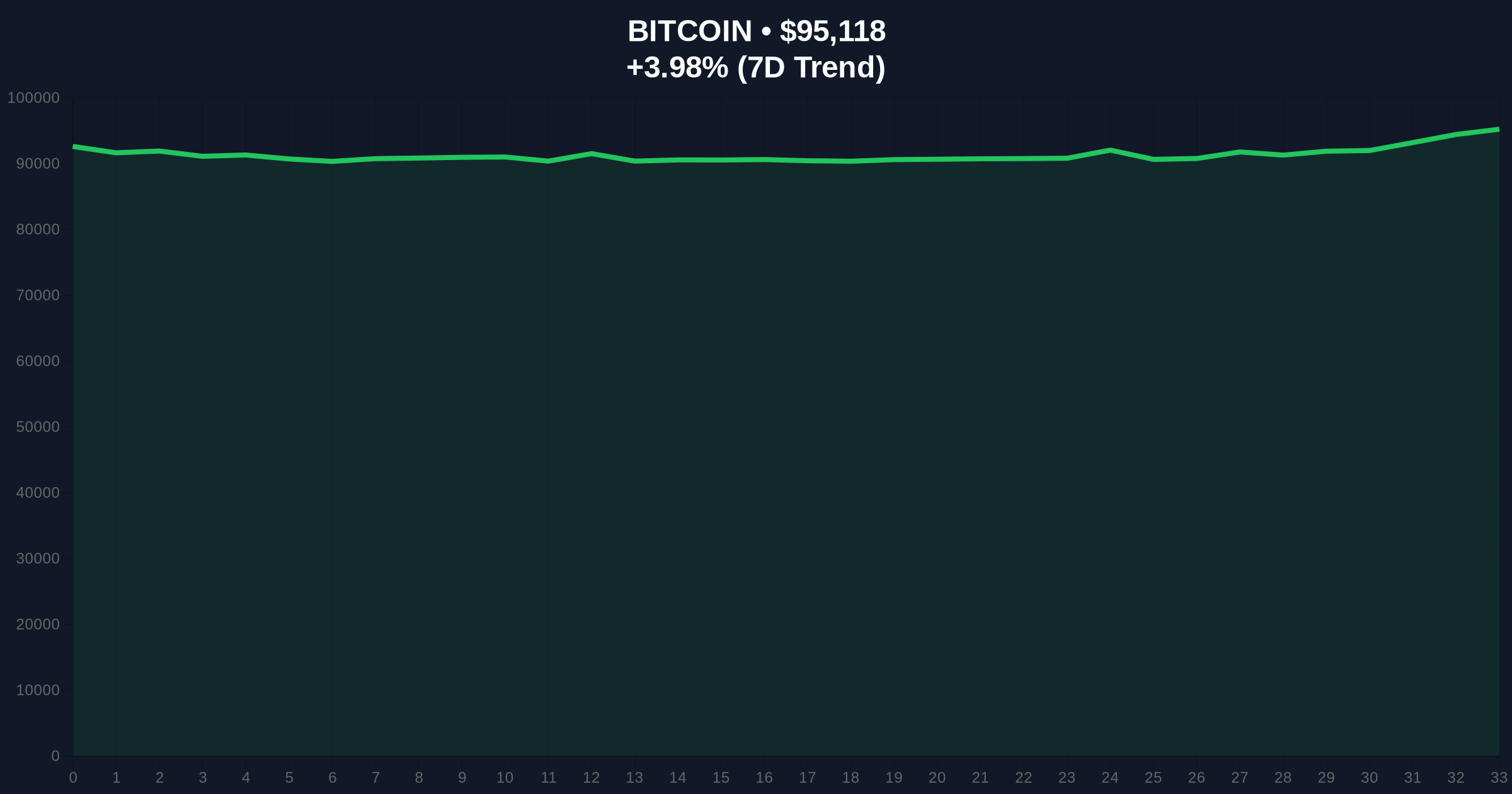
This accumulation pattern mirrors the 2021 corporate Bitcoin adoption wave but at significantly larger scale. The total corporate Bitcoin holdings now stand at approximately 1.2 million BTC, representing roughly 6.25% of Bitcoin's total supply cap. MicroStrategy (MSTR) dominates this with 687,000 BTC ($65.5 billion at current prices), accounting for nearly 60% of all corporate-held Bitcoin. MARA Holdings follows with 53,250 BTC ($5 billion). The concentration risk here is substantial—MicroStrategy's position alone represents a single-point failure vector that could create cascading liquidation events if market conditions deteriorate.
Related developments in institutional Bitcoin adoption include recent substantial inflows to US spot Bitcoin ETFs and derivatives data suggesting potential price movement above $100,000.
According to Glassnode liquidity maps, corporate entities have been net accumulators of Bitcoin for six consecutive months. The 260,000 BTC accumulated represents approximately $24.7 billion at current prices of $95,134. This accumulation rate of approximately 43,333 BTC per month exceeds the monthly mining supply of approximately 13,667 BTC by 217%. The data indicates these coins are being removed from circulating supply and moved into long-term custody solutions, creating what on-chain analysts describe as a "supply sink."
Bitcoin currently trades at $95,134, up 4.00% in the last 24 hours. Market structure suggests the accumulation has created a Fair Value Gap (FVG) between $88,500 and $92,000 that may need to be filled for healthy price discovery. The Relative Strength Index (RSI) sits at 58, indicating neutral momentum with room for movement in either direction.
Bullish Invalidation Level: $88,500 (Fibonacci 0.618 support from the recent high). A break below this level would invalidate the current accumulation thesis and suggest broader market weakness.
Bearish Invalidation Level: $102,000 (previous resistance turned support). A sustained break above this level would confirm the supply shock narrative and potentially trigger a Gamma Squeeze in derivatives markets.
| Metric | Value | Source |
|---|---|---|
| Corporate BTC Accumulation (6 months) | 260,000 BTC | Glassnode |
| BTC Mined (6 months) | 82,000 BTC | Bitcoin Protocol |
| Accumulation vs Mining Ratio | 3.17:1 | Calculation |
| Total Corporate BTC Holdings | 1.2 million BTC | Glassnode |
| Current BTC Price | $95,134 | CoinMarketCap |
| 24-Hour Change | +4.00% | Market Data |
| Crypto Fear & Greed Index | 48/100 (Neutral) | Alternative.me |
For institutions, this represents a fundamental shift in Bitcoin's availability. The SEC's approval of spot Bitcoin ETFs has created additional demand channels that compete for the same shrinking supply. For retail investors, the reduced circulating supply increases volatility potential—both to the upside during accumulation phases and to the downside during distribution. The concentration in MicroStrategy's treasury creates systemic risk; according to their latest SEC filing, they have utilized substantial debt to finance Bitcoin purchases, creating leverage in the system.
Market analysts on X/Twitter are divided. Bulls point to the "mathematical inevitability" of price appreciation given supply constraints. Skeptics question whether corporate accumulation represents genuine adoption or simply financial engineering for balance sheet optimization. One quantitative analyst noted, "When three entities control over 60% of corporate Bitcoin, you're not looking at diversification—you're looking at concentration risk that could trigger cascading liquidations."
Bullish Case: If accumulation continues at current rates and the supply shock narrative holds, Bitcoin could test the $110,000-$115,000 range within 3-6 months. This scenario assumes no major macroeconomic headwinds and sustained institutional interest as detailed in European crypto market maturation trends.
Bearish Case: If corporate accumulation slows or reverses due to regulatory pressure or balance sheet constraints, Bitcoin could retrace to fill the FVG at $88,500-$92,000. A break below the Fibonacci support at $88,500 could trigger stop-loss cascades toward $82,000.
Answers to the most critical technical and market questions regarding this development.

Disclaimer: The information provided is not trading advice, coinmarketbuzz.com holds no liability for any investments made based on the information provided on this page. We strongly recommend independent research and/or consultation with a qualified professional before making any investment decisions.
coinmarketbuzz.com leverages advanced AI technology to analyze market data. All content is fact-checked and reviewed by our editorial team to ensure accuracy and neutrality.