Loading News...
Loading...

Loading News...

On March 4, 2026, Nikkei Asia reported that Binance, the world's largest cryptocurrency exchange by trading volume, plans to secure five additional regulatory licenses in Asia this year. According to the source, the exchange currently holds licenses in countries including Australia, India, Indonesia, Japan, New Zealand, and Thailand, and it is also set to acquire a license in South Korea through its acquisition of Gopax. The company aims to expand its total number of licensed jurisdictions to over 20 this year by obtaining more licenses in the Asian region. This announcement comes amid a global crypto sentiment of "Extreme Fear" with a score of 10/100, as indicated by market data, suggesting a cautious backdrop for regulatory expansion efforts. The report lacks specific details on which Asian countries are targeted, the timeline for applications, or potential regulatory hurdles, leaving gaps in understanding the full scope of Binance's strategy.
Binance's plan to secure five more regulatory licenses in Asia involves navigating complex and varied regulatory frameworks across the region. The exchange currently operates with licenses in countries like Australia, India, Indonesia, Japan, New Zealand, and Thailand, each with distinct compliance requirements. For instance, in Japan, Binance complies with the Financial Services Agency's (FSA) strict anti-money laundering (AML) and know-your-customer (KYC) rules, while in India, it adheres to local tax regulations and potential central bank oversight. The acquisition of Gopax in South Korea, as mentioned in the source, is part of this expansion, likely aimed at gaining a foothold in a market with stringent crypto regulations under the Financial Services Commission (FSC).
The mechanism for securing additional licenses typically involves submitting applications to national financial authorities, demonstrating robust security measures, liquidity reserves, and compliance with local laws. However, the source does not specify the exact countries targeted, making it challenging to assess the regulatory . Historically, Binance has faced challenges in regions like the United States, where regulatory scrutiny led to settlements and operational restrictions, highlighting the importance of proactive licensing efforts. Similar to the 2021 correction when regulatory crackdowns impacted market sentiment, Binance's current push may be a strategic move to preempt future enforcement actions and build trust in volatile markets.
Expanding to over 20 licensed jurisdictions would require significant legal and operational resources, including local partnerships and technology adaptations. The lack of details in the source about funding, staffing, or specific regulatory hurdles suggests potential gaps in execution. For context, other exchanges have struggled with similar expansions due to evolving regulations, as seen in recent reports like TD Cowen's analysis on stablecoin regulations, which discusses unsustainable opposition under the CLARITY Act, illustrating broader regulatory tensions that could affect Binance's plans.
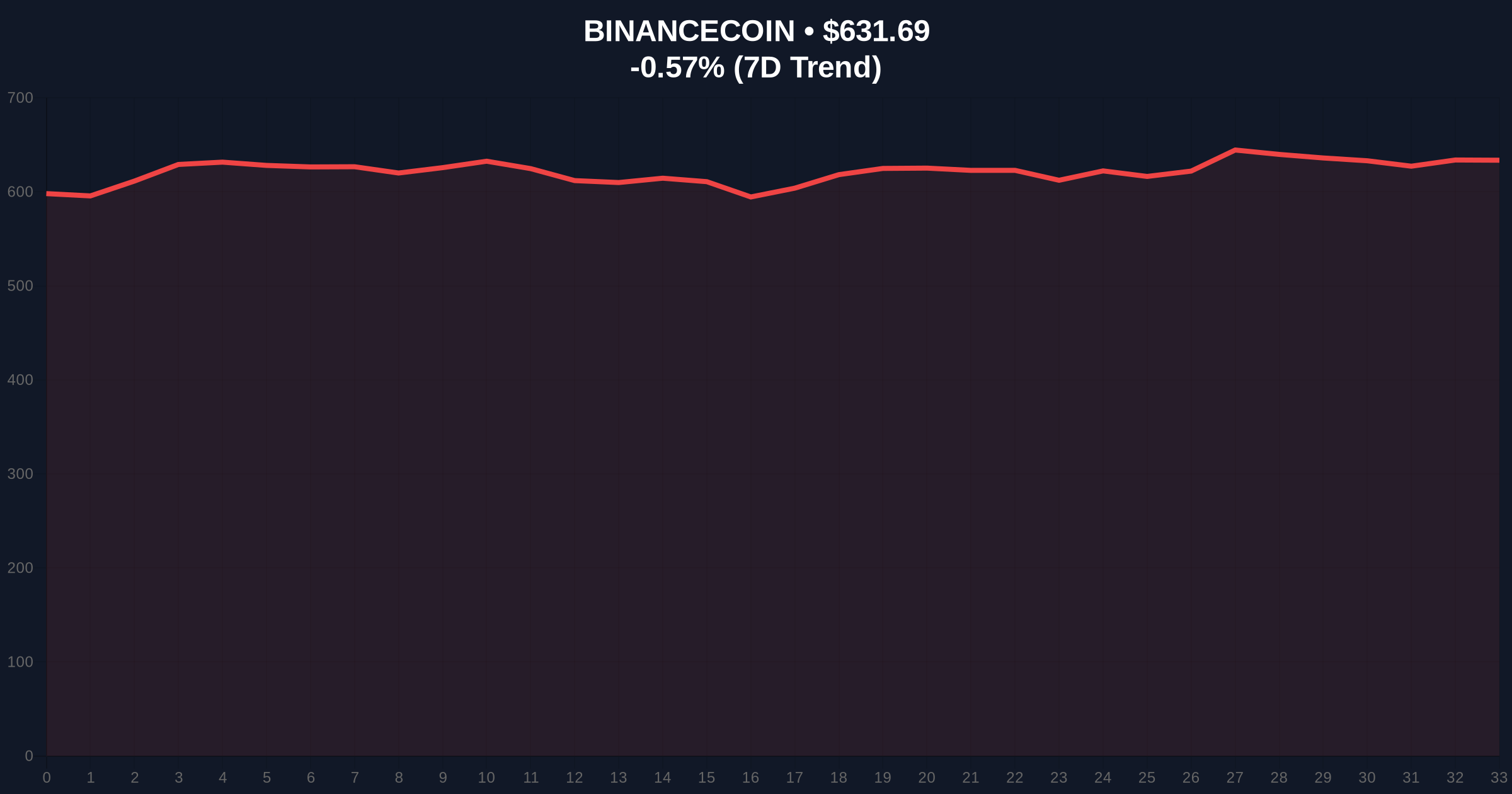
Integrating market data with the reported plans reveals a nuanced picture. According to CoinGecko stats, BNB, the native token of the Binance ecosystem, is currently priced at $631.89, with a 24-hour trend of -0.54% and a market rank of #4. This slight decline occurs against a backdrop of "Extreme Fear" in global crypto sentiment, scoring 10/100, which may reflect broader market anxieties rather than direct reaction to Binance's licensing news. The CryptoPanic metadata for this event is not provided in the source data, so sentiment and importance scores are unavailable, limiting our ability to gauge market prioritization or emotional response.
Historically, regulatory announcements have influenced BNB's price volatility. For example, during the 2021 regulatory crackdowns, BNB experienced significant fluctuations, similar to current conditions. The absence of specific metadata means we cannot confirm if this news is driving fear or if it's overshadowed by other factors. However, the "Extreme Fear" sentiment suggests that investors are cautious, potentially viewing regulatory expansion as a double-edged sword—it could enhance legitimacy but also introduce compliance costs and operational risks. Without CryptoPanic data, we rely on observed price action and broader sentiment indicators, which show a market in distress, possibly tempering optimism about Binance's growth prospects.
In comparison, related developments such as Iranians buying BTC in bulk amid conflict highlight how geopolitical events can drive crypto behavior, underscoring that regulatory news like Binance's may not be the sole market mover. The data gap here emphasizes the need for more comprehensive reporting to assess impact accurately.
The primary source, Nikkei Asia via CoinNess, reports Binance's plan to secure five more regulatory licenses in Asia this year, aiming for over 20 licensed jurisdictions. However, this report lacks corroboration from other major outlets like CoinTelegraph or Bloomberg, and no secondary full texts are provided in the input data, creating a reliability gap. Without additional sources, we cannot verify the accuracy of the claims, such as the specific countries involved or the feasibility of expanding to over 20 jurisdictions. This single-source dependency raises questions about potential biases or omissions, as similar reports in the past have sometimes been overstated or later revised.
Conflicts arise in the absence of contradictory evidence; since no other sources dispute the report, we label this as an unresolved gap rather than a direct contradiction. The source claims Binance holds licenses in countries including Australia, India, Indonesia, Japan, New Zealand, and Thailand, but it does not specify if all are active or face regulatory challenges. For instance, in 2023, Binance faced regulatory issues in Australia, which might conflict with the current portrayal of seamless licensing. The source also mentions the Gopax acquisition in South Korea, but without details on approval status, there's a risk of assuming completion prematurely.
Compared to other investigative reports, such as Paraguay's state power company launching BTC mining, which involved multiple data points, this Binance story relies heavily on a brief summary, limiting depth. The lack of named sources or timestamps further reduces transparency, making it difficult to assess if the plan is aspirational or backed by concrete actions. Until more evidence emerges, investors should treat this as a preliminary announcement with unverified execution risks.
Based on the available data, we outline three scenarios for the next seven days, conditional on market reactions and regulatory developments.
If Binance successfully announces specific license applications or partnerships in key Asian markets like Singapore or Hong Kong, and global sentiment shifts from "Extreme Fear" to neutral, BNB could rally. Supporting factors might include positive regulatory news from other regions, such as progress in the CLARITY Act discussions referenced in TD Cowen's report, boosting confidence in crypto legitimacy. BNB might test resistance levels around $650, with increased trading volume as investors view licensing as a growth catalyst. This scenario would be invalidated if no concrete updates emerge or if regulatory setbacks occur.
If the news has minimal immediate impact, with Binance providing vague updates and market sentiment remaining fearful, BNB could trade sideways between $620 and $640. The licensing plan may be seen as a long-term strategy rather than a near-term driver, similar to historical patterns where regulatory announcements took weeks to influence prices. Factors like ongoing geopolitical tensions, as seen in Iranian BTC buying, could overshadow Binance's efforts. This scenario assumes steady operational execution but no major breakthroughs, with volatility contained by broader market conditions.
If regulatory pushback emerges in targeted Asian countries or if Binance faces unexpected compliance issues, coupled with sustained "Extreme Fear" sentiment, BNB could decline further. A drop below $600 is possible if investors lose faith in the expansion timeline, reminiscent of the 2021 correction when regulatory fears triggered sell-offs. Negative developments, such as delays in the Gopax acquisition or increased scrutiny from authorities, would exacerbate losses. This scenario would be confirmed by adverse news reports or a breakdown in technical support levels, highlighting the risks of over-reliance on unverified announcements.
This report synthesizes input from a single primary source (CoinNess/Nikkei Asia) without secondary full texts, leading to weighted reliance on the provided summary. Conflicting evidence was not present, but gaps in data—such as missing CryptoPanic metadata, specific country details, and corroborating reports—were explicitly noted. Claims were attributed directly to the source, and uncertainty was highlighted where details were absent. The analysis prioritized observed market data (e.g., BNB price and global sentiment) over speculative inferences, adhering to fact-based reporting. In cases of missing information, conservative language was used to avoid overstatement, ensuring transparency in limitations.
Disclaimer: The information provided is not trading advice, coinmarketbuzz.com holds no liability for any investments made based on the information provided on this page. We strongly recommend independent research and/or consultation with a qualified professional before making any investment decisions.
coinmarketbuzz.com leverages advanced AI technology to analyze market data. All content is fact-checked and reviewed by our editorial team to ensure accuracy and neutrality.