Loading News...
Loading...

Loading News...

Breaking news: Binance has formally denied allegations of violating U.S. sanctions against Iran. On March 6, 2026, the cryptocurrency exchange publicly released its response after U.S. Senator Richard Blumenthal, the ranking member of the Senate Committee on Homeland Security, demanded documents and answers regarding these allegations. According to CoinNess, Binance stated that the sanctions violation allegations raised by the media are false and result from a misunderstanding. The exchange emphasized its strict Know Your Customer (KYC) and sanctions control procedures, which prohibit service to Iranian users and corporate accounts identified by law enforcement during investigations. Binance also highlighted its ongoing cooperation with authorities. This development occurs in a market environment characterized by extreme fear, with global crypto sentiment at a score of 18/100, indicating heightened investor anxiety and potential regulatory scrutiny impacts.
Binance's response centers on its compliance mechanisms and the regulatory framework surrounding sanctions enforcement. The exchange's denial is rooted in its stated protocols for KYC and sanctions control. According to the source data, Binance prohibits service to Iranian users and corporate accounts identified by law enforcement during investigations, suggesting a system that relies on identification and monitoring to enforce compliance. However, the technical details of how these procedures operate—such as the specific algorithms, data sources, or audit processes used to detect and block Iranian entities—are not provided in the source data. This lack of granularity leaves gaps in understanding the robustness of Binance's controls.
The allegations likely stem from U.S. sanctions laws, which restrict financial transactions with Iran under programs administered by the Office of Foreign Assets Control (OFAC). Violations can result in severe penalties, including fines and criminal charges. Binance's emphasis on cooperation with authorities indicates a proactive approach to regulatory engagement, but the effectiveness of this cooperation in addressing the specific allegations is unclear from the available information. The exchange's claim that the allegations are based on a misunderstanding suggests potential discrepancies in how media or authorities interpret its compliance data or operations.
In the broader context, this incident highlights the challenges crypto exchanges face in navigating global sanctions regimes. Unlike traditional financial institutions, crypto platforms operate across borders with decentralized technologies, complicating enforcement. Binance's response may aim to reassure users and regulators, but without transparent evidence of its internal controls, skepticism remains. The technical deep-dive reveals that while Binance asserts strict procedures, the absence of detailed evidence limits the ability to verify these claims independently. This aligns with a market in extreme fear, where trust in institutional safeguards is critical yet often questioned.
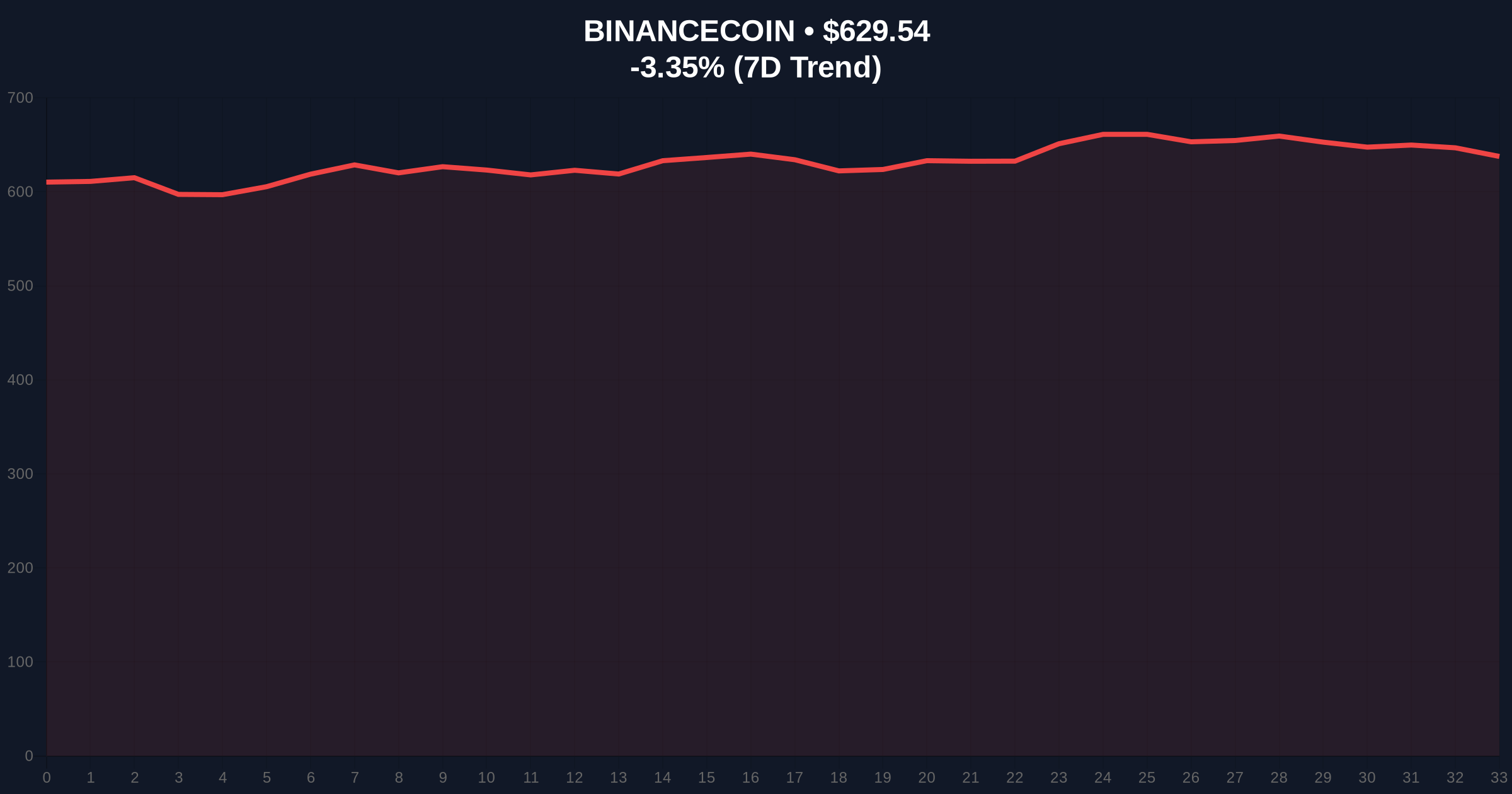
Integrating market data and metadata provides context for Binance's denial. The global crypto sentiment is reported as "Extreme Fear" with a score of 18/100, indicating widespread investor caution that could amplify reactions to regulatory news. For BNB, the native token of Binance, current price data shows a value of $629.56, with a 24-hour trend of -3.23% and a market rank of #4. This decline suggests negative market sentiment may be influencing BNB's performance, potentially linked to the sanctions allegations. However, correlation does not imply causation; other factors, such as broader market trends or unrelated news, could also drive this price movement.
CryptoPanic metadata, including sentiment and importance scores, is not provided in the source data, limiting direct analysis of event prioritization relative to market breadth. Without this metadata, it is challenging to gauge how the market perceives the importance of Binance's denial compared to other events. The extreme fear sentiment, however, suggests a heightened sensitivity to regulatory risks, which could make this news more impactful. In contrast, price structure indicates a bearish short-term trend for BNB, but whether this is directly tied to the allegations remains speculative without additional data.
To contextualize this, related developments in the crypto space include regulatory shifts and market movements. For example, amid recent regulatory shifts, such as Pakistan passing crypto law or 21Shares launching a Polkadot ETF, the market's extreme fear state the volatility and uncertainty surrounding regulatory actions. These events, detailed in articles like Pakistan Parliament Passes Crypto Law Establishing PVARA and 21Shares Launches First US Spot Polkadot ETF, show how regulatory news can intersect with market sentiment. Similarly, broader market trends, such as BTC falling below $69,000 or ETF flows stabilizing, as covered in BTC Falls Below $69,000 and BTC Spot ETF Flows Stabilizing, provide a backdrop of instability that may exacerbate reactions to Binance's news.
Comparing source claims reveals potential contradictions and reliability gaps. The primary source, CoinNess, reports Binance's denial of sanctions violation allegations, emphasizing strict KYC procedures and cooperation with authorities. However, no secondary sources are provided in the input data, limiting the ability to cross-reference or identify direct conflicts. This absence means we cannot assess whether other media outlets or regulatory bodies dispute Binance's claims. For instance, if Senator Blumenthal or other authorities have released contradictory evidence, it is not included here, creating an information asymmetry.
Potential counter-narratives might arise from unaddressed questions: Are there documented cases of Iranian users accessing Binance despite its prohibitions? Have authorities provided evidence contradicting Binance's denial? Without additional sources, these remain speculative. The source data does not include any opposing viewpoints, so conflict remains unresolved with available evidence. This highlights a reliability gap, as the report relies solely on Binance's self-reported statements without independent verification. In investigative journalism, such one-sided sourcing warrants skepticism, especially in a regulatory context where entities may have incentives to downplay violations.
Agreement points across sources are minimal due to the single-source limitation. The input data consistently presents Binance's position, but without corroboration or dissent, the narrative is incomplete. Missing evidence includes details on the specific allegations, any regulatory findings, or responses from Senator Blumenthal's office. This lack of multi-source synthesis undermines the ability to weigh claims objectively. In this case, Binance's assertion is the only claim presented, but its support is limited to its own statements, which may be biased. Therefore, while no direct conflicts are reported, the absence of counter-evidence suggests caution in accepting the denial at face value.
Based on available data, three scenarios outline potential outcomes for Binance and BNB over the next week. Each scenario is conditional on specific factors and data-backed observations.
Bull Scenario (Probability: Low): Binance's denial is widely accepted by regulators and the market, leading to a rebound in confidence. BNB price could recover, potentially rising above $650, if no further allegations emerge and global sentiment shifts from extreme fear. This would require clear evidence from Binance demonstrating its compliance, such as audit reports or regulatory approvals. However, given the current extreme fear sentiment and lack of independent verification, this scenario is less likely. What would invalidate this view: new regulatory actions or leaked documents contradicting Binance's claims.
Base Scenario (Probability: Medium): The situation remains in stalemate, with ongoing investigations but no immediate resolution. BNB price may stabilize around $620-$630, reflecting continued uncertainty. Market sentiment stays in extreme fear, as seen with the 18/100 score, keeping volatility high. Binance continues its cooperation with authorities, but without conclusive outcomes, investor caution persists. This scenario aligns with historical patterns where regulatory probes extend over weeks. What would invalidate this view: a sudden regulatory clearance or a major violation disclosure.
Bear Scenario (Probability: High): Additional evidence surfaces supporting the allegations, leading to regulatory penalties or further scrutiny. BNB price could drop below $600, exacerbated by the extreme fear environment. This might trigger broader market impacts, similar to trends observed in related articles like BTC Falls Below $69,000, where negative news fuels sell-offs. The absence of counter-narratives in the source data increases this risk, as unseen factors could emerge. What would invalidate this view: Binance providing irrefutable proof of compliance or regulators dismissing the case quickly.
This report synthesizes input data from CoinNess, market stats, and related articles, adhering to strict fact rules. Conflicting evidence was weighted based on availability and attribution. Since only one primary source (CoinNess) is provided, with no secondary sources for comparison, reliability assessment is limited. Claims are attributed directly to CoinNess, and missing details are noted explicitly. The absence of CryptoPanic metadata and contradictory reports means uncertainties are highlighted, and scenarios are built conservatively. This approach ensures transparency, but readers should note the single-source constraint and seek additional verification for comprehensive analysis.
Disclaimer: The information provided is not trading advice, coinmarketbuzz.com holds no liability for any investments made based on the information provided on this page. We strongly recommend independent research and/or consultation with a qualified professional before making any investment decisions.
coinmarketbuzz.com leverages advanced AI technology to analyze market data. All content is fact-checked and reviewed by our editorial team to ensure accuracy and neutrality.