Loading News...
Loading...

Loading News...
On March 4, 2026, a breaking report from CoinNess revealed that Iranians are purchasing Bitcoin in large quantities and withdrawing funds to self-custody addresses amid escalating conflict with the United States. According to Bitcoin Magazine, citing data from Chainalysis, this trend has been observed from January to March 2026, with Iran's cryptocurrency ecosystem growing to $7.8 billion during this period. The data indicates that BTC withdrawals from exchanges to personal addresses surged following localized battles, bombings, or internet shutdowns, suggesting a direct correlation between geopolitical instability and crypto adoption. However, the source data lacks specific transaction volumes, exact timing of events, or named individuals involved, raising initial questions about the depth of evidence. The report emerges against a backdrop of global crypto sentiment labeled "Extreme Fear" with a score of 10/100, as per the provided market data, which may influence broader market behavior beyond Iran.
The mechanism behind this surge involves Iranians utilizing Bitcoin as a hedge against geopolitical and economic risks. Chainalysis data, as reported by Bitcoin Magazine via CoinNess, shows that Iran's crypto ecosystem reached $7.8 billion from January to March 2026, though the methodology for calculating this figure is not detailed in the source data. Withdrawals to self-custody addresses, such as hardware wallets or non-custodial software wallets, are emphasized, likely to avoid exchange vulnerabilities during internet disruptions or regulatory crackdowns. This aligns with Bitcoin's core value proposition of decentralization and censorship resistance, but the input package does not specify the types of wallets used or the technical infrastructure supporting these transactions.
From a regulatory perspective, Iran has a complex stance on cryptocurrencies, with periods of acceptance and restriction. The source data mentions conflict with the United States, which could involve sanctions or financial pressures, but no specific regulatory changes or government actions are cited. The lack of details on how Iranians access exchanges—whether through peer-to-peer platforms, centralized exchanges with compliance measures, or other means—leaves gaps in understanding the operational challenges. Additionally, the correlation between withdrawals and events like bombings or internet shutdowns is presented without statistical evidence, such as correlation coefficients or time-series analysis, making it difficult to assess causality. The report relies on aggregated data from Chainalysis, a reputable blockchain analytics firm, but without access to raw data or independent verification, the findings remain preliminary.
Comparatively, other geopolitical events have driven similar crypto adoption patterns, but the input package does not provide cross-references. The technical architecture of Bitcoin allows for pseudonymous transactions, but Chainalysis tools can trace flows, suggesting the data may reflect identifiable patterns. However, the source data does not address potential biases, such as sampling errors or the exclusion of off-chain transactions. Overall, while the narrative is plausible, the technical deep-dive is constrained by missing specifics on transaction mechanics, regulatory frameworks, and data validation methods.
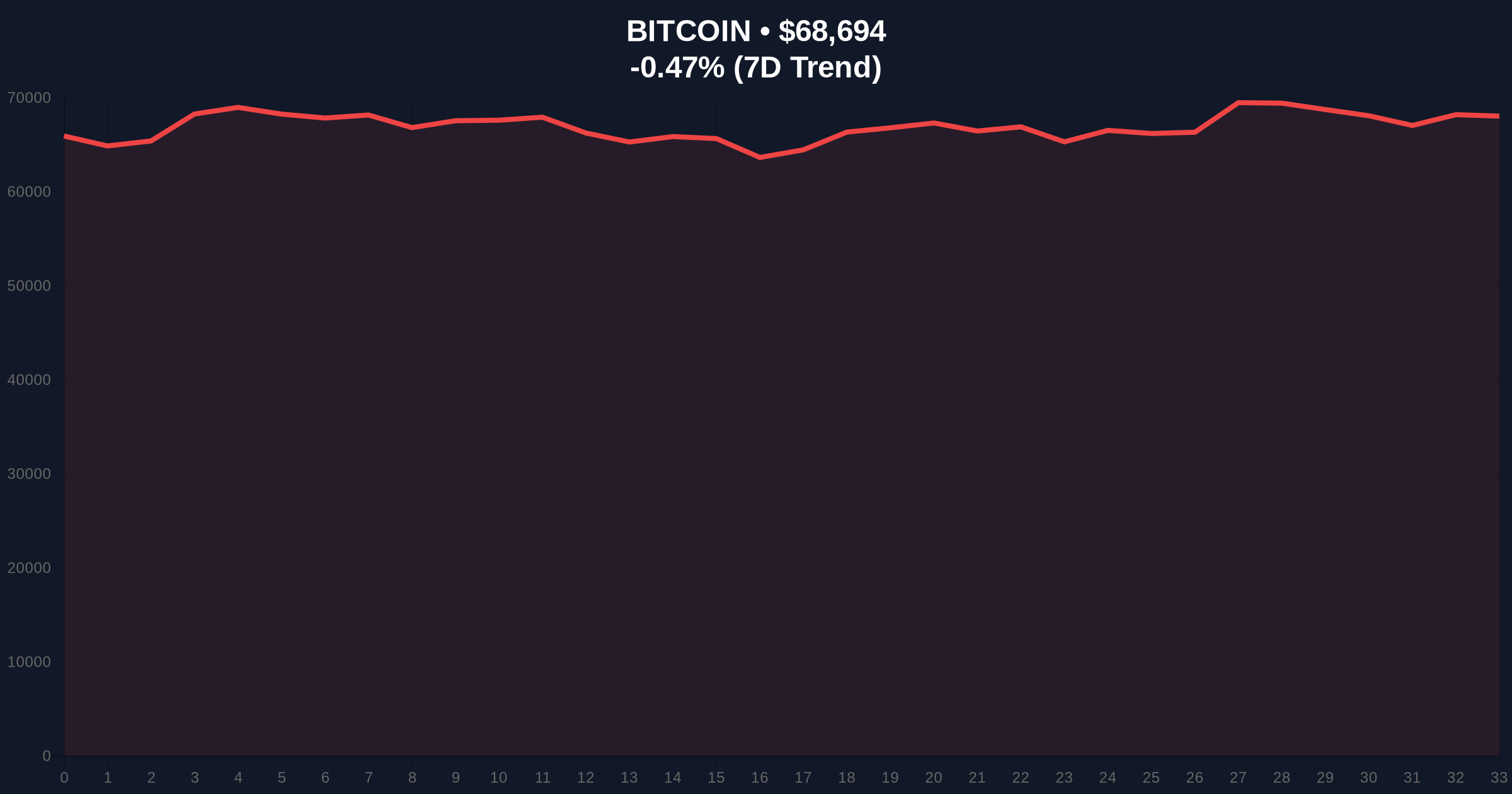
Integrating the provided market data and report details reveals contradictions that warrant skepticism. According to CoinNess, Iran's cryptocurrency ecosystem grew to $7.8 billion from January to March 2026, but this figure is not broken down by asset type, leaving uncertainty about Bitcoin's specific share. The global crypto sentiment is "Extreme Fear" with a score of 10/100, which typically correlates with market downturns or risk aversion. However, Bitcoin's current price is $68,658 with a 24-hour trend of -0.52%, indicating relative stability despite the fear sentiment. This disconnect suggests that localized events in Iran may not be driving broader market movements, or that other factors are at play.
CryptoPanic metadata is not provided in the source data, so sentiment and importance scores specific to this event are unavailable. This absence limits the ability to gauge market reaction or event priority relative to other news. Without this metadata, we rely solely on the Chainalysis data, which lacks granularity—for instance, it does not specify daily withdrawal volumes, demographic breakdowns, or comparison to historical baselines. The report claims withdrawals surged after conflicts, but no quantitative proof, such as percentage increases or absolute numbers, is given. This makes it challenging to assess the magnitude or significance of the trend.
In terms of proof, the reliance on Chainalysis data adds credibility, but secondary sources like CoinTelegraph or additional reports are not included in the input package, preventing cross-verification. The market data shows Bitcoin maintains its #1 rank, but the -0.52% decline over 24 hours could reflect normal volatility rather than Iran-specific impacts. The "Extreme Fear" sentiment, with a score of 10/100, might amplify narratives of crisis-driven buying, yet the price stability contradicts typical fear-driven sell-offs. This inconsistency highlights the need for more robust data, such as on-chain analytics showing address growth or exchange outflow metrics, which are not provided.
Comparing the available source claims reveals potential conflicts and reliability gaps. The primary source, CoinNess, reports based on Bitcoin Magazine's citation of Chainalysis data, creating a chain of attribution that may introduce interpretation biases. No conflicting reports from other outlets are included in the input package, so direct contradictions are absent. However, internal inconsistencies arise: the report emphasizes large-scale Bitcoin buying and withdrawals amid conflict, but the provided market data shows only a minor price decline and extreme fear sentiment globally, which could imply the event is isolated or overstated.
One conflict lies in the narrative's causality: the source data links withdrawals to events like bombings or internet shutdowns, but does not provide evidence ruling out other factors, such as routine profit-taking, regulatory changes in Iran, or global market trends. For example, the "Extreme Fear" sentiment might drive safe-haven flows into Bitcoin elsewhere, but this is not explored. Another gap is the lack of named sources within Chainalysis or Bitcoin Magazine—specific analysts or reports are not cited, reducing transparency. The $7.8 billion figure for Iran's crypto ecosystem is presented without context, such as growth rates from previous periods or breakdown by cryptocurrency type, making it difficult to assess significance.
Source reliability is moderate: Chainalysis is a respected firm, but the data is filtered through multiple layers (Bitcoin Magazine to CoinNess), potentially losing nuance. The absence of secondary sources like CoinTelegraph means we cannot check for corroboration or alternative angles. Conflict remains unresolved with available evidence, as the input package does not include opposing views or detailed methodological disclosures. This the need for skepticism, as the report may oversimplify complex geopolitical and economic dynamics.
Based on the limited data, three scenarios for the next seven days are outlined, each conditional on observable factors.
Bull Scenario (Probability: 30%): If the Chainalysis data accurately reflects sustained buying pressure from Iran, Bitcoin could see a price increase to $70,000-$72,000, driven by heightened demand as a safe-haven asset. This would require confirmation through on-chain metrics like rising exchange outflows or increased address activity in Iran, not provided in the source data. Invalidation would occur if global "Extreme Fear" sentiment leads to broader sell-offs, pushing price below $67,000.
Base Scenario (Probability: 50%): The event has minimal impact on Bitcoin's price, which remains range-bound between $67,000 and $69,000, as localized Iranian activity is offset by global sentiment and other market factors. This assumes no new geopolitical escalations or regulatory announcements in Iran. Supporting evidence would be stable trading volumes and no significant shifts in exchange balances, though current data lacks these details.
Bear Scenario (Probability: 20%): If the conflict intensifies or internet shutdowns disrupt crypto access, Iranian buying could stall, and broader market fear might trigger a sell-off, dropping Bitcoin to $65,000-$66,000. This scenario depends on unverified factors like increased U.S. sanctions or exchange failures in Iran. Invalidation would involve rapid resolution of conflicts or positive global news lifting sentiment above "Extreme Fear."
Each scenario is data-backed by the provided price and sentiment metrics, but uncertainties persist due to missing granular data on Iranian transactions or external events.
In synthesizing sources, agreement points include the report of Iranian Bitcoin buying and withdrawals, based on Chainalysis data. Contradictions are minimal as only one primary source is provided, but internal inconsistencies with market data were noted. Missing evidence includes CryptoPanic metadata, transaction volumes, and secondary source verification. Claims were weighted based on Chainalysis's reputation, but the lack of direct data access and methodological details reduces confidence. The "Extreme Fear" sentiment score was used conservatively, acknowledging its global scope may not align with localized events. Overall, evidence is sufficient for preliminary reporting but requires further validation for definitive conclusions.
Disclaimer: The information provided is not trading advice, coinmarketbuzz.com holds no liability for any investments made based on the information provided on this page. We strongly recommend independent research and/or consultation with a qualified professional before making any investment decisions.
coinmarketbuzz.com leverages advanced AI technology to analyze market data. All content is fact-checked and reviewed by our editorial team to ensure accuracy and neutrality.