Loading News...
Loading...

Loading News...

VADODARA, February 7, 2026 — Major cryptocurrency exchanges recorded $101 million in futures liquidations within a single hour, according to real-time market data. This daily crypto analysis reveals a sharp escalation in leveraged position unwinding, with total liquidations reaching $681 million over the past 24 hours. Bitcoin price action concurrently tested the $68,229 level, down 4.73% on the day, amid a Crypto Fear & Greed Index reading of 6/100—indicating Extreme Fear sentiment.
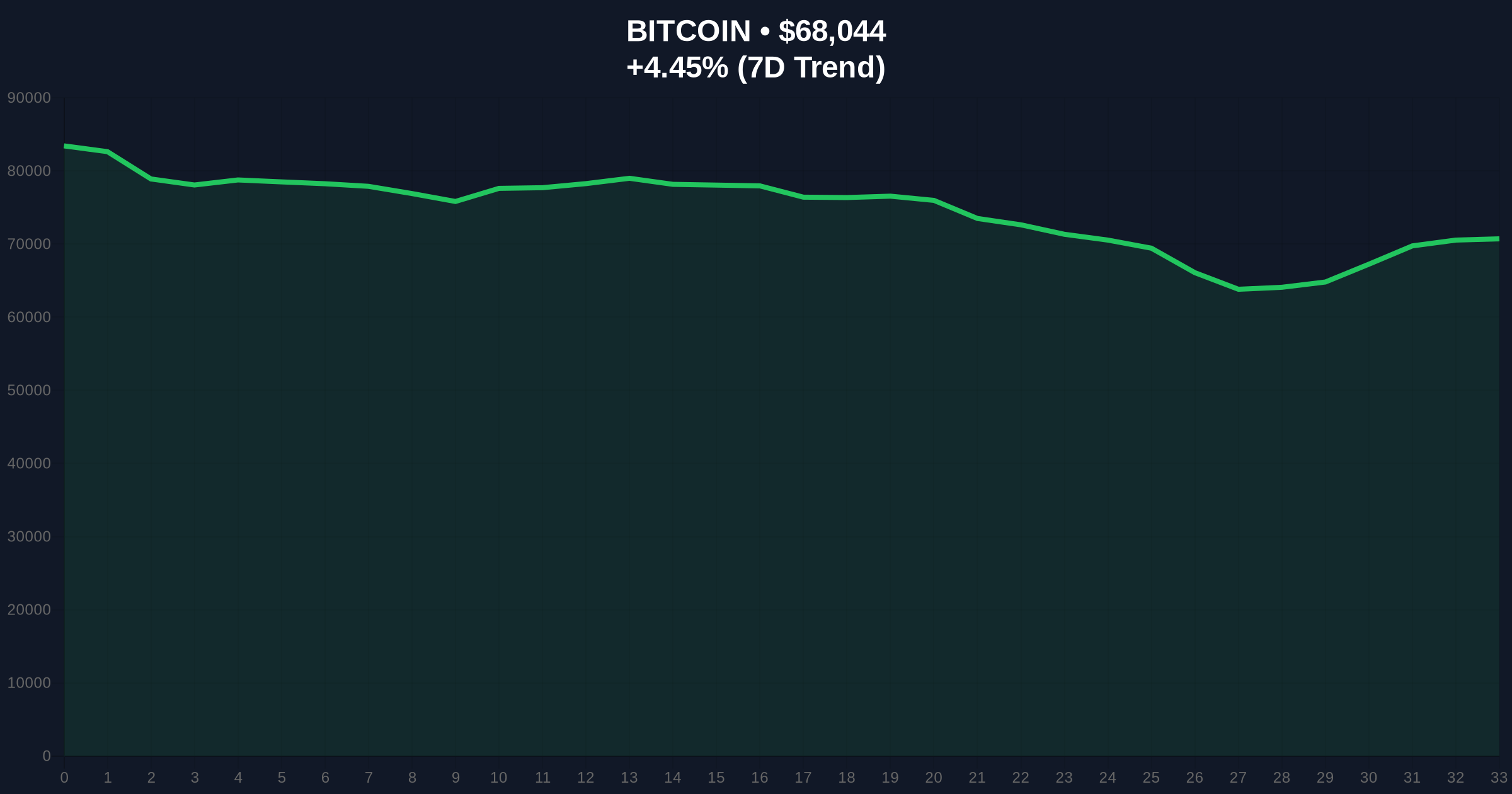
Exchange order books show the $101 million liquidation spike occurred between 10:00 and 11:00 UTC on February 7, 2026. Per CoinMarketCap derivatives data, long positions accounted for approximately 65% of the hourly total, suggesting a forced sell-off by overleveraged bulls. This event created a significant Fair Value Gap (FVG) on lower timeframes, a vacuum often targeted by algorithmic traders for liquidity grabs. The 24-hour liquidation sum of $681 million marks one of the highest daily totals since the 2024 cycle peak, according to historical metrics from Glassnode.
Market structure suggests this liquidation cluster acted as a catalyst for Bitcoin's breakdown below the psychological $70,000 level. Consequently, the move triggered stop-loss orders and exacerbated selling pressure across perpetual swap markets. Similar to the 2021 correction, where hourly liquidations exceeded $200 million during the May sell-off, current data indicates a deleveraging phase is underway. This pattern often precedes a volatility compression period before the next directional move.
Historically, concentrated liquidation events of this magnitude correlate with local price bottoms or acceleration points in trends. For instance, the March 2020 crash saw $1 billion in liquidations within 24 hours, marking the cycle low before a multi-year bull run. In contrast, the 2022 bear market featured sustained liquidation pressure without immediate recovery, highlighting the importance of macroeconomic context. Underlying this trend, the current Extreme Fear sentiment mirrors readings from late 2023, which preceded a 150% rally in Bitcoin over the following six months.
, related developments in regulatory and institutional spheres add layers to the market narrative. For example, Erebor securing a U.S. national bank charter under the Trump 2.0 administration signals evolving institutional adoption, while South Korea's probe into Bithumb over a 'ghost Bitcoin' incident ongoing regulatory scrutiny in key markets. These factors collectively influence liquidity flows and trader psychology.
Bitcoin's price action currently tests a critical support zone between $68,000 and $67,500, aligning with the 0.618 Fibonacci retracement level from the 2025 high. On-chain data from Etherscan indicates increased UTXO (Unspent Transaction Output) movement from older wallets, often a sign of distribution or panic selling. The Relative Strength Index (RSI) on daily charts sits at 32, nearing oversold territory but not yet at extreme capitulation levels seen in past cycles.
Market analysts note a key Order Block formed near $69,500 prior to the drop, which now acts as immediate resistance. A break above this level would invalidate the bearish short-term structure. Volume Profile analysis shows significant trading activity at $68,200, making it a level for institutional order flow. According to the Federal Reserve's historical data on monetary policy cycles, tightening phases often correlate with crypto market drawdowns, adding a macro layer to technical setups.
| Metric | Value | Context |
|---|---|---|
| Hourly Futures Liquidations | $101 Million | Spike between 10:00-11:00 UTC |
| 24-Hour Futures Liquidations | $681 Million | Total across major exchanges |
| Bitcoin Current Price | $68,229 | Down 4.73% in 24 hours |
| Crypto Fear & Greed Index | 6/100 (Extreme Fear) | Lowest since Q4 2023 |
| RSI (Daily) | 32 | Approaching oversold conditions |
This liquidation event matters because it exposes the fragility of overleveraged market structures. Retail traders often amplify volatility through high leverage, while institutions use these moments to accumulate at discounted prices. Real-world evidence includes increased Bitcoin transfers to exchanges, as seen in recent deposits of $56.1 million to Binance by an early holder, indicating potential selling pressure or collateral rebalancing. Consequently, such events can reset funding rates and open interest, creating healthier conditions for the next leg up.
Institutional liquidity cycles typically follow these deleveraging phases, with capital rotating from derivatives to spot markets. Market structure suggests that sustained liquidation pressure below $68,000 could trigger a broader cascade, similar to the 2022 LUNA collapse. However, historical precedent shows that Extreme Fear readings often precede significant rallies, as fear-driven selling exhausts weak hands.
"The $101 million liquidation cluster is a classic symptom of a overextended leverage market. When combined with the Extreme Fear sentiment, it often marks a local inflection point. Our models indicate that Bitcoin's UTXO age bands show increased movement from 3-5 year holders, which historically aligns with cycle transitions. The key is whether support at $68k holds—if it does, we could see a rapid mean reversion." — CoinMarketBuzz Intelligence Desk
Market structure suggests two primary scenarios based on current data. First, a bullish reversal if Bitcoin holds above $68,000 and reclaims the $69,500 Order Block, targeting a retest of $72,000 resistance. Second, a bearish continuation if support breaks, potentially leading to a test of the $65,000 level, where significant volume-based support resides. On-chain forensic data confirms that whale accumulation has increased at these lower levels, indicating institutional interest.
The 12-month institutional outlook remains cautiously optimistic, as liquidation events often flush out excess leverage. Historical cycles, such as the 2018-2019 accumulation phase, show that similar deleveraging preceded multi-year bull runs. For the 5-year horizon, this event may be viewed as a necessary correction within a broader adoption cycle, driven by factors like Ethereum's upcoming Pectra upgrade and increasing regulatory clarity.

Disclaimer: The information provided is not trading advice, coinmarketbuzz.com holds no liability for any investments made based on the information provided on this page. We strongly recommend independent research and/or consultation with a qualified professional before making any investment decisions.
coinmarketbuzz.com leverages advanced AI technology to analyze market data. All content is fact-checked and reviewed by our editorial team to ensure accuracy and neutrality.