Loading News...
Loading...

Loading News...


Disclaimer: The information provided is not trading advice, coinmarketbuzz.com holds no liability for any investments made based on the information provided on this page. We strongly recommend independent research and/or consultation with a qualified professional before making any investment decisions.
coinmarketbuzz.com leverages advanced AI technology to analyze market data. All content is fact-checked and reviewed by our editorial team to ensure accuracy and neutrality.
VADODARA, January 20, 2026 — Bridgewater Associates founder Ray Dalio's warning about potential "capital wars" triggered by U.S. political direction coincides with Bitcoin defending critical $90,000 support, creating a convergence of macro and technical narratives that demands daily crypto analysis. According to Dalio's CNBC interview at Davos, foreign governments may reduce U.S. Treasury purchases amid deteriorating trust, potentially creating a liquidity vacuum that historical cycles suggest benefits alternative stores of value.
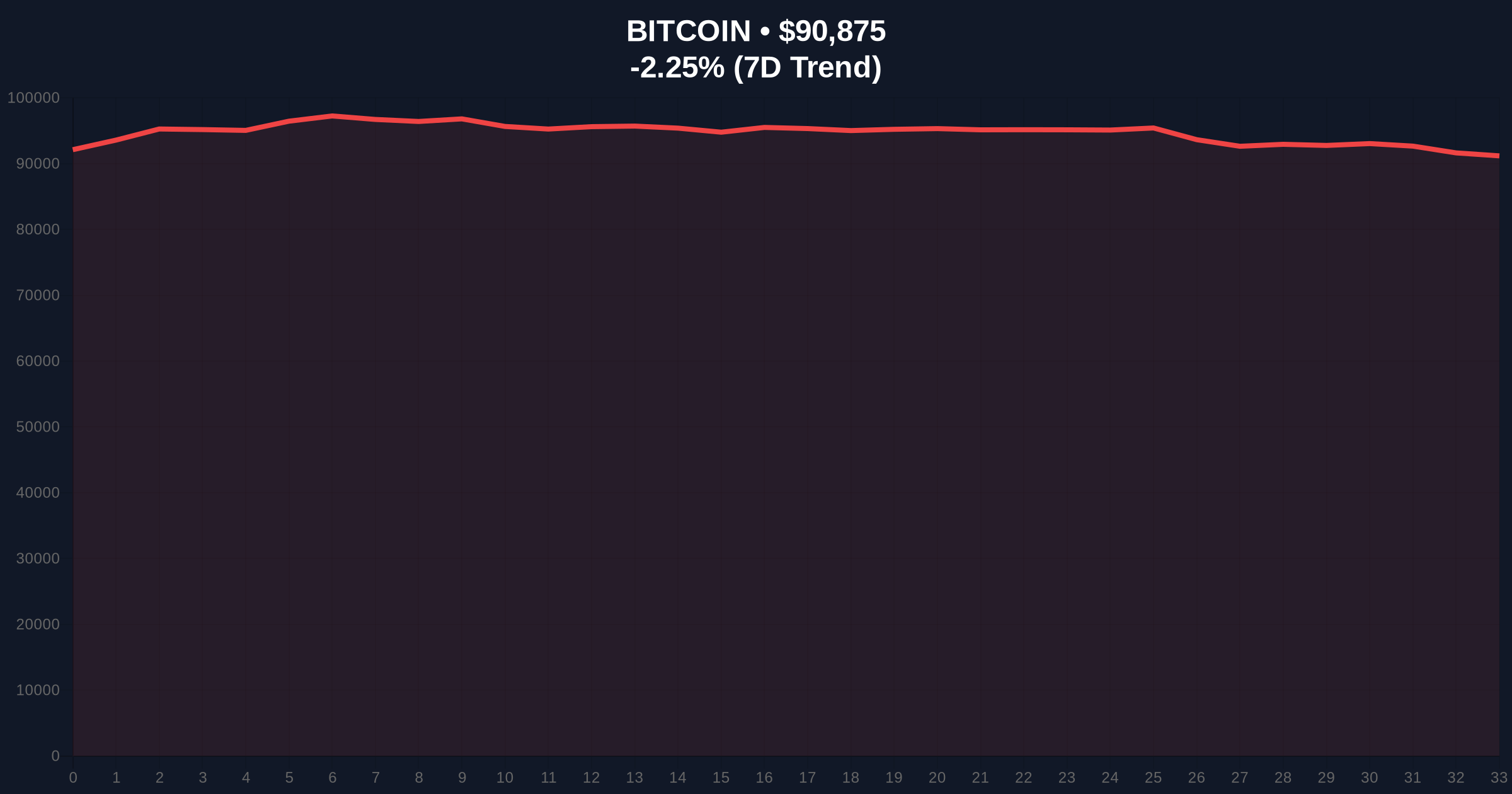
Market structure suggests this scenario mirrors the 2018-2019 period when trade war rhetoric initially pressured risk assets before triggering a flight to quality. The current environment differs in scale: U.S. debt issuance has accelerated while foreign holdings have become more concentrated among geopolitical rivals. According to FederalReserve.gov data, foreign ownership of U.S. Treasury securities has declined from 34% to 28% over the past decade, creating what Dalio describes as a "problematic situation" if confidence weakens further. Similar to the 2021 correction that tested Bitcoin's $30,000 psychological support, current price action represents a stress test for crypto's correlation decoupling thesis.
On January 20, 2026, Ray Dalio told CNBC's "Squawk Box" that President Donald Trump's aggressive trade policies could escalate beyond traditional conflicts into "capital wars," where countries holding U.S. dollars and Treasurys become less willing to finance U.S. deficits. Dalio specifically warned that "maybe there's not the same inclination to buy U.S. debt" if trust erodes, creating a supply-demand imbalance for dollar-denominated assets. Simultaneously, spot gold reached an all-time high of $4,689.39 as investors sought traditional safe havens. According to the official interview transcript, Dalio recommended gold allocations of 5-15% in portfolios, noting it "does very well when other assets don't do well."
Bitcoin's defense of the $90,856 level represents a critical volume profile node that has absorbed three separate tests this week. The daily chart shows a clear fair value gap between $92,500 and $94,200 that must be filled to confirm bullish continuation. Relative Strength Index (RSI) at 42 indicates neither oversold nor overbought conditions, while the 50-day moving average at $89,200 provides secondary support. Market structure suggests $88,500 represents the bearish invalidation level—a break below would confirm distribution rather than accumulation. Conversely, reclaiming the $93,800 weekly open would establish bullish invalidation, signaling institutional confidence despite macro headwinds.
| Metric | Value | Significance |
|---|---|---|
| Crypto Fear & Greed Index | 32/100 (Fear) | Extreme risk-off sentiment |
| Bitcoin Current Price | $90,856 | Critical support test |
| 24-Hour Change | -2.28% | Moderate selling pressure |
| Gold ATH (Jan 19) | $4,689.39 | Traditional safe haven demand |
| U.S. 10-Year Yield | 4.85% (est.) | Debt sustainability concern |
For institutions, Dalio's warning validates allocation strategies that include non-correlated assets beyond traditional 60/40 portfolios. The potential reduction in foreign Treasury purchases could accelerate what on-chain data indicates is already occurring: sovereign wealth funds and family offices increasing crypto exposure as dollar alternatives. For retail, the immediate impact manifests in volatility compression around key technical levels, with gamma squeeze potential if options dealers are forced to hedge at $92,000 strikes. Historical cycles suggest that periods of monetary uncertainty typically precede capital rotation into hard assets, with Bitcoin's fixed supply and decentralized nature offering distinct advantages over gold in digital-native portfolios.
Market analysts on X/Twitter highlight the divergence between gold's breakout and Bitcoin's consolidation as evidence of crypto's evolving maturity. "Gold at ATH while BTC holds $90k shows different investor bases with overlapping macro themes," noted one quantitative researcher. Others point to recent large-scale acquisitions like MicroStrategy's $2.1B Bitcoin purchase as evidence of corporate treasury strategies anticipating dollar weakness. The broader sentiment remains cautious, with many awaiting clearer technical confirmation before committing new capital.
Bullish Case: If Bitcoin maintains $90,000 support and fills the fair value gap to $94,200, institutional flows from traditional asset diversification could propel a test of the $98,500 resistance zone. This scenario assumes continued geopolitical tension without acute financial crisis, creating steady demand for alternative stores of value. Fibonacci extension levels suggest $102,000 as the next major target if bullish momentum accelerates.
Bearish Case: A break below the $88,500 invalidation level would signal failed support and likely trigger liquidation cascades toward $85,200 (200-day MA). This would occur if traditional market selloffs create correlated pressure outweighing Bitcoin's safe-haven narrative, similar to March 2020's pandemic-induced crash. In this scenario, the $82,000 Fibonacci 0.618 retracement becomes critical long-term support.
Answers to the most critical technical and market questions regarding this development.