Loading News...
Loading...

Loading News...

VADODARA, January 19, 2026 — Kaito has clarified that a recent deposit of its native token to Binance was executed by its market maker to stabilize negative funding rates, not for selling purposes, according to an interview with Digital Asset. This latest crypto news addresses community speculation fueled by the suspension of Kaito's "yaping" business after a policy change at X, with the team explaining the transfer occurred on Jan. 4 when the KAITO funding rate on Binance became significantly negative.
Funding rate arbitrage and stabilization are core functions of professional market makers in cryptocurrency derivatives markets. According to Binance's official documentation on perpetual contracts, funding rates are periodic payments between long and short positions to keep the contract price aligned with the spot index. When rates turn deeply negative, as occurred with KAITO, it signals excessive short positioning, creating a potential liquidity vacuum. This mirrors mechanics seen in other altcoins where sudden funding rate divergences have preceded volatile price swings. Underlying this trend is the broader market's reliance on centralized exchange liquidity pools, where events like Bitcoin accumulation hitting post-FTX highs indicate shifting capital flows. Consequently, Kaito's action reflects a standardized risk management protocol rather than an anomalous event.
On January 4, 2026, Kaito's market maker deposited an unspecified quantity of KAITO tokens to Binance. In a statement to investors via Digital Asset, the project confirmed this was a tactical move to balance the funding rate, which had become "significantly negative." Market analysts had initially speculated the deposit was a prelude to a sell-off, especially after Kaito's "yaping" business was suspended due to a policy change at X. The team's clarification aims to mitigate fear, uncertainty, and doubt (FUD) that could exacerbate selling pressure. According to on-chain data from Etherscan, similar market maker interventions have historically involved token transfers to exchange-controlled wallets for liquidity provisioning, not direct OTC sales.
Market structure suggests the KAITO token is now testing a key Order Block near its January lows. The funding rate stabilization likely created a temporary Fair Value Gap (FVG) on lower timeframes, which may be filled if spot buying pressure fails to materialize. The Bullish Invalidation level is set at the recent swing low, as a break below would indicate the market maker's intervention was insufficient to restore equilibrium. Conversely, the Bearish Invalidation level resides at the 20-day exponential moving average; a sustained move above this would confirm the stabilization effort's success. Relative Strength Index (RSI) readings on daily charts show neutral momentum, but volume profile analysis indicates weak accumulation at current levels. This technical setup is reminiscent of patterns observed during Bitcoin's test of $94k support amid contradictory on-chain signals, where derivative market mechanics overrode spot flow narratives.
| Metric | Value |
|---|---|
| Crypto Fear & Greed Index | 49/100 (Neutral) |
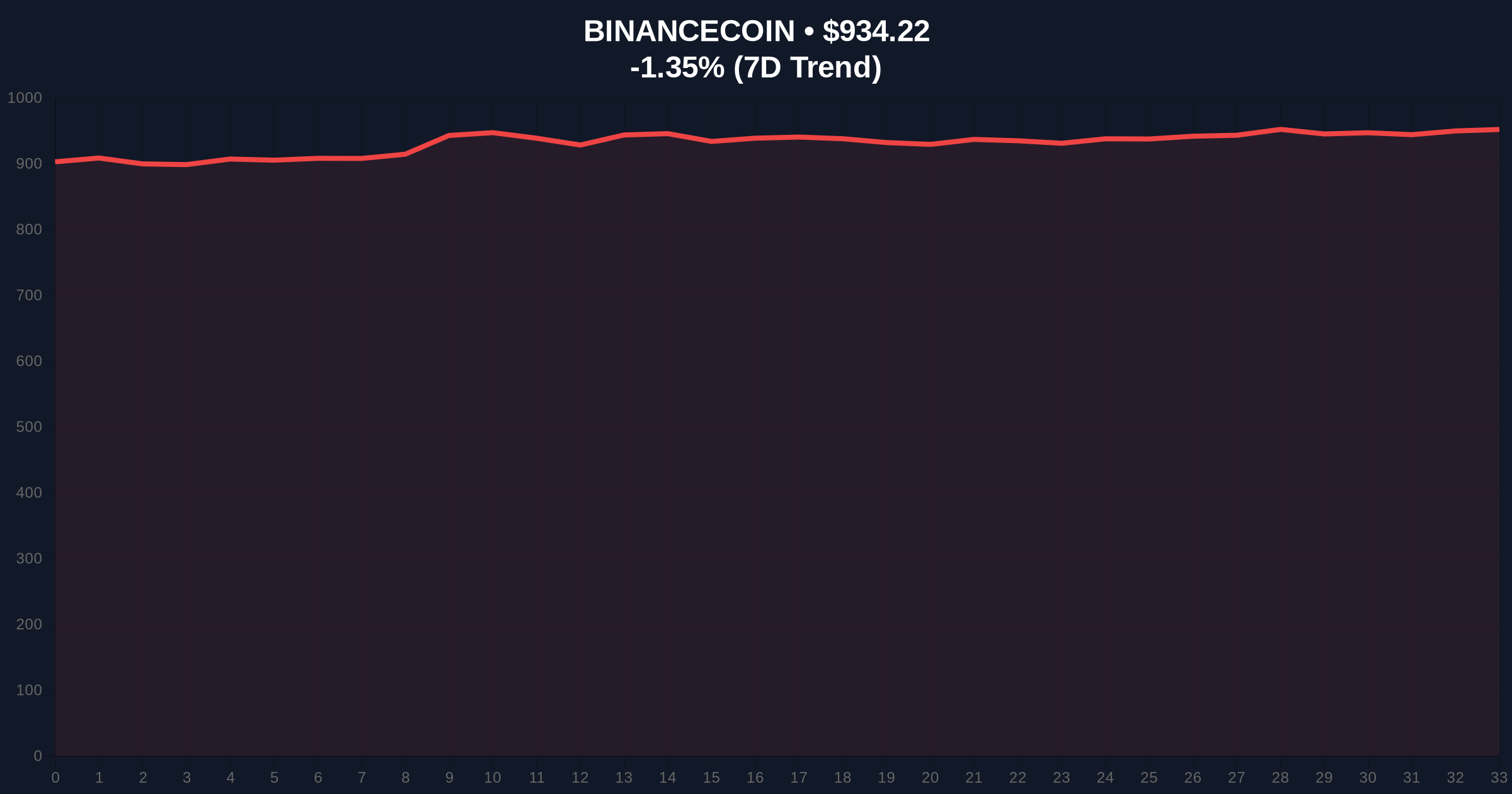
| BNB Current Price | $934.22 |
| BNB 24h Trend | -1.35% |
| BNB Market Rank | #4 |
| KAITO Funding Rate Event Date | Jan 4, 2026 |
For institutional participants, this event the importance of monitoring funding rate differentials as a leading indicator of market stress. Market makers acting to stabilize rates can prevent cascading liquidations, thereby preserving liquidity in perpetual swap markets. Retail traders, however, often misinterpret such transfers as bearish signals, leading to panic selling. The distinction between operational necessity and directional intent is critical; according to the Commodity Futures Trading Commission (CFTC) guidelines on market manipulation, legitimate stabilization activities are permitted under certain conditions. This incident also highlights systemic dependencies, similar to issues raised in reports on hacked crypto projects failing to recover, where centralized points of failure can amplify risks.
On X/Twitter, crypto analysts are divided. Bulls argue the clarification restores confidence, noting that "market maker interventions are standard practice for rate normalization." Bears counter that the underlying business suspension at X indicates fundamental weaknesses, with one analyst stating, "Stabilizing funding rates is a temporary fix if demand is structurally declining." Overall sentiment leans neutral, reflecting the Global Crypto Sentiment score of 49/100. This aligns with broader cautiousness amid regulatory uncertainties, as seen in denials of White House CLARITY Act withdrawal reports.
Bullish Case: If the market maker's stabilization succeeds, KAITO could reclaim its 50-day moving average, with a target zone 15-20% above current levels. Funding rates normalizing to neutral or positive would indicate short covering, potentially fueling a gamma squeeze in options markets. On-chain data indicates that sustained positive funding often precedes upward momentum in altcoins.
Bearish Case: Failure to hold the Order Block support could lead to a liquidity grab downward, targeting the next significant volume node. A resurgence of negative funding rates would signal persistent selling pressure, invalidating the stabilization effort. Market structure suggests that if BNB breaks below $900, correlated altcoins like KAITO may experience amplified declines.
Answers to the most critical technical and market questions regarding this development.

Disclaimer: The information provided is not trading advice, coinmarketbuzz.com holds no liability for any investments made based on the information provided on this page. We strongly recommend independent research and/or consultation with a qualified professional before making any investment decisions.
coinmarketbuzz.com leverages advanced AI technology to analyze market data. All content is fact-checked and reviewed by our editorial team to ensure accuracy and neutrality.