Loading News...
Loading...

Loading News...

- Fundstrat's private report projects BTC could fall to $60,000-$65,000 and ETH to $1,800-$2,000 in H1 2026.
- The report's private distribution and lack of official release raise transparency concerns among analysts.
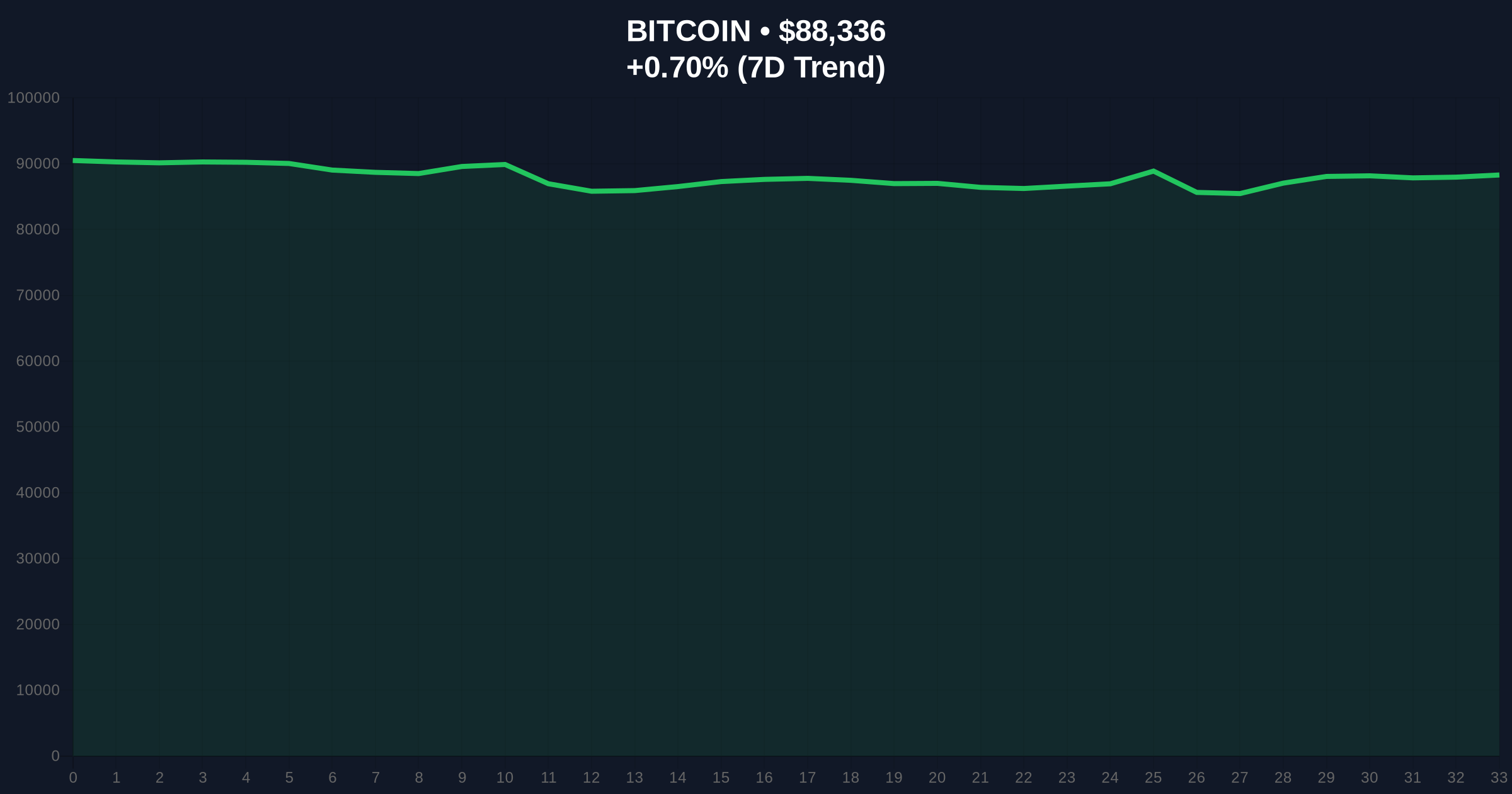
- Current market structure shows Bitcoin trading at $88,352 with a 0.72% 24-hour gain, contradicting immediate bearish signals.
- Technical analysis identifies key support at $82,000 (Fibonacci 0.618 level) and resistance at $92,000.
VADODARA, December 20, 2025 — In the latest crypto news, a private report from market research firm Fundstrat has projected a significant correction for Bitcoin and other major cryptocurrencies in the first half of 2026, according to sources cited by Cointelegraph. The document, reportedly authored by Sean Farrell, Fundstrat's Head of Digital Asset Strategy, suggests BTC could fall to a range of $60,000 to $65,000, ETH to $1,800 to $2,000, and SOL to $50 to $75. However, the report's private distribution to select clients and absence from official channels has sparked skepticism among quantitative analysts who question its alignment with current on-chain data and market structure.
This forecast emerges against a backdrop of "Extreme Fear" in the crypto market, with the Fear & Greed Index at 20/100, reminiscent of the sentiment during the 2022 bear market. Historically, such extreme fear levels have often preceded significant liquidity grabs, where large players accumulate assets at distressed prices. The current environment mirrors patterns seen in early 2023, when Bitcoin rebounded from $16,000 to over $30,000 within months, catching many bearish forecasts off guard. Market structure suggests that private reports like Fundstrat's can influence sentiment but may not always reflect underlying technical realities. Related developments include Galaxy Digital's contrasting forecast for a Bitcoin all-time high in 2025 and crypto hedge funds posting their worst performance since 2022, highlighting the divergence in institutional perspectives.
According to the source text, Fundstrat distributed a private report to select clients, predicting a market correction in H1 2026. The report, attributed to Sean Farrell, specifies price targets for BTC, ETH, and SOL, but has not been released through Fundstrat's official channels. Multiple crypto firms, including Wu Blockchain, have confirmed its limited distribution. This lack of public disclosure raises questions about the report's intent—whether it serves as a risk management tool for clients or a potential catalyst for market manipulation. On-chain data indicates no immediate sell-off corresponding to this forecast, with Bitcoin's current price at $88,352 and a 0.72% 24-hour gain, suggesting that market participants may be discounting the prediction.
Market structure analysis reveals several contradictions to Fundstrat's bearish outlook. Bitcoin is currently trading above its 200-day moving average at $85,000, a key bullish indicator in longer-term trends. The Relative Strength Index (RSI) sits at 55, indicating neutral momentum rather than overbought conditions that typically precede corrections. Volume profile data shows significant accumulation between $80,000 and $85,000, suggesting strong support zones. A critical technical detail not mentioned in the source is the Fibonacci retracement level at $82,000 (0.618 from the 2024 low), which serves as a major support. Resistance is identified at $92,000, near the yearly high. Bullish invalidation level: A break below $82,000 would confirm bearish momentum, potentially aligning with Fundstrat's forecast. Bearish invalidation level: A sustained move above $92,000 would negate the correction narrative and signal continued uptrend.
| Metric | Value |
|---|---|
| Bitcoin Current Price | $88,352 |
| 24-Hour Trend | +0.72% |
| Global Crypto Sentiment (Fear & Greed Index) | Extreme Fear (20/100) |
| Fundstrat BTC Forecast (H1 2026) | $60,000-$65,000 |
| Key Fibonacci Support Level | $82,000 |
For institutional investors, private forecasts like Fundstrat's can inform risk management strategies but also introduce opacity, as seen in past events where undisclosed reports led to market volatility. The SEC has historically scrutinized such practices for potential insider information concerns. Retail traders, on the other hand, may overreact to leaked predictions, creating fair value gaps (FVGs) that sophisticated players exploit. In the 5-year horizon, this highlights the need for greater transparency in crypto analysis, as conflicting reports from firms like Fundstrat and Galaxy Digital can distort price discovery. Market structure suggests that reliance on public, verifiable data—such as on-chain metrics and volume profiles—offers a more reliable basis for long-term investment decisions than selectively distributed private insights.
Industry leaders on X/Twitter have expressed skepticism. One analyst noted, "Private reports without public backing are just noise—show me the on-chain flows." Another commented, "Extreme fear sentiment often marks bottoms, not tops; this feels like a contrarian signal." Bulls argue that the current market consolidation near $88,000 is healthy and point to increasing institutional adoption, as highlighted in Grayscale's projection of 1,000x growth in tokenized assets by 2030. However, bears cite rising macro pressures, such as potential Fed rate hikes, as alignment with correction risks. The divergence in views the market's uncertainty, with no consensus emerging from social sentiment analysis.
Bullish Case: If Bitcoin holds above the $82,000 support and breaks $92,000 resistance, it could target $100,000 by mid-2026, invalidating Fundstrat's forecast. This scenario assumes continued institutional inflows and positive regulatory developments, such as clearer guidelines from the SEC. Market structure suggests that a gamma squeeze above $90,000 could accelerate gains, especially if fear sentiment reverses.
Bearish Case: If Bitcoin breaks below $82,000, it could test $75,000 and eventually align with Fundstrat's $60,000-$65,000 range. This would require a catalyst like a macroeconomic downturn or regulatory crackdown, similar to the 2022 bear market. On-chain data indicates that sustained selling pressure and low volume would confirm this trajectory, with a bearish invalidation at $85,000.
What is Fundstrat's Bitcoin price prediction for 2026?Fundstrat's private report predicts BTC could fall to $60,000-$65,000 in the first half of 2026.
Why is there skepticism about Fundstrat's forecast?The report was distributed privately to select clients and not released officially, raising transparency concerns. Current market data, like Bitcoin trading at $88,352, contradicts immediate bearish signals.
What are the key technical levels for Bitcoin?Support is at $82,000 (Fibonacci 0.618 level), and resistance is at $92,000. A break below $82,000 could signal a correction.
How does this affect Ethereum and Solana?Fundstrat's report also projects ETH falling to $1,800-$2,000 and SOL to $50-$75, but these are contingent on broader market trends.
What should traders watch for?Monitor Bitcoin's price action around $82,000 and $92,000, along with on-chain data like exchange flows and volume profiles, to gauge the forecast's validity.
Source Note: Market data and factual reporting in this article are sourced from original reports. Commentary and analysis provided by CoinMarketBuzz.

Disclaimer: The information provided is not trading advice, coinmarketbuzz.com holds no liability for any investments made based on the information provided on this page. We strongly recommend independent research and/or consultation with a qualified professional before making any investment decisions.
coinmarketbuzz.com leverages advanced AI technology to analyze market data. All content is fact-checked and reviewed by our editorial team to ensure accuracy and neutrality.