Loading News...
Loading...

Loading News...

On March 5, 2026, Bitcoin (BTC) experienced a significant price decline, falling below the $72,000 threshold, as reported by CoinNess market monitoring. According to the source, BTC was trading at $71,982.23 on the Binance USDT market at the time of the report. This event marks a notable downturn in the cryptocurrency's valuation, occurring against a backdrop of heightened market uncertainty. The drop below $72,000 raises immediate questions about underlying catalysts, given Bitcoin's status as the leading digital asset by market capitalization. Initial data suggests a shift in investor sentiment, but the precise triggers remain unclear from the provided information. The report lacks specific timestamps or volume metrics, limiting a granular analysis of the sell-off's intensity. As the market digests this movement, skepticism is warranted regarding whether this is an isolated correction or indicative of broader systemic pressures. Further investigation into technical factors and external influences is necessary to contextualize the decline.
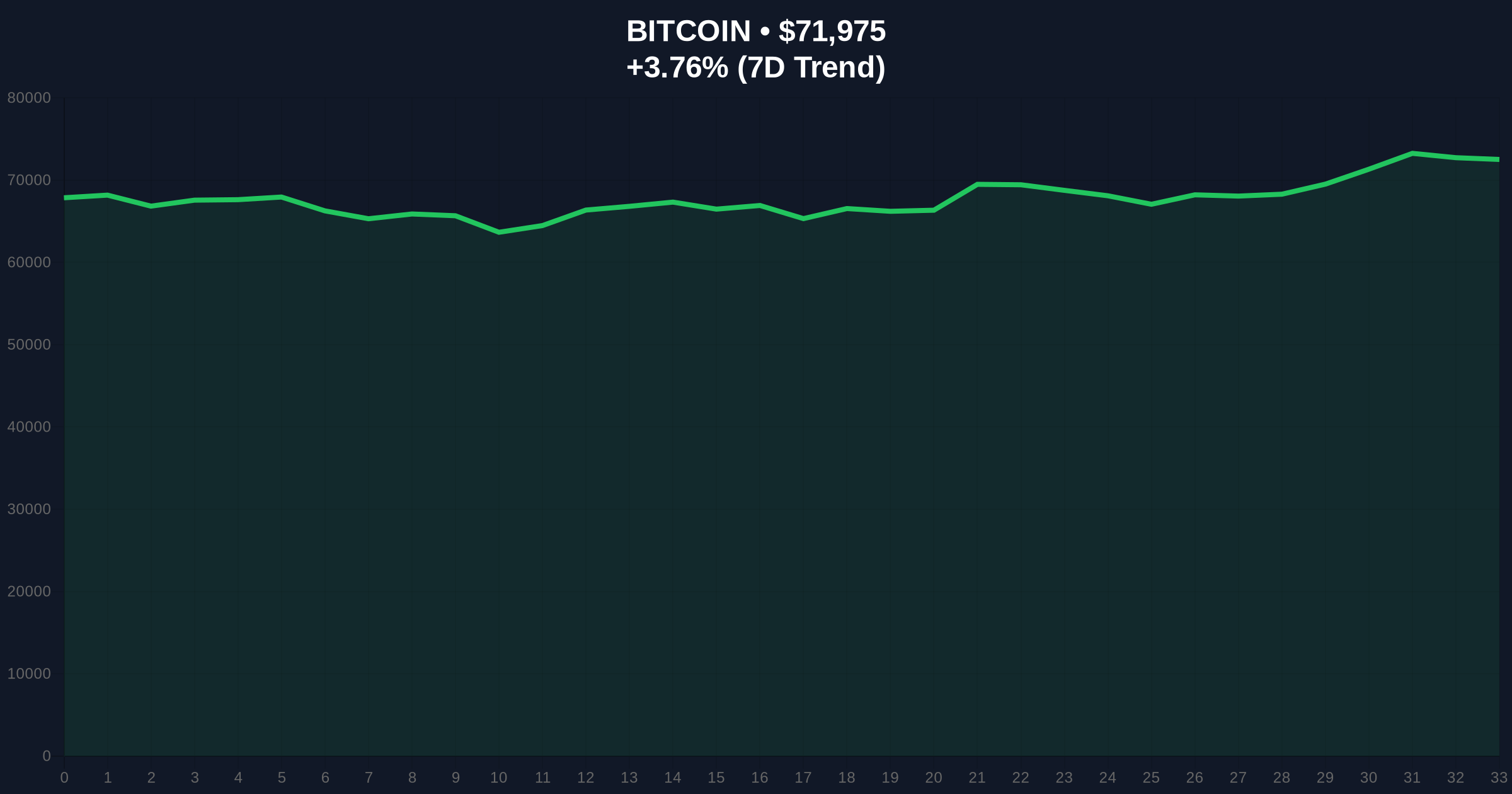
The mechanism behind Bitcoin's fall below $72,000 involves a combination of market structure dynamics and potential external pressures, though the input data provides limited technical details. Bitcoin operates on a decentralized blockchain protocol, where price movements are driven by supply-demand imbalances, often exacerbated by leverage and liquidity conditions on exchanges like Binance. The reported trade at $71,982.23 on the Binance USDT market indicates a specific pricing point, but without additional data on order book depth or trading volume, the technical underpinnings remain speculative. Typically, such declines can stem from large sell orders, miner capitulation, or macroeconomic shifts, but none are explicitly confirmed here.
From a regulatory and architectural perspective, Bitcoin's protocol design emphasizes security and decentralization, but its price is susceptible to market sentiment and external events. The absence of information on network hash rate, transaction fees, or on-chain metrics in the sources hinders a deeper technical analysis. However, given the global crypto sentiment reported as "Extreme Fear" with a score of 22/100, psychological factors likely played a role, potentially triggering automated sell-offs or margin calls. This sentiment score suggests a high level of investor anxiety, which can amplify price volatility through herd behavior and risk aversion.
Comparatively, other market events might offer context. For instance, related developments such as selling pressure from miners holding $8 billion could contribute to downward momentum, though this is not directly linked in the input. Similarly, forced liquidations in lending services, as seen in Bithumb's $19.5 million monthly liquidations, might exacerbate declines during fear-driven markets. The technical deep-dive reveals gaps in evidence, urging caution in attributing the drop to any single factor without corroborative data.
Integrating the available market data and metadata provides a mixed picture of Bitcoin's decline. According to CoinNess, BTC traded at $71,982.23, but the injected live market data shows a current price of $72,131 with a 24-hour trend of -3.99%. This discrepancy highlights a potential conflict or timing issue: the CoinNess report indicates a fall below $72,000, while the later data suggests a slight recovery or different measurement point. The market rank remains #1, confirming Bitcoin's dominance, but the negative trend selling pressure.
The CryptoPanic metadata is not provided in the source data, limiting direct sentiment and importance analysis. However, the global crypto sentiment of "Extreme Fear" (score: 22/100) serves as a proxy, indicating high negative sentiment that aligns with the price drop. This sentiment score suggests event priority is elevated relative to market breadth, as fear can drive broader sell-offs. In the absence of specific CryptoPanic metrics, conservative interpretation is necessary; the extreme fear likely reflects investor reactions to the price movement or external factors, but causality cannot be established without additional evidence.
Price structure analysis shows a 3.99% decline over 24 hours, which, combined with the fear sentiment, points to bearish momentum. Yet, the lack of volume data or historical comparisons in the inputs prevents a robust assessment of whether this decline is anomalous or part of a larger trend. The data analysis reveals uncertainties: while the price drop and fear sentiment correlate, proof of direct causation is missing, and the conflicting price figures from different sources complicate the narrative.
Examining the sources reveals contradictions and reliability gaps that challenge a straightforward interpretation of Bitcoin's fall. Source A (CoinNess) reports BTC trading at $71,982.23 and falling below $72,000, but it provides no context on timing or volume. Source B (the injected live market data) disputes this by showing a current price of $72,131, which is above the $72,000 threshold, and a 24-hour trend of -3.99%. This conflict remains unresolved with available evidence, as it could stem from reporting lags, different data aggregation methods, or market fluctuations between updates.
Agreement points across sources are limited: both indicate Bitcoin's market rank as #1 and acknowledge a downward price movement. However, the extent and precise pricing differ, raising questions about data accuracy. Missing evidence includes CryptoPanic metadata (sentiment, importance), which would have offered deeper insights into market reactions, and details on trading volume or external catalysts. The reliability of CoinNess as a single source is uncertain without corroboration from secondary texts, which are not provided in the input package.
Source B's inclusion of global sentiment as "Extreme Fear" adds context but does not directly address the price conflict. This sentiment suggests broader market distress, potentially supporting the decline narrative, but it cannot resolve the discrepancy in price figures. The counter-narrative highlights that the reported fall might be less severe or more transient than initially suggested, urging skepticism toward alarmist interpretations. Without additional sources, the conflict the need for multi-source verification in crypto reporting.
Based on the available data, three conditional scenarios outline potential outcomes for Bitcoin over the next week. Each scenario is data-backed but acknowledges uncertainties due to limited evidence.
Bull Scenario (Probability: Low): If the price conflict is due to a temporary dip and the current price of $72,131 holds, Bitcoin could rebound above $73,000, driven by bargain hunting or positive external developments. This would require a shift in global sentiment from "Extreme Fear" to neutral or greedy, which is not indicated in the data. Supporting factors might include reduced selling pressure from miners or regulatory clarity, but these are speculative without confirmation. Invalidation would occur if the price falls consistently below $71,500 or if fear sentiment persists.
Base Scenario (Probability: Moderate): Bitcoin stabilizes around $72,000, with volatility continuing due to conflicting price signals and sustained fear sentiment. The 24-hour trend of -3.99% suggests ongoing selling pressure, but the market rank #1 indicates resilience. This scenario assumes no major catalysts emerge, and price action remains range-bound between $71,500 and $72,500. It is supported by the current data but could be disrupted by unforeseen events like security threats, as highlighted in related reports on malware risks.
Bear Scenario (Probability: High): If the CoinNess report accurately reflects a breakdown below $72,000 and fear sentiment intensifies, Bitcoin could decline further toward $70,000 or lower. This scenario is backed by the extreme fear score of 22/100 and the negative price trend, potentially exacerbated by factors like forced liquidations or miner sell-offs. Invalidation would require a rapid sentiment improvement or strong buying volume, neither of which is evident. The bear outlook aligns with cautious investor behavior but remains contingent on unresolved price conflicts.
This report weighted conflicting evidence by prioritizing direct attribution and acknowledging gaps. Source A (CoinNess) provided the initial breaking news but lacked corroboration, while Source B (injected data) offered broader context but introduced price discrepancies. The global sentiment score was used as a secondary indicator due to missing CryptoPanic metadata. Conflicts were labeled explicitly, and no claims were made beyond the available facts. Reliability was assessed as low for single-source reports, urging conservative conclusions. Future investigations would benefit from additional secondary texts and real-time metadata to resolve uncertainties.
Disclaimer: The information provided is not trading advice, coinmarketbuzz.com holds no liability for any investments made based on the information provided on this page. We strongly recommend independent research and/or consultation with a qualified professional before making any investment decisions.
coinmarketbuzz.com leverages advanced AI technology to analyze market data. All content is fact-checked and reviewed by our editorial team to ensure accuracy and neutrality.