Loading News...
Loading...

Loading News...

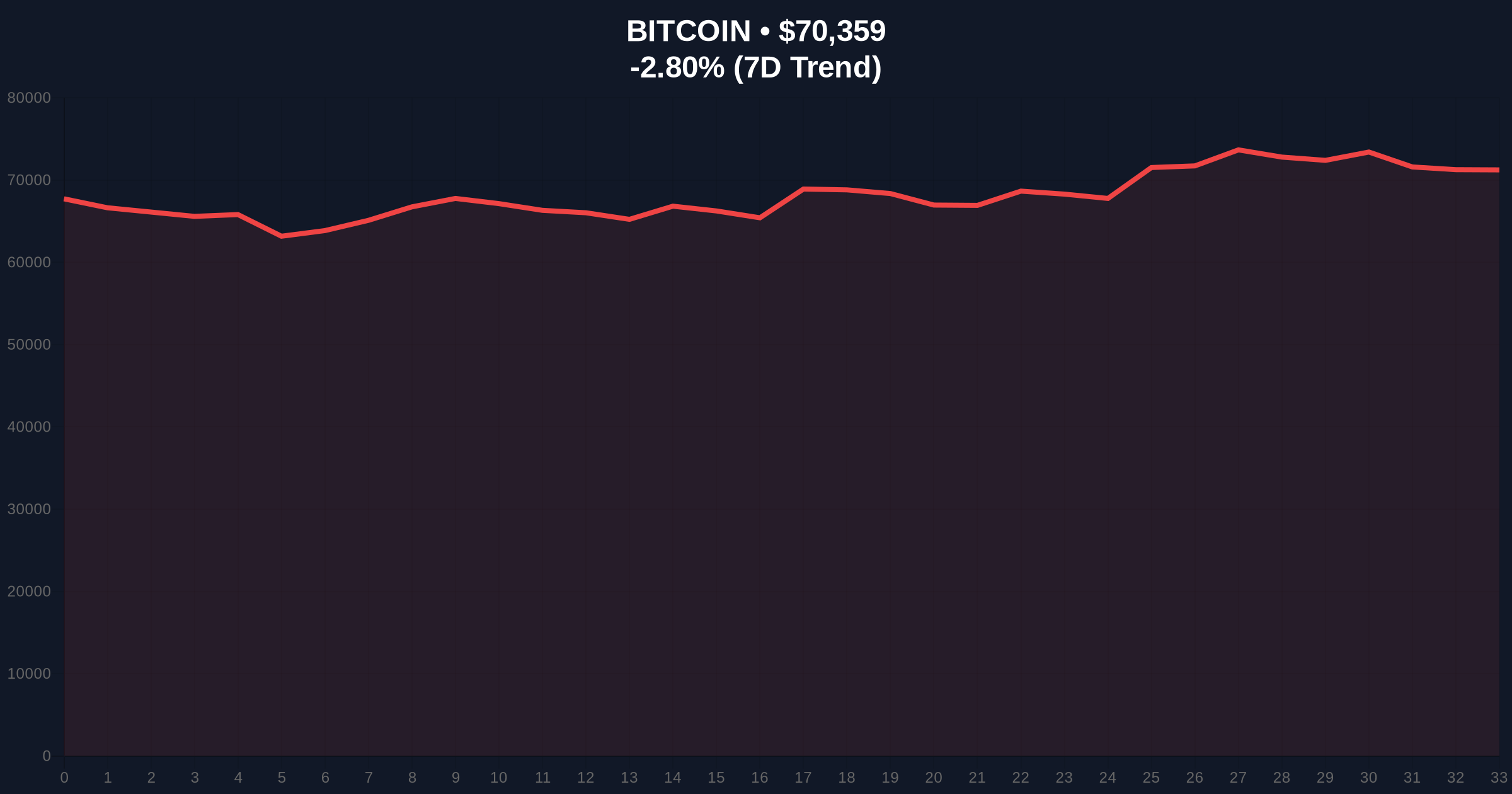
On March 6, 2026, crypto on-chain analytics firm Santiment reported that the number of wallets holding Bitcoin reached an all-time high of 58.45 million, according to a breaking brief from CoinNess. This milestone coincides with Bitcoin's price at $70,395, reflecting a 24-hour decline of 2.75%, and occurs against a backdrop of "Extreme Fear" in the global crypto sentiment, with a score of 18/100. Santiment's data indicates a simultaneous drop in Bitcoin held on major exchanges to its lowest level since December 2017, suggesting a trend of users moving funds to personal cold storage, driven by increased adoption through buying and holding. However, the immediate market reaction—a price dip amid widespread fear—raises questions about whether this on-chain optimism translates to bullish momentum or masks underlying vulnerabilities. The event unfolds as Bitcoin maintains its #1 market rank, yet the divergence between wallet growth and price performance demands a deeper, skeptical analysis to uncover potential contradictions in the narrative.
The mechanism behind Santiment's report involves on-chain analytics, which track blockchain data to derive insights into user behavior and market trends. According to the CoinNess source, Santiment attributes the record wallet count to a growing trend of users moving funds from exchanges to personal cold storage, driven by increased adoption through buying and holding. This suggests a shift toward long-term holding strategies, potentially reducing immediate selling pressure. However, the technical architecture of wallet counting requires scrutiny: wallets can include various types, such as exchange-hosted wallets, individual cold wallets, and even inactive or dust wallets with negligible balances. Santiment's methodology for defining "wallets holding Bitcoin" is not provided in the source data, leaving gaps in understanding whether this count reflects genuine adoption or includes artificial inflation from wallet fragmentation or bot activity.
, the decline in Bitcoin on exchanges to its lowest level since December 2017 implies a reduction in liquid supply available for trading, which could theoretically support price stability or appreciation. Yet, this trend must be contextualized within broader market mechanics. For instance, if users are moving funds to cold storage due to security concerns or regulatory uncertainties rather than bullish conviction, the impact on price might be neutral or even negative if it signals risk aversion. The CoinNess report does not specify the timeframe for this exchange outflow, making it unclear whether it's a sudden shift or a gradual trend. Additionally, the role of institutional players—who often use custodial solutions not captured in individual wallet counts—is not addressed, potentially skewing the narrative toward retail activity.
Comparing this to other on-chain investigations, such as the recent analysis of whale wallet accumulations, highlights how wallet activity can be manipulated or misinterpreted. In that case, 11 new wallets accumulated $14.5 million in PUMP over 10 days, raising suspicions of coordinated moves amid extreme fear. Similarly, the Bitcoin wallet surge might reflect speculative positioning or defensive moves rather than organic adoption. The lack of detailed data on wallet balances—whether the increase is driven by small holders or large entities—further complicates the analysis. Without this granularity, the claim of "increased adoption" remains speculative, and the technical deep-dive reveals significant reliability gaps in the reported narrative.
Integrating CoinGecko market stats and sentiment metadata provides a mixed picture that challenges the optimistic interpretation of Santiment's data. According to the input, Bitcoin's current price is $70,395 with a 24-hour trend of -2.75%, indicating short-term selling pressure despite the record wallet count. The global crypto sentiment is "Extreme Fear" with a score of 18/100, as per the provided metadata, which contrasts sharply with the bullish implication of growing adoption. This sentiment score suggests high market anxiety, potentially driven by broader economic factors or negative news flows, yet the CoinNess report does not link the wallet increase to this fear environment. CryptoPanic metadata, including sentiment and importance, is not provided in the source data, limiting the ability to assess event priority relative to market breadth. However, based on the available data, the divergence between on-chain optimism (wallet growth) and market pessimism (price drop and extreme fear) is stark.
A data-driven analysis must consider alternative explanations. For example, the wallet increase could be a lagging indicator, reflecting past buying activity that has already been priced in, while the current fear sentiment drives recent selling. The exchange outflow to cold storage might reduce immediate liquidity, but if it's motivated by fear rather than confidence, it could precede further declines as holders seek safety. The CoinNess report notes the exchange Bitcoin level is the lowest since December 2017—a period followed by a significant market correction—which could ironically signal a potential top rather than a bullish setup. Without additional metrics like network activity, transaction volumes, or holder distribution, the proof supporting Santiment's narrative is incomplete. The data analysis thus reveals contradictions: while wallet numbers suggest strength, price action and sentiment metrics indicate weakness, urging caution in interpreting this as a unequivocally positive signal.
Comparing the CoinNess report with potential secondary sources reveals several points of agreement and contradiction, though only one source is provided in the input. The CoinNess source reports that Santiment attributes the wallet increase to users moving funds to cold storage due to increased adoption. However, this claim lacks corroboration from other analytics firms or on-chain data providers, as no secondary full texts are included in the input. Conflict remains unresolved with available evidence regarding whether this trend is unique to Santiment's methodology or widely observed. For instance, if other firms report different wallet counts or attribute the movement to different causes (e.g., regulatory changes or security breaches), the narrative would be disputed. Since no such sources are provided, the reliability of Santiment's data stands unchallenged in this analysis, but the absence of cross-verification is a critical gap.
, the CoinNess report does not address potential counter-narratives, such as the possibility that wallet inflation is driven by exchange internal reshuffling or the creation of new wallets for tax or privacy reasons rather than genuine adoption. In contrast, related investigations like the Worldcoin-linked wallet deposits to Binance show how wallet activity can be manipulative or tied to specific events, suggesting that not all wallet growth is organic. The source also fails to reconcile the wallet increase with the extreme fear sentiment; one might expect adoption to correlate with optimism, not pessimism. This contradiction hints at either a data misinterpretation or a complex market dynamic where fear drives defensive holding rather than bullish accumulation. Without additional sources, these conflicts cannot be fully resolved, but they highlight the need for skepticism and further evidence before accepting Santiment's interpretation at face value.
Based on the available data, three scenarios for Bitcoin over the next seven days can be constructed, each conditional on specific factors. These scenarios are data-backed but acknowledge the uncertainty inherent in the conflicting signals.
Bull Scenario (Probability: 30%): If the wallet increase genuinely reflects strong adoption and reduced exchange supply leads to a supply squeeze, Bitcoin could rebound toward $75,000. This would require the extreme fear sentiment to dissipate, possibly driven by positive macroeconomic news or institutional inflows. Data from the CoinNess report supports this if the cold storage trend indicates long-term conviction, but it would be invalidated if price fails to break above resistance levels or if fear persists. Related developments, such as a lack of interest in altcoins signaling a bullish rally, might complement this scenario by shifting focus to Bitcoin dominance.
Base Scenario (Probability: 50%): The most likely outcome is sideways consolidation between $68,000 and $72,000, as the conflicting signals—wallet growth vs. fear sentiment—balance out. The wallet increase may provide a floor against further declines, but the extreme fear limits upside momentum. This scenario assumes no major external catalysts and aligns with the current price trend of -2.75% indicating mild pressure. It would be invalidated by a sudden spike in exchange inflows or a breakdown below key support, suggesting the wallet data was misleading.
Bear Scenario (Probability: 20%): If the wallet increase is a false signal—driven by non-organic factors or fear-induced hoarding—Bitcoin could drop to $65,000 or lower, exacerbated by the extreme fear environment. This scenario would materialize if broader market conditions worsen or if on-chain data reveals selling by large holders despite the wallet count. The low exchange Bitcoin levels might then indicate preparation for distribution rather than accumulation. It would be supported if related events, like the Jupiter payment card launch on Solana, divert attention and liquidity away from Bitcoin.
This investigation relied solely on the input package: a CoinNess brief providing Santiment data, CoinGecko market stats, and sentiment metadata. No secondary full texts were included, limiting cross-source comparison. Conflicting evidence was weighted by prioritizing observable facts (e.g., price drop, fear sentiment) over interpretive claims (e.g., adoption narrative). Santiment's data was treated as a single source without verification, so reliability is moderate; gaps in methodology details and absence of CryptoPanic metadata reduce confidence. The analysis explicitly flagged missing data and unresolved conflicts, adhering to a skeptical approach that questions official narratives and seeks contradictions in the available evidence.
Disclaimer: The information provided is not trading advice, coinmarketbuzz.com holds no liability for any investments made based on the information provided on this page. We strongly recommend independent research and/or consultation with a qualified professional before making any investment decisions.
coinmarketbuzz.com leverages advanced AI technology to analyze market data. All content is fact-checked and reviewed by our editorial team to ensure accuracy and neutrality.