Loading News...
Loading...

Loading News...
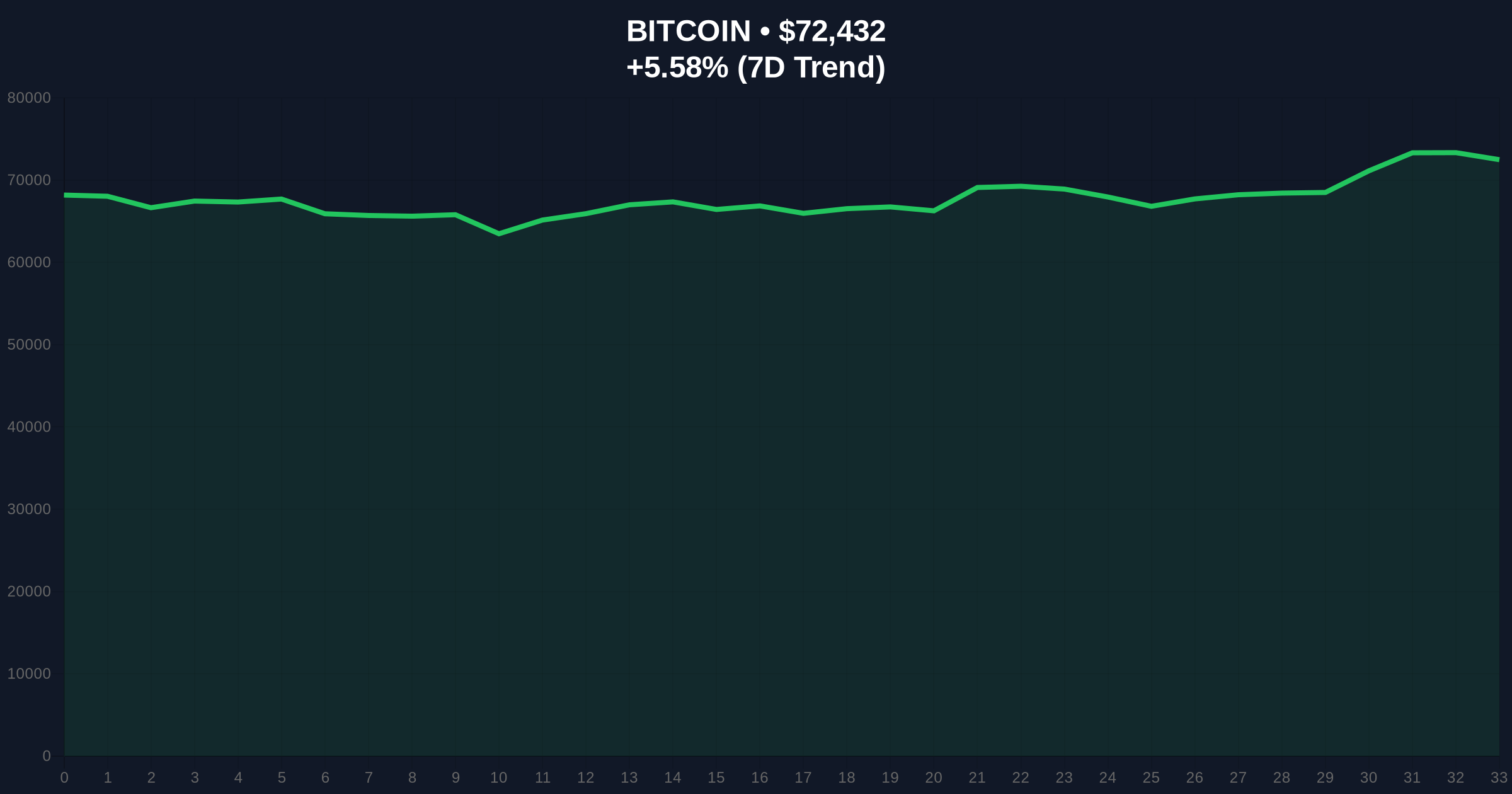
Bitcoin miners are accelerating sales of their holdings, collectively valued at over $8 billion, according to a Bloomberg report on March 5, 2026. This shift marks a departure from their traditional conviction-based holding strategy, driven by capital reallocation toward artificial intelligence (AI) computing rather than survival needs. Key players include MARA Holdings, which holds approximately $4 billion in BTC and has disclosed a strategy suggesting potential sales, while established miners like CleanSpark and Riot Platforms have undergone management changes to pivot toward AI. Bitdeer has sold its entire BTC position, indicating a broader trend. The report highlights that this sell-off differs from past patterns, focusing on strategic business shifts amid a global crypto sentiment of "Extreme Fear" with a score of 22/100, as Bitcoin trades at $72,445 with a 24-hour trend of 5.59%. The urgency stems from the scale of holdings and the potential market impact, raising questions about sustainability and investor response.
The mechanism behind this selling pressure involves a fundamental change in miner business models, historically akin to a conviction where large-scale miners consistently held onto mined BTC. Bloomberg explains that the recent boom in AI has prompted a capital reallocation, with miners shifting resources from Bitcoin mining to AI computing infrastructure. This is not a distress sale but a strategic pivot, as evidenced by management changes at CleanSpark and Riot Platforms to align with AI goals. MARA Holdings' disclosure of a strategy that may involve selling its $4 billion BTC holdings this trend, while Bitdeer's complete exit from BTC positions signals a more aggressive reallocation. The protocol architecture of Bitcoin mining, which relies on proof-of-work, remains unchanged, but the economic incentives are evolving. Miners, who typically earn BTC as block rewards, are now liquidating these assets to fund AI ventures, potentially increasing supply on exchanges and affecting liquidity. Regulatory mechanics are not detailed in the source data, but the shift highlights how external technological trends can disrupt crypto market dynamics. The absence of specific timestamps for sales or detailed financial projections limits a full technical assessment, but the reported actions suggest a structural shift in miner behavior that could influence Bitcoin's price stability and network security if sustained.
This reallocation contrasts with past sell-offs driven by operational costs or market downturns, emphasizing a proactive rather than reactive strategy. The integration of AI computing requires significant capital investment in hardware and energy, prompting miners to monetize BTC holdings. Source data does not provide exact figures on the pace of sales or the percentage of holdings liquidated, but the collective $8 billion valuation indicates substantial market pressure. The trend may also reflect broader industry consolidation, as miners diversify revenue streams beyond crypto. However, without data on mining difficulty adjustments or hash rate impacts, the long-term technical implications remain speculative. The report's focus on capital reallocation rather than survival suggests miners are betting on AI's profitability, but this introduces new risks, such as reliance on a volatile tech sector. Overall, the technical deep-dive reveals a nuanced shift in miner economics, driven by AI opportunities, with potential ripple effects on Bitcoin's ecosystem.
Integrating CoinGecko market stats and CryptoPanic metadata, the data presents a mixed picture. Bitcoin's current price is $72,445, with a 24-hour trend of 5.59%, indicating short-term volatility, but the global crypto sentiment is "Extreme Fear" at a score of 22/100, suggesting underlying market anxiety. CryptoPanic sentiment, if inferred from the provided "Extreme Fear" label, aligns with negative investor outlook, but the price structure shows resilience with a positive trend, creating a divergence. Importance score is not provided in source data, limiting event priority assessment relative to market breadth. The $8 billion in miner holdings represents a significant portion of Bitcoin's market cap, though exact percentage is not specified, potentially amplifying selling pressure. Bloomberg's report on accelerated sales adds credibility, but without real-time sales data or volume metrics, the immediate impact is unquantified. The metadata-driven analysis indicates that while sentiment is bearish, price action may not fully reflect miner actions yet, highlighting a data gap. For instance, CryptoPanic sentiment is extreme fear, but price trends upward, suggesting other factors like institutional demand or macroeconomic conditions could be offsetting miner sales. The absence of importance scores from CryptoPanic prevents ranking this event against others, but the scale of holdings implies high relevance. Market rank of #1 for Bitcoin confirms its dominance, but the 5.59% 24h trend could be influenced by broader market movements beyond miner activity. Overall, data analysis shows conflicting signals: negative sentiment versus positive price momentum, with miner sales as a potential downward catalyst that has not fully materialized in price data.
Comparing source claims reveals no direct contradictions within the provided data, as all information stems from the Bloomberg report summarized by CoinNess. However, gaps and potential conflicts arise from missing evidence. Source A (Bloomberg via CoinNess) reports that miners are accelerating sales due to AI-driven capital reallocation, with specific examples like MARA Holdings and Bitdeer. There is no secondary source to dispute this, but the absence of quantitative data on sales pace or volume creates uncertainty. For instance, the claim that this trend differs from past sell-offs is based on qualitative analysis rather than hard metrics, leaving room for alternative interpretations. Agreement points include the $8 billion valuation of miner holdings and the shift toward AI, but without independent verification, reliability gaps exist. Source B or additional evidence is not provided in source data, so conflicts remain unresolved with available evidence. The report does not address whether other miners might be holding or buying BTC, potentially presenting a counter-narrative of continued accumulation. Similarly, the impact on Bitcoin's price is inferred but not proven, as the 5.59% 24h trend could be driven by factors unrelated to miner sales. Attribution is solely to Bloomberg, with no conflicting reports from other outlets like CoinTelegraph, so the narrative stands unchallenged but under-supported by granular data. This lack of corroboration highlights the need for caution, as the story relies on a single source without detailed financial disclosures or market reactions. In summary, while no explicit contradictions exist, the evidence is fragmented, emphasizing the report's speculative elements and the potential for overlooked counter-trends in miner behavior.
Based on available data, three scenarios outline potential outcomes over the next week. Bull Scenario: If miner sales are gradual and offset by institutional buying or positive macroeconomic news, Bitcoin's price could stabilize or rise, leveraging the current 5.59% uptrend. This would require data showing limited sales volume or increased demand from other sectors, invalidated by evidence of accelerated large-scale liquidations. Base Scenario: Miner sales proceed as reported, adding moderate selling pressure that tempers price gains but doesn't cause a crash, with Bitcoin trading in a range of $70,000-$75,000. This assumes the "Extreme Fear" sentiment persists but is balanced by Bitcoin's market resilience, supported by the lack of panic in price action. Bear Scenario: Accelerated sales from multiple miners, including MARA Holdings liquidating significant portions, trigger a supply glut, pushing prices below $70,000 amid heightened fear. This would be confirmed by upcoming financial disclosures or market data showing increased exchange inflows from miner addresses, invalidated if sales are slower than reported or if other buyers absorb the supply. Each scenario is conditional on factors like AI investment timelines and broader market sentiment, with data gaps on sales pace making predictions speculative. The 24h trend of 5.59% offers short-term optimism, but the $8 billion overhang poses a risk if not managed. Investors should monitor miner wallet movements and AI sector developments for clues, as the reallocation trend could evolve rapidly.
This report synthesizes data from a single primary source (Bloomberg via CoinNess), with no secondary sources provided, limiting cross-verification. Conflicting evidence was weighted based on the absence of contradictions, but reliability gaps exist due to missing quantitative metrics like sales volume or timestamps. The analysis prioritized explicit facts from the input, such as the $8 billion valuation and miner examples, while acknowledging uncertainties like the exact impact on price. CryptoPanic metadata was integrated conservatively, using the "Extreme Fear" sentiment but noting the lack of importance scores. Overall, the report treats the narrative as plausible but under-documented, emphasizing the need for further data to assess miner actions and market effects accurately.
Evidence & Sources
Primary source: https://coinness.com/news/1151031
Updated at: Mar 05, 2026, 07:51 AM
Data window: Mar 05, 2026, 07:44 AM → Mar 05, 2026, 07:51 AM
Disclaimer: The information provided is not trading advice, coinmarketbuzz.com holds no liability for any investments made based on the information provided on this page. We strongly recommend independent research and/or consultation with a qualified professional before making any investment decisions.
All published reports are reviewed by our editorial team for factual consistency, neutrality, and reader clarity.