Loading News...
Loading...

Loading News...
Evidence & Sources
Primary source: https://cointelegraph.com/markets/bitcoin-price-falls-under-dollar71k-as-us-iran-war-tensions-spark-sell-off
Updated at: Apr 12, 2026, 10:44 PM
Data window: Apr 12, 2026, 09:56 PM → Apr 12, 2026, 10:43 PM
Evidence stats: 9 metrics, 3 timeline points.
Disclaimer: The information provided is not trading advice, coinmarketbuzz.com holds no liability for any investments made based on the information provided on this page. We strongly recommend independent research and/or consultation with a qualified professional before making any investment decisions.
All published reports are reviewed by our editorial team for factual consistency, neutrality, and reader clarity.
VADODARA, April 12, 2026. The following report is based on currently available verified source material and market data.
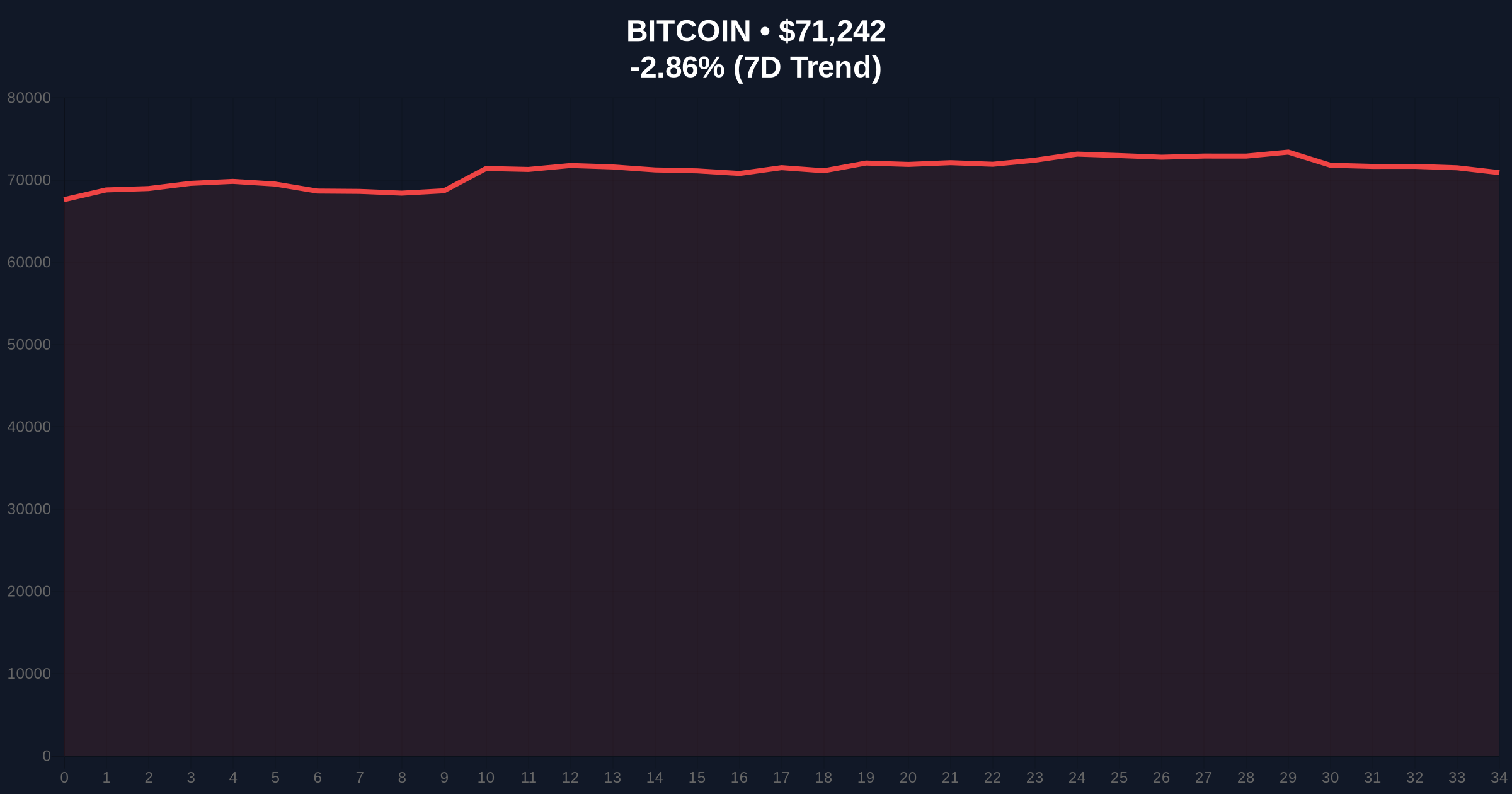
Bitcoin Price Drops Below $71K as US-Iran War Tensions Trigger Sell-Off developed into a market-moving story within the reported window. The initial source indicates immediate relevance for crypto sentiment, while fuller validation is still tied to cited datasets and official statements.
Bitcoin's price action dipped sharply following the breakdown in US-Iran talks. Key metrics from the sell-off include a drop to under $71,000, with current price at $71,252 reflecting a 2.84% decline over 24 hours. Source: CoinGecko. The liquidation total for BTC over the past 24 hours neared $350 million, primarily affecting long positions. Source: public statement. Market sentiment is at "Extreme Fear" with a score of 16/100, indicating heightened risk aversion among traders.
| Metric | Value | Source |
|---|---|---|
| Current BTC Price | $71,252 | CoinGecko |
| 24h Price Change | -2.84% | CoinGecko |
| Initial Drop Below | $71,000 | Public statement |
| Liquidation Total (24h) | ~$350M | Public statement |
| Market Sentiment | Extreme Fear (16/100) | Not provided in source data |
Why now? The timing is critical as Bitcoin had been trading near recent highs, making it vulnerable to sudden geopolitical shocks. The breakdown in US-Iran talks removes a key stability factor, injecting uncertainty into global markets just as inflation concerns resurface.
Who benefits? Short-term traders and those holding cash or stablecoins may gain from volatility, while long-position holders and leveraged traders face immediate losses. Institutions monitoring macro risks might adjust allocations away from risk-on assets.
Time horizons: In the short-term (days/weeks), continued tension could suppress Bitcoin prices and increase liquidation risks. Longer-term (months/years), if the Fed responds with liquidity injections despite inflation, it could eventually support crypto prices, but this depends on economic outcomes.
Causal chain: Geopolitical event (US-Iran talks fail) → increased oil price risks → higher inflation expectations → risk-off sentiment in traditional markets → Bitcoin, as a 24-hour asset, reacts first with sell-off → long liquidations amplify downward pressure → sentiment shifts to "Extreme Fear."
The sell-off mechanism operates through interconnected market layers. Initially, the breakdown in US-Iran negotiations directly impacts oil markets, as the Strait of Hormuz is a major transit route. This triggers fears of rising oil prices, which feed into inflation expectations, US CPI inflation jumped from 2.4% to 3.3%, with models predicting over 4.0% if escalation continues. Bitcoin, traded 24/7, reacts in real-time to this news, unlike traditional markets closed over the weekend. As prices fall, leveraged long positions hit liquidation thresholds, with data showing nearly $350 million in liquidations, creating a feedback loop that accelerates the decline. This process highlights Bitcoin's role as a leading indicator for risk sentiment during off-hours.
This event contrasts with other crypto developments, showing how geopolitical factors can overshadow internal market dynamics. For instance:
The bearish scenario hinges on several uncertainties. What could invalidate the analysis? If negotiations resume quickly or military action is avoided, the sell-off may reverse, but source data indicates no plans for additional talks. Key risks include:
Failure condition: The mechanism breaks if oil prices stabilize unexpectedly or if Bitcoin decouples from macro trends, but current data shows strong correlation.
Near-term, traders should monitor US policy responses and inflation data, with the March Producer Price Index (PPI) print due next week. If the Fed signals liquidity support despite inflation, it could provide a floor for Bitcoin prices. However, continued geopolitical escalation may keep sentiment in "Extreme Fear," suppressing rallies. Practically, this event reinforces the need for risk management in crypto portfolios, especially during volatile weekends.
Bitcoin has historically shown sensitivity to geopolitical events, often acting as a barometer for global risk appetite. The US-Iran conflict, with its implications for oil and inflation, taps into broader macroeconomic concerns that have influenced crypto markets since Bitcoin's inception. This sell-off occurs amid a backdrop of rising recession odds and inflationary pressures, adding layers to its significance.
Cross-market reactions include heightened focus on inflation metrics, with analysts like The Kobeissi Letter modeling scenarios up to 4.0%+ CPI. In crypto, related trends such as whale activity targeting $88K or regulatory shifts in Japan may take a backseat until geopolitical stability returns. For context, recent articles cover topics like Michael Saylor's Bitcoin purchases and US sports teams exploring fan tokens, but these are overshadowed by immediate macro risks.
The Bitcoin sell-off under $71K driven by US-Iran tensions crypto's vulnerability to geopolitical shocks and its real-time market dynamics. With liquidations mounting and sentiment at "Extreme Fear," the event serves as a reminder of the interconnectedness between traditional macro factors and digital asset prices.