Loading News...
Loading...

Loading News...
VADODARA, April 12, 2026. The following report is based on currently available verified source material and market data.
On April 11, 2026, Bitcoin and the broader cryptocurrency market traded flat as U.S. and Iranian officials opened high-level talks in Islamabad, Pakistan. This development follows a week of market gains triggered by a two-week ceasefire announcement, which led to a derivatives short squeeze wiping out over $430 million in bearish positions. The current market stagnation reflects investor caution amid fragile geopolitical conditions, with Israel continuing airstrikes against Lebanon and Iran announcing tolls for ships passing through the Strait of Hormuz. The situation matters because geopolitical tensions have historically driven volatility in crypto markets, and the current negotiations could either stabilize or further disrupt global risk assets.
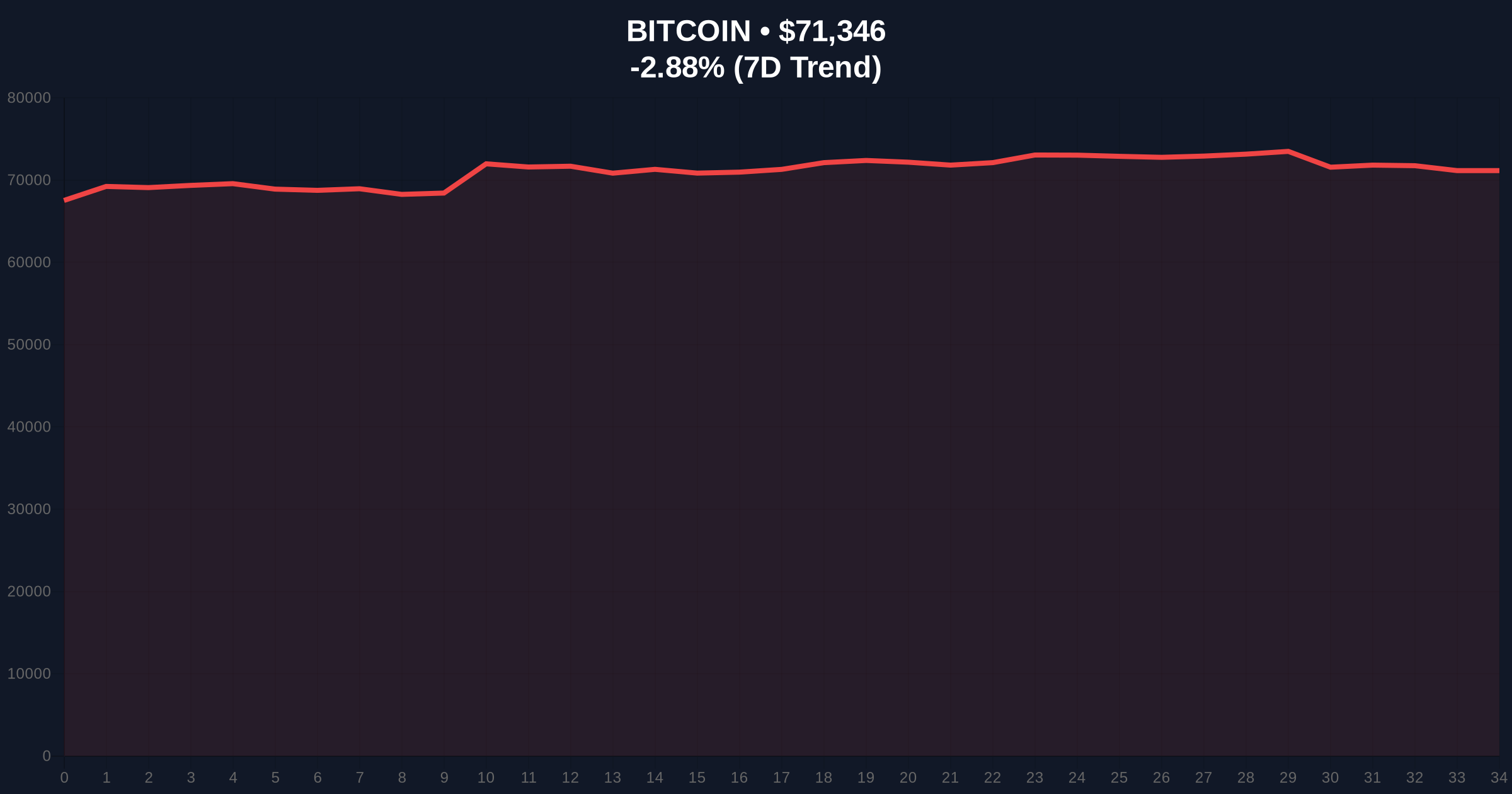
Key metrics from the event highlight a market in a holding pattern. Bitcoin is trading below $73,000, with a 24-hour decline of 0.6% as of the initial report, though later data shows a price of $71,301 and a 24-hour trend of -2.90%. The broader market is mostly flat, with the CoinDesk 20 index up 0.12% and Ethereum up 0.1% over the past 24 hours. Global crypto sentiment is in "Extreme Fear" with a score of 16/100, indicating high investor anxiety. The derivatives short squeeze earlier in the week eliminated over $430 million in bearish positions, providing temporary upward momentum.
| Metric | Value | Source |
|---|---|---|
| Bitcoin Price | $71,301 | Source: CoinGecko |
| 24h Trend | -2.90% | Source: CoinGecko |
| Derivatives Short Squeeze Loss | Over $430 million | Source: public statement |
| Global Crypto Sentiment | Extreme Fear (16/100) | Source: CoinGecko |
| CoinDesk 20 Index 24h Change | Up 0.12% | Source: public statement |
Why now? The market is at a critical juncture where geopolitical developments directly influence risk appetite. Similar to the 2021 correction triggered by macroeconomic shifts, current tensions around the Strait of Hormuz, a vital oil route, could revive inflation trades and impact crypto as a hedge asset. The timing coincides with Bitcoin testing key support levels, making price action sensitive to external news.
Who benefits? Short-term traders may capitalize on volatility spikes, while long-term holders face uncertainty. Institutions monitoring macro indicators could adjust portfolios based on negotiation outcomes. Retail investors in "Extreme Fear" sentiment may be prone to panic selling if tensions escalate.
Time horizons: In the short term (days/weeks), market flatness may persist until negotiation clarity emerges. Over the longer term (months/years), resolution could boost crypto adoption as a geopolitical hedge, while escalation might lead to sustained risk-off sentiment.
Causal chain: Ceasefire announcement → reduced immediate war risk → short squeeze → temporary price rise → negotiation uncertainty → market flatness → investor caution due to fragile truce and Strait of Hormuz tolls.
The market's flat trading stems from a mechanical balance between opposing forces. Initially, the ceasefire announcement reduced perceived geopolitical risk, triggering a derivatives short squeeze: bearish positions were forced to cover as prices rose, liquidating over $430 million and creating upward momentum. However, as negotiations began, uncertainty returned. The mechanism involves: 1) High-level talks introducing ambiguity on future outcomes, 2) Conflicting actions (Israel airstrikes, Iran tolls) offsetting positive ceasefire news, and 3) Thin liquidity during uncertain periods leading to muted price movements. This creates a stalemate where buyers and sellers await clearer signals, resulting in the observed flat market structure.
Compared to adjacent developments, the crypto market's reaction mirrors traditional finance's caution during geopolitical events. For instance, oil markets have seen volatility due to Strait of Hormuz disruptions, influencing inflation expectations that historically correlate with crypto movements. In contrast, other crypto sectors show varied responses:
The bearish scenario hinges on negotiation breakdowns or escalating conflicts. Key risks include:
Uncertainty remains high: data on institutional flows or on-chain metrics during this period is not provided in source data, making it hard to gauge deeper market health. The failure condition would be a breakdown in negotiations coupled with increased military actions, breaking the current fragile stability.
Practically, traders should monitor negotiation outcomes and Strait of Hormuz traffic for near-term cues. A successful resolution could lift crypto markets by reducing risk premiums, while failure may test Bitcoin's support levels, such as the $65,000 base noted by analysts. Institutions may increase hedging strategies, and regulatory attention on crypto as a geopolitical tool could intensify.
Historically, crypto markets have shown sensitivity to geopolitical events, such as the 2022 Russia-Ukraine conflict which initially caused sell-offs followed by rallies as Bitcoin was viewed as a digital gold. The current situation echoes past patterns where ceasefire announcements provide temporary relief, but underlying tensions keep volatility elevated. The Strait of Hormuz is a critical chokepoint for global oil, and disruptions there have previously impacted inflation narratives that influence crypto valuations.
Cross-market reactions include oil futures volatility and traditional equity markets absorbing shocks through strong earnings, as noted by Fidelity's Jurrien Timmer. In crypto, related trends involve:
Bitcoin and the broader crypto market are in a holding pattern as U.S.-Iran negotiations introduce uncertainty after a week of gains. The flat trading reflects a balance between ceasefire optimism and ongoing geopolitical risks, with "Extreme Fear" sentiment underscoring investor caution. While mechanisms like the short squeeze provided temporary momentum, the market's direction now hinges on diplomatic outcomes and their impact on global risk appetite.
What to watch next: By Francisco Rodrigues|Edited by Nikhilesh De Apr 11, 2026, 4:25 p.m.; CNN reported earlier Saturday that Vice President J.D..
Evidence & Sources
Primary source: https://www.coindesk.com/markets/2026/04/11/bitcoin-broader-market-flat-as-u-s-iran-negotiations-begin
Updated at: Apr 12, 2026, 11:56 PM
Data window: Apr 11, 2026, 06:25 PM → Apr 12, 2026, 11:41 PM
Evidence stats: 9 metrics, 4 timeline points.
Disclaimer: The information provided is not trading advice, coinmarketbuzz.com holds no liability for any investments made based on the information provided on this page. We strongly recommend independent research and/or consultation with a qualified professional before making any investment decisions.
All published reports are reviewed by our editorial team for factual consistency, neutrality, and reader clarity.