Loading News...
Loading...

Loading News...

Evidence & Sources
Primary source: https://cointelegraph.com/markets/bitcoin-traders-set-dollar88k-target-as-market-bias-finally-tilts-toward-bulls
Updated at: Apr 12, 2026, 07:46 PM
Data window: Apr 10, 2026, 06:47 PM → Apr 12, 2026, 07:45 PM
Evidence stats: 9 metrics, 2 timeline points.
Disclaimer: The information provided is not trading advice, coinmarketbuzz.com holds no liability for any investments made based on the information provided on this page. We strongly recommend independent research and/or consultation with a qualified professional before making any investment decisions.
All published reports are reviewed by our editorial team for factual consistency, neutrality, and reader clarity.
VADODARA, April 12, 2026. The following report is based on currently available verified source material and market data.
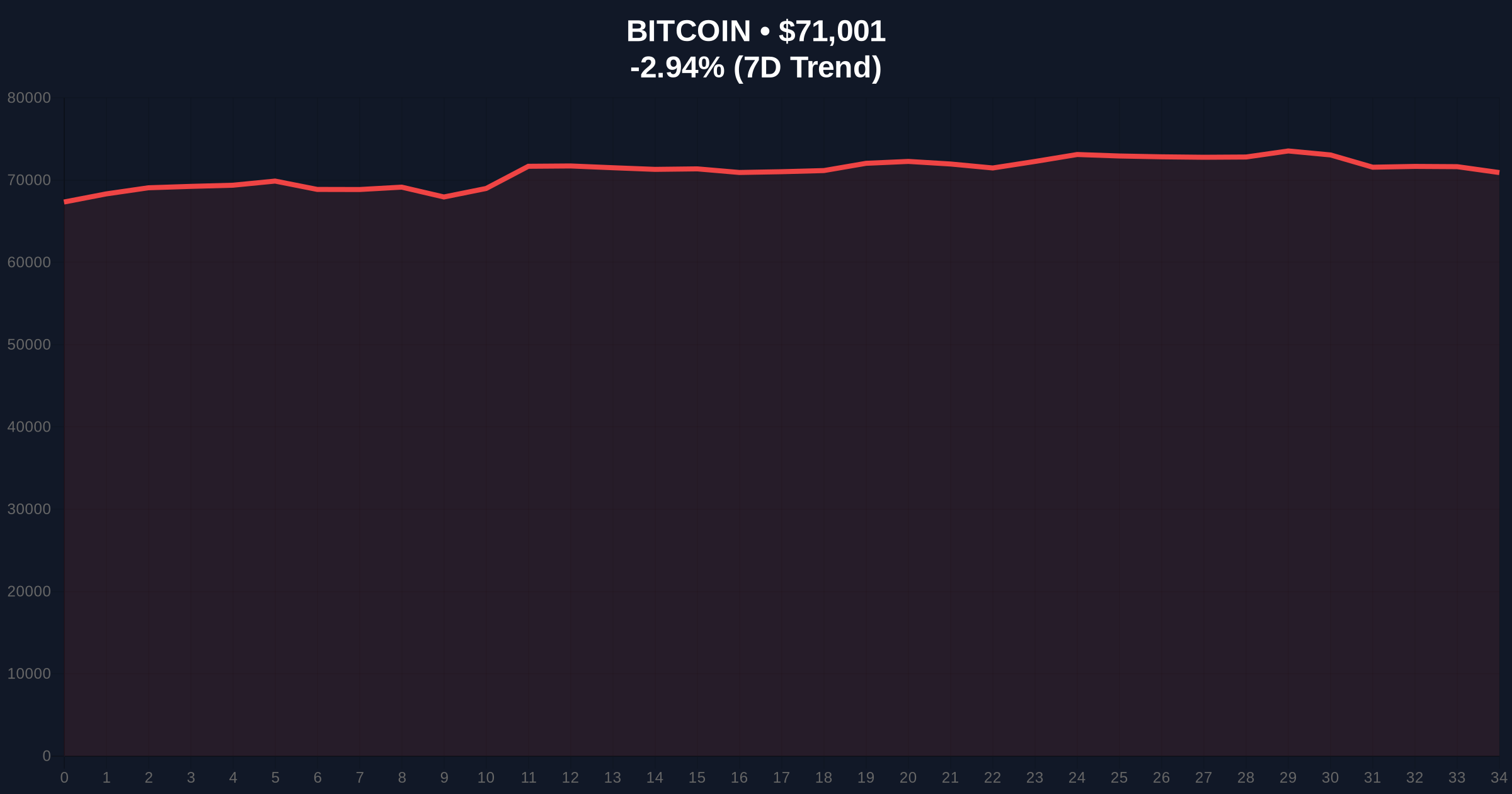
Bitcoin traders are setting an $88,000 price target as market bias tilts bullish, driven by a sharp uptick in whale activity and reduced exchange inflows. This shift, reported on April 10, 2026, comes despite Bitcoin's current price of $71,002 and a 24-hour decline of 2.94%, with global crypto sentiment stuck in 'Extreme Fear.' The development matters because it signals potential supply absorption by large holders, which could reduce sell-side pressure and pave the way for a breakout toward key resistance levels, impacting both short-term traders and long-term investors.
Concrete metrics from the source data reveal a mixed picture. Bitcoin's price is currently $71,002, down 2.94% in 24 hours, while traders target a supply zone at $88,000. Whale inflows to exchanges have dropped to $2.96 billion, the first sub-$3 billion reading since June 2025, down from $8 billion in February, a $5 billion decrease over two months. The long-term holder realized cap change reached $49 billion on April 9, indicating renewed accumulation. A weekly high of $73,255 was hit recently, with price compression between $70,000 and $72,000 over four days. The $76,000 level marks the upper boundary of a 64-day sideways phase, and liquidity is stacked between $86,000 and $90,000. Source: CoinGecko, public statement, exchange data.
| Metric | Value | Source |
|---|---|---|
| Current Bitcoin Price | $71,002 | CoinGecko |
| 24h Trend | -2.94% | CoinGecko |
| Target Supply Zone | $88,000 | Public statement |
| Whale Inflows to Exchanges (30-day) | $2.96 billion | Exchange data |
| Global Crypto Sentiment | Extreme Fear (16/100) | CoinGecko |
Why now? The significance stems from Bitcoin holding above $72,000 after a period of compression, combined with whale activity shifting from aggressive selling to steady absorption. This occurs amid a 64-day sideways phase and descending trendline from October highs near $126,000, creating a potential breakout setup mirroring Q2 2025. Who benefits? Large whales and long-term holders stand to gain from reduced sell-side pressure and price appreciation, while retail traders may face volatility if the breakout fails. Short-term impact (days/weeks) includes potential rallies toward $86,000, $90,000, while longer-term implications involve a major shift if the bearish trendline breaks, removing psychological barriers. Causal chain: Whale inflows drop → reduced immediate sell-side pressure on exchanges → supply absorption by stronger hands → price stabilization above $70,000 → breakout pressure builds toward $76,000 trigger zone → liquidity at $86,000, $90,000 offers clean path for expansion.
The underlying mechanism involves on-chain metrics and market structure dynamics. Whale-sized orders of $1 million to $10 million pushed the spot cumulative volume delta (CVD) above $600 million on April 9, indicating buying pressure from large cohorts. Simultaneously, the 30-day Bitcoin inflows to exchanges from whales dropped significantly, reducing the amount of BTC available for immediate sale on platforms. This creates a supply squeeze: as whales accumulate and hold rather than deposit to exchanges, sell-side liquidity thins. When combined with technical support from the 30-day VWAP and 50-day moving average converging below price, it forms a dynamic base. The $76,000 level acts as a trigger; a push above it could absorb limited asks and catalyze momentum toward the $86,000, $90,000 liquidity zone, similar to the Q2 2025 breakout sequence.
Compared to adjacent developments, Bitcoin's potential breakout contrasts with broader market sentiment and regulatory shifts. While Bitcoin may be forming a base, other assets face different pressures.
The bullish narrative faces several contradictions and uncertainties. First, global crypto sentiment is in 'Extreme Fear' with a score of 16/100, suggesting retail caution despite whale optimism, this divergence could indicate a lack of broad market conviction. Second, Bitcoin's price is down 2.94% in 24 hours to $71,002, below the cited $72,000 support, raising questions about immediate stability. Third, the data relies heavily on whale metrics, but retail selling or macroeconomic shocks could override these signals. Key risks include:
Practically, near-term implications focus on the $76,000 level as a make-or-break zone. If Bitcoin clears this resistance, traders will watch for momentum toward $86,000, $90,000, with liquidity maps guiding price targets. However, sustained 'Extreme Fear' sentiment may dampen retail FOMO, requiring continued whale support to drive rallies. Institutions may increase scrutiny of on-chain metrics like the long-term holder realized cap change for accumulation signals. Regulatory developments, such as those in Japan, could further influence inflows if ETF approvals materialize.
Historically, Bitcoin has experienced similar breakout setups, notably in Q2 2025 when a prolonged compression below moving averages preceded a rapid expansion after clearing a descending trendline. The current structure mirrors this, with the $86,000, $90,000 range identified as a supply zone from past analysis. This context frames the current whale activity as part of a cyclical pattern where accumulation phases lead to explosive moves, but past performance does not guarantee future results.
Cross-market reactions include increased institutional interest, as seen with Michael Saylor signaling new Bitcoin purchases despite strategy losses. Additionally, Japan's reclassification of crypto as financial instruments may pave the way for ETFs, potentially boosting Bitcoin's appeal. Fidelity strategists have noted Bitcoin may be forming a base at $65,000, aligning with the 'paper hands' flush-out narrative. These developments suggest a broader trend of maturation, but regulatory and market sentiment hurdles remain.
Bitcoin's push toward an $88,000 target is underpinned by whale-driven supply absorption and technical setups, yet contradicted by extreme fear sentiment and recent price declines. Traders should monitor the $76,000 breakout level and whale inflow metrics for confirmation, while remaining wary of broader market risks.