Loading News...
Loading...

Loading News...

VADODARA, April 11, 2026. The following report is based on currently available verified source material and market data.
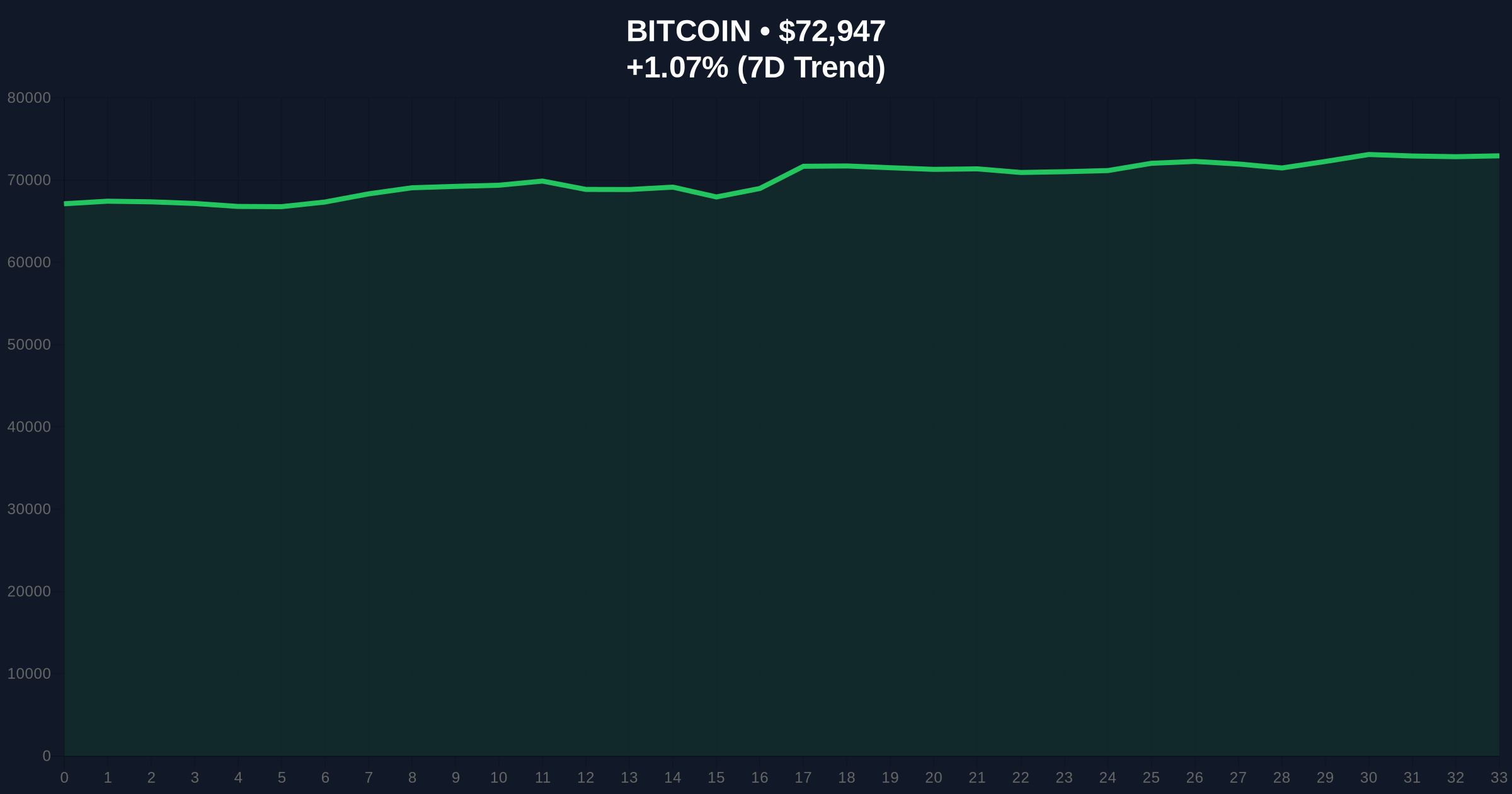
On April 11, 2026, the Bitcoin market revealed a stark division after six weeks of geopolitical conflict, with price stability masking a deepening structural split. Bitcoin has held a range of $65,000 to $73,000, but this surface calm depends entirely on a handful of mandated institutional buyers absorbing selling pressure from whales, miners, and other discretionary holders. The market's future hinges on whether concentrated inflows can sustain this absorption and push beyond the $73,000 ceiling, as extreme fear sentiment persists and selling accelerates among traditional accumulators.
The data a market in tension: Bitcoin's price was $72,931 with a 24-hour trend of 1.05%, according to CoinGecko, while the Fear and Greed Index registered "Extreme Fear" at a score of 15/100. During the war period, the price range tightened between $65,000 and $73,000, with $600 million liquidation events occurring. Key metrics highlight the split: Strategy added 4,871 BTC for $329.9 million at an average of $67,718 per coin on April 5, while whales reversed from buying 200,000 BTC annually to selling 188,000 BTC, and listed miners liquidated over 19,000 BTC in a single week. Source: CoinGecko, Source: public statement.
| Metric | Value | Source |
|---|---|---|
| Bitcoin Price | $72,931 | CoinGecko |
| 24h Trend | 1.05% | CoinGecko |
| Fear & Greed Score | 15/100 (Extreme Fear) | Market data |
| Price Range (War Period) | $65,000 - $73,000 | Public statement |
| Strategy Purchase (April 5) | 4,871 BTC for $329.9M | Public statement |
| Whale Selling Reversal | 400,000 BTC swing | Public statement |
This split matters now because it exposes Bitcoin's fragility during crises: institutional mandates are propping up the market while traditional support erodes. Why now? The war has amplified risk aversion, testing Bitcoin's resilience as a safe-haven asset. Who benefits? Mandated buyers like Strategy and ETF providers gain accumulation opportunities at lower prices, while discretionary sellers face pressure to exit amid volatility. Time horizons: Short-term, stability depends on continued institutional inflows; long-term, sustainability requires broader market participation. Causal chain: War triggers selling by whales and miners → mandated buyers absorb supply → price stabilizes in range → if inflows slow, selling could overwhelm bids → price risks breaking support.
The market split operates through a mechanical imbalance in buying and selling pressures. On the buy side, entities like Strategy and U.S. spot Bitcoin ETFs purchase based on structural mandates, Strategy's STRC product inflows fund accumulation, while ETFs see concentrated flows, with Swiss-listed products accounting for 70% of global ETP inflows. This creates a steady, non-discretionary bid. On the sell side, whales and miners liquidate due to operational strains or sentiment shifts, with whale holdings swinging by 400,000 BTC annually. The mechanism hinges on liquidity absorption: mandated buyers soak up discretionary sales, preventing price collapses but concentrating market dependence. Consequently, price stability becomes a function of institutional capital flows rather than organic demand.
This dynamic mirrors trends in adjacent crypto sectors, where institutionalization drives market structure shifts. For instance, Ethereum sees similar patterns with Bitmine Immersion Technologies accumulating 71,252 ETH in a week. However, Bitcoin's split is more pronounced due to its larger market cap and ETF dominance. Key comparisons include:
The bullish narrative of sustained stability faces significant risks. Key uncertainties include:
Practically, this split implies near-term market fragility. Traders should monitor institutional flow data and whale wallet movements for signs of imbalance. If mandated buying holds, Bitcoin may test $73,000 resistance; if not, support levels could be challenged. Longer-term, increased institutional dependence may reduce retail influence but also heighten systemic risk if key buyers pivot.
Historically, Bitcoin markets have shown resilience during crises, but the current split reflects a maturation phase where institutional players dominate liquidity. Since the 2024 bull market, whale behavior has shifted from accumulation to distribution, while ETF approvals in 2025 introduced new mandated buyers. This structural evolution makes the war period a stress test for Bitcoin's new market architecture.
Cross-market reactions include heightened scrutiny on resistance levels, as seen in analyst warnings about Bitcoin's $73K test. Additionally, whale activity in other assets, such as significant token deposits to exchanges, echoes the discretionary selling trend. Regulatory discussions, like those around SEC clarity for XRP, could influence institutional participation. These developments underscore broader market tensions amid the Bitcoin split.
In summary, Bitcoin's market split during war reveals a fragile stability underpinned by mandated institutional buyers against a backdrop of widespread discretionary selling. While price has held range-bound, the concentration of buying pressure raises sustainability questions. The path forward depends on balancing these forces, with extreme fear sentiment highlighting underlying vulnerabilities.
What to watch next: By Shaurya Malwa|Edited by Omkar Godbole Apr 11, 2026, 12:02 p.m.; Riot Platforms, MARA Holdings, and Genius Group disclosed selling more than 19,000 BTC from their treasuries in a single week earlier this month..
Evidence & Sources
Primary source: https://www.coindesk.com/markets/2026/04/10/the-bitcoin-market-is-splitting-in-two-here-s-who-is-buying-and-selling-amid-the-war
Updated at: Apr 11, 2026, 02:06 PM
Data window: Apr 11, 2026, 02:02 PM → Apr 11, 2026, 02:05 PM
Evidence stats: 9 metrics, 4 timeline points.
Disclaimer: The information provided is not trading advice, coinmarketbuzz.com holds no liability for any investments made based on the information provided on this page. We strongly recommend independent research and/or consultation with a qualified professional before making any investment decisions.
All published reports are reviewed by our editorial team for factual consistency, neutrality, and reader clarity.