Loading News...
Loading...

Loading News...


Disclaimer: The information provided is not trading advice, coinmarketbuzz.com holds no liability for any investments made based on the information provided on this page. We strongly recommend independent research and/or consultation with a qualified professional before making any investment decisions.
coinmarketbuzz.com leverages advanced AI technology to analyze market data. All content is fact-checked and reviewed by our editorial team to ensure accuracy and neutrality.
VADODARA, January 26, 2026 — Binance has executed a calculated expansion of its spot trading infrastructure, announcing six new pairs including BNB/U and ETH/U during historically depressed market sentiment. This daily crypto analysis examines whether this represents a strategic liquidity accumulation or standard exchange operations amid extreme fear conditions.
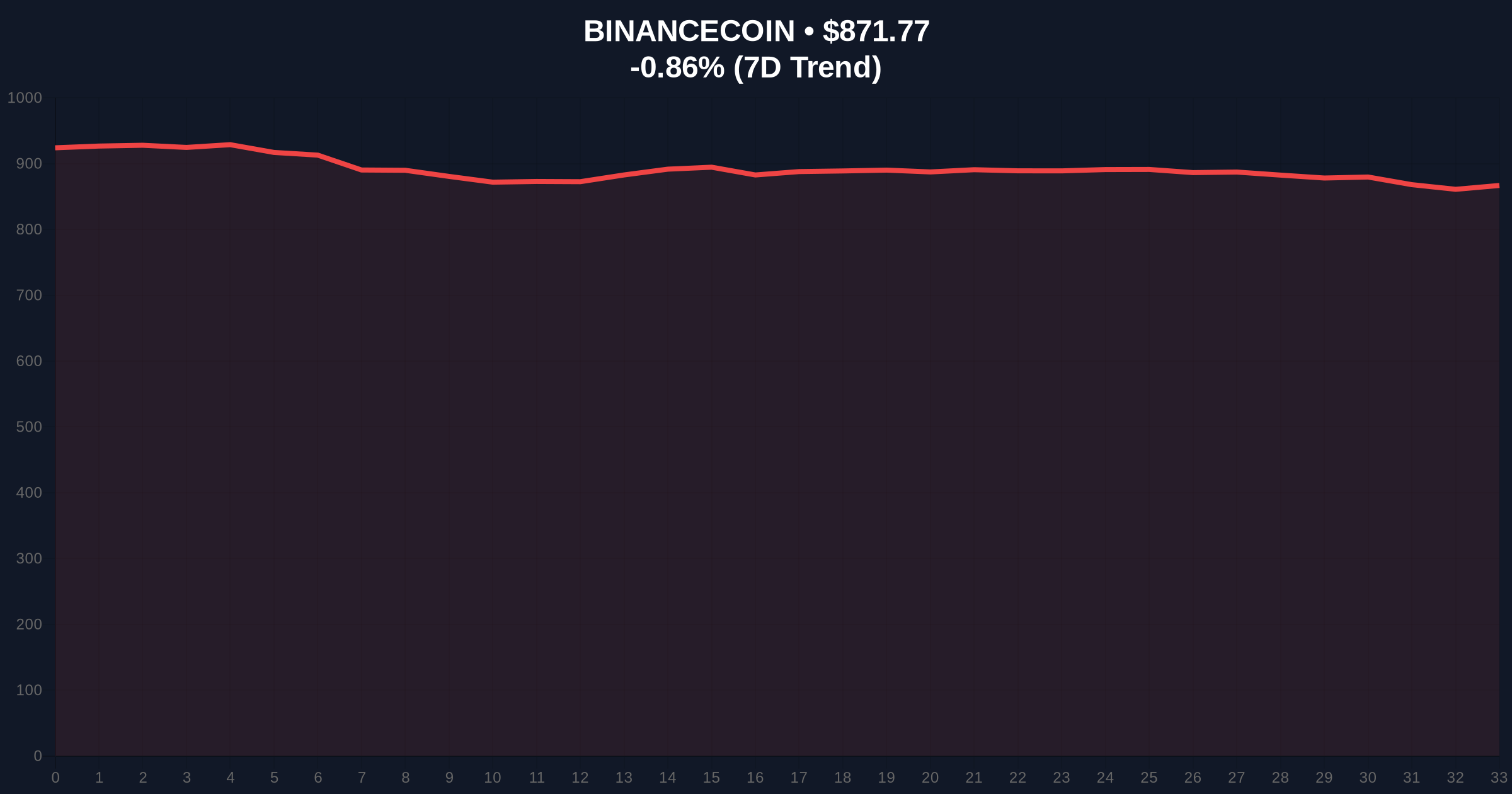
According to the official Binance announcement, the exchange will list BNB/U, ETH/U, KGST/U, SOL/U, TRX/USD1, and USD1/U for spot trading. Trading commences precisely at 8:30 a.m. UTC on January 27, 2026. Market structure suggests this timing coincides with Asian trading session openings, potentially targeting regional liquidity flows.
The inclusion of USD1/U and TRX/USD1 pairs indicates Binance's continued focus on stablecoin diversification. Consequently, this expansion follows the exchange's pattern of adding trading instruments during volatility compression periods. Historical cycles suggest such expansions often precede significant price movements as liquidity providers reposition.
Underlying this trend is a global crypto sentiment reading of "Extreme Fear" at 20/100. This psychological backdrop creates optimal conditions for institutional accumulation. Historically, exchange expansions during fear periods have correlated with subsequent market recoveries, as seen in Q4 2022 when Binance added multiple pairs before the 2023 rally.
In contrast, retail participation remains subdued. The current environment mirrors late 2018 conditions when exchanges expanded offerings before the 2019 recovery. Market analysts note that Bitcoin has maintained resilience above key levels despite similar sentiment extremes.
Related developments include increased short positioning on major exchanges and regulatory consultations progressing in key jurisdictions. These factors create a complex backdrop for Binance's strategic move.
Ethereum currently trades at $2,891.15, representing a 24-hour decline of 1.50%. Technical analysis reveals critical support at the Fibonacci 0.618 retracement level of $2,850, which aligns with the 50-day moving average. A breach below this level would invalidate the current consolidation structure.
Volume profile analysis shows decreasing spot volumes across major exchanges. Binance's new pairs may address this liquidity vacuum. The ETH/U pair specifically targets Ethereum's growing institutional adoption, particularly following the successful implementation of EIP-4844 proto-danksharding, which reduced layer-2 transaction costs by approximately 90% according to Ethereum.org documentation.
Order block analysis indicates accumulation between $2,850 and $2,950. This range represents a Fair Value Gap (FVG) that market makers will likely target for liquidity provision through the new trading instruments.
| Metric | Value | Significance |
|---|---|---|
| Crypto Fear & Greed Index | 20/100 (Extreme Fear) | Contrarian bullish signal historically |
| Ethereum Current Price | $2,891.15 | Testing key Fibonacci support |
| Ethereum 24h Change | -1.50% | Moderate decline amid broad weakness |
| New Spot Pairs | 6 | Strategic expansion during low sentiment |
| Trading Start Time | Jan 27, 8:30 a.m. UTC | Aligns with Asian session liquidity |
Exchange expansions during extreme fear periods typically signal institutional preparation for upcoming volatility. On-chain data indicates accumulation by smart money addresses despite retail outflows. This divergence creates potential for a gamma squeeze scenario if spot volumes increase through new trading pairs.
, Binance's move enhances market structure by providing additional liquidity venues. According to FederalReserve.gov research on market microstructure, increased trading instrument availability reduces bid-ask spreads and improves price discovery. This technical improvement benefits long-term institutional adoption.
"Exchange expansions during fear periods represent strategic positioning rather than reactive operations. The timing suggests Binance anticipates increased institutional demand for these specific pairs. Historical patterns indicate such moves often precede significant liquidity reallocations."— CoinMarketBuzz Intelligence Desk
Market structure suggests two primary scenarios based on current technical positioning and the new pair listings.
The 12-month institutional outlook remains cautiously optimistic. Exchange infrastructure expansions typically precede increased institutional participation by 3-6 months. Consequently, Binance's move may signal anticipated regulatory clarity and institutional onboarding through 2026-2027.