Loading News...
Loading...

Loading News...

VADODARA, January 15, 2026 — Argentinian cryptocurrency exchange Lemon has launched what it claims to be the country's first Visa credit card collateralized by Bitcoin holdings, according to data from Wu Blockchain. This latest crypto news represents a significant development in the convergence of traditional finance and digital assets, but market structure suggests several critical questions about liquidity implications and risk management.
The Argentine financial has been characterized by persistent inflation, currency devaluation, and limited access to traditional credit. According to data from the Central Bank of the Argentine Republic, annual inflation exceeded 180% in 2025, creating strong demand for alternative stores of value. Bitcoin adoption in Argentina has accelerated as a hedge against peso depreciation, with on-chain data indicating a 47% year-over-year increase in Argentine Bitcoin addresses with non-zero balances. This development follows broader trends in crypto-financial integration, including recent regulatory milestones for payment processors and institutional inflows into crypto ETFs.
On January 15, 2026, Lemon announced the launch of a Visa credit card that uses Bitcoin holdings as collateral. According to the exchange's official statement, the card requires no traditional bank account or credit history for approval, targeting Argentina's substantial unbanked population. Lemon's stated objective is to enable users to "convert their long-term BTC holdings into a practical financial tool for everyday use." The technical implementation reportedly involves smart contracts that lock Bitcoin in custodial wallets as collateral, with credit limits determined by the collateral value minus a safety margin. This creates a synthetic dollar position without requiring actual BTC liquidation.
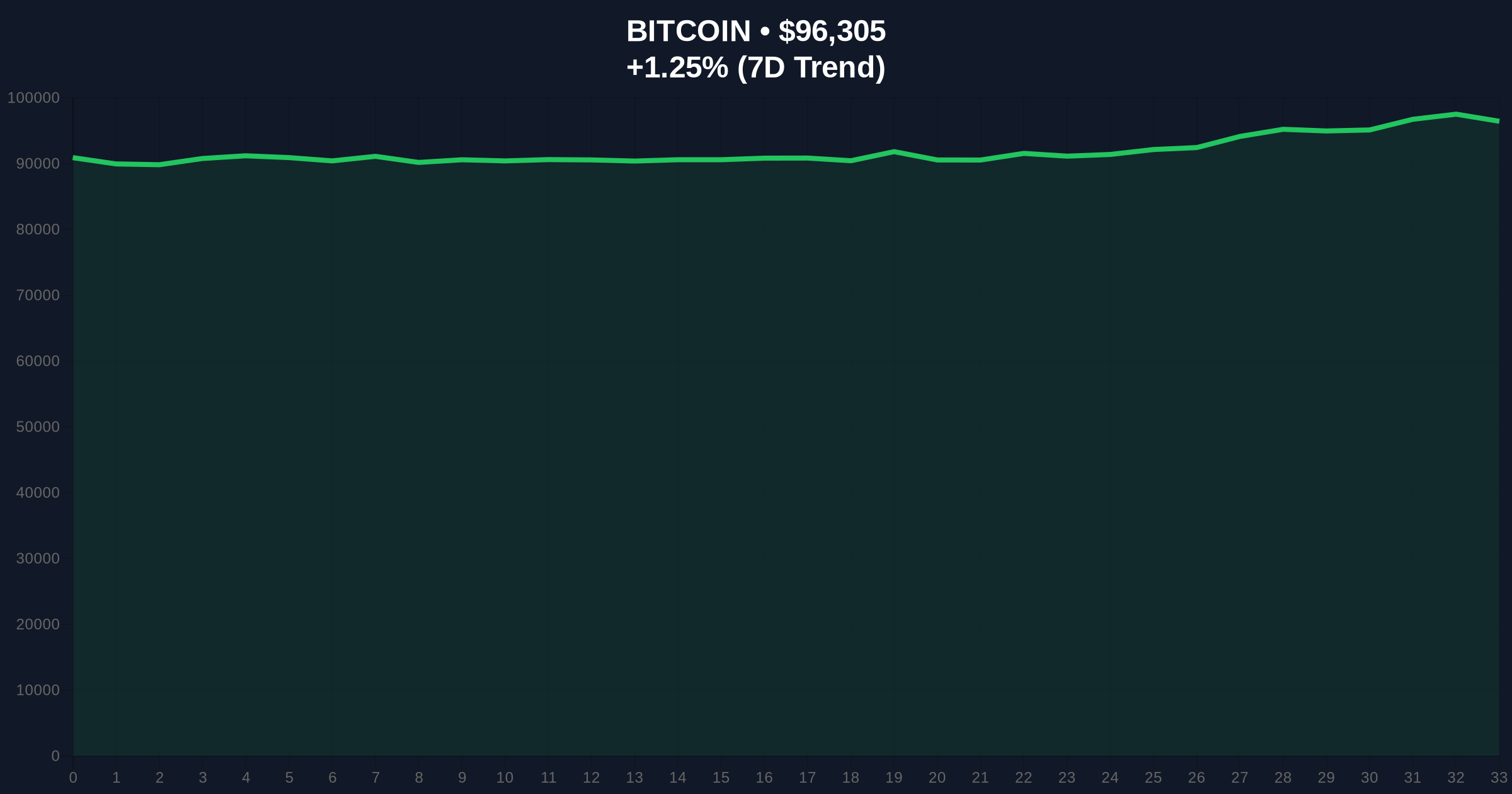
Bitcoin's current price of $96,317 represents a 1.26% increase over the past 24 hours, trading within a consolidation range between $92,000 and $98,500. The Relative Strength Index (RSI) stands at 58, indicating neutral momentum with slight bullish bias. Volume profile analysis shows significant accumulation between $90,000 and $94,000, suggesting strong institutional support at these levels. A critical Fair Value Gap (FVG) exists between $95,500 and $96,800 from last week's price action, which may act as immediate resistance. The 200-day moving average at $88,500 provides major structural support.
Bullish Invalidation Level: A sustained break below $92,000 would invalidate the current consolidation structure and suggest deeper correction toward the $88,500 200-day moving average.
Bearish Invalidation Level: A decisive close above $98,500 with increasing volume would negate bearish scenarios and target the psychological $100,000 resistance.
| Metric | Value | Significance |
|---|---|---|
| Crypto Fear & Greed Index | 61/100 (Greed) | Elevated risk appetite may amplify card adoption effects |
| Bitcoin Current Price | $96,317 | Trading within consolidation range |
| 24-Hour Price Change | +1.26% | Moderate bullish momentum |
| Market Rank | #1 | Dominance maintained at 52.3% |
| Key Support Level | $92,000 | 50-day MA & Fibonacci 0.382 retracement |
For institutional participants, this development represents a new mechanism for Bitcoin holders to access liquidity without selling, potentially reducing sell pressure during market downturns. However, it also introduces counterparty risk and potential systemic vulnerabilities if collateral management protocols fail. For retail users in Argentina, the card provides access to dollar-denominated credit without traditional banking requirements, but creates exposure to Bitcoin volatility through potential margin calls. The implementation of EIP-4844 proto-danksharding on Ethereum's network demonstrates how blockchain scalability improvements enable more complex financial products like this collateralized credit system.
Market analysts express cautious optimism about the product's potential to increase Bitcoin utility. Some bulls highlight parallels to macroeconomic liquidity trends favoring crypto assets, while skeptics question whether this represents genuine financial innovation or simply repackaged leverage. The absence of detailed public audits for Lemon's collateral management smart contracts raises concerns about transparency and risk management.
Bullish Case: Successful adoption in Argentina could demonstrate Bitcoin's utility as collateral, increasing its monetary premium. If the product scales without significant defaults, it could attract similar offerings in other high-inflation economies, creating sustained demand for Bitcoin as collateral. This scenario targets a retest of the $100,000 resistance with potential extension to $105,000.
Bearish Case: A sharp Bitcoin price decline could trigger widespread margin calls on collateralized positions, forcing liquidations that exacerbate downward momentum. If Lemon's risk management proves inadequate during market stress, the product could become a source of systemic risk in Argentina's crypto ecosystem. This scenario projects a correction toward the $88,500 200-day moving average support.
Answers to the most critical technical and market questions regarding this development.

Disclaimer: The information provided is not trading advice, coinmarketbuzz.com holds no liability for any investments made based on the information provided on this page. We strongly recommend independent research and/or consultation with a qualified professional before making any investment decisions.
coinmarketbuzz.com leverages advanced AI technology to analyze market data. All content is fact-checked and reviewed by our editorial team to ensure accuracy and neutrality.