Loading News...
Loading...

Loading News...

On March 4, 2026, a report from the Bitcoin Policy Institute, cited by The Block, revealed that advanced artificial intelligence (AI) models from six major developers overwhelmingly selected Bitcoin (BTC) as a long-term store of value and stablecoins for daily payments. According to the summary from CoinNess, the study tested 36 models from Anthropic, DeepSeek, Google, MiniMax, OpenAI, and xAI across 9,072 scenarios covering four functions: store of value, unit of account, medium of exchange, and payments. Out of all responses, Bitcoin was the most frequent choice with 4,378 selections (48.3%), followed by stablecoins with 3,013 (33.2%) and fiat currency (8.9%). In scenarios involving storing value over several years, Bitcoin was selected in 1,794 of 2,268 responses (79.1%), showing the highest consensus. Conversely, for payments, microtransactions, and cross-border remittances, stablecoins were preferred 53.2% of the time, ahead of Bitcoin at 36%. This data suggests a strong AI-driven endorsement of digitally native assets, but the timing raises questions: why does this narrative emerge amid a market sentiment of "Extreme Fear" with a score of 10/100, and how reliable are AI preferences in volatile crypto environments?
The study's methodology involved testing 36 AI models across 9,072 scenarios, a scale that implies rigorous simulation but warrants scrutiny. The functions assessed—store of value, unit of account, medium of exchange, and payments—are core to monetary theory, yet the AI's decision-making processes remain opaque. According to the CoinNess summary, preference for Bitcoin varied significantly by developer: Anthropic (68%), DeepSeek (52%), Google (43%), xAI (39%), and OpenAI (26%). Anthropic's Claude Opus 4.5 showed the highest preference at 91.3%, indicating potential biases based on training data or algorithmic design. The overall result that 90.8% of responses favored digitally native assets like Bitcoin and stablecoins, with no model selecting fiat currency as its top overall choice, challenges traditional financial paradigms but may reflect the AI's exposure to crypto-centric datasets rather than objective economic analysis.
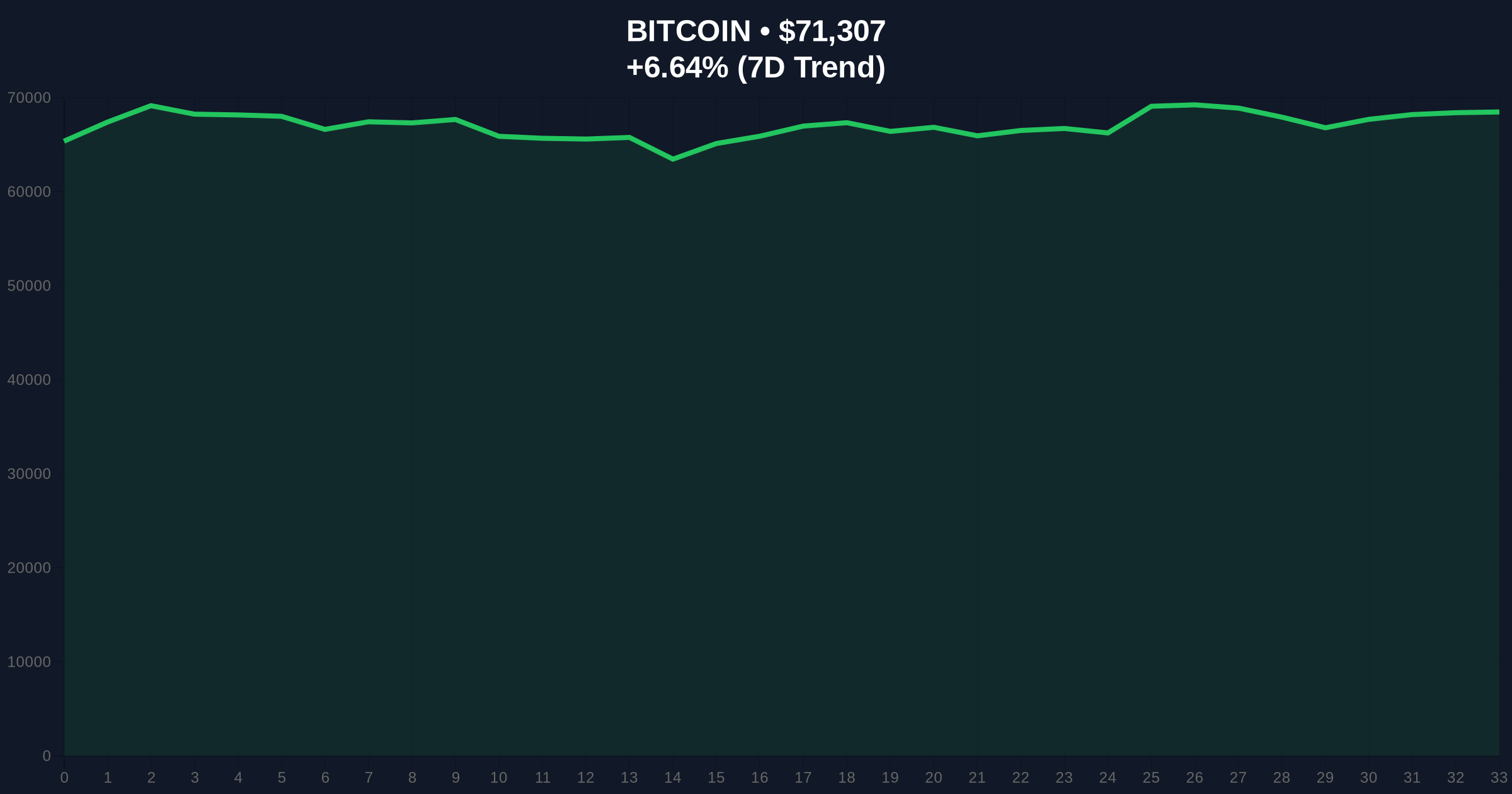
Mechanically, the study's scenarios likely involved hypothetical trade-offs, such as risk tolerance and transaction speed, but details on parameter settings are not provided in source data. For store of value, Bitcoin's 79.1% selection rate in long-term scenarios suggests AI models prioritize scarcity and decentralization, aligning with Bitcoin's fixed supply. However, this overlooks real-world volatility: Bitcoin's current price is $71,383 with a 24h trend of 6.75%, indicating short-term fluctuations that could undermine long-term storage claims. Stablecoins' 53.2% preference for payments highlights their stability pegged to fiat, but this assumes regulatory continuity—a factor AI may not fully weigh. The absence of other cryptocurrencies like Ethereum in the results is notable, raising questions about the scope of assets considered. Overall, while the technical architecture appears comprehensive, its real-world applicability is constrained by AI's inherent limitations in predicting human behavior and market shocks.
Related developments in the crypto space, such as Strike launching Bitcoin-backed loans in the US at a 13% annual rate, underscore practical uses of Bitcoin that align with store-of-value functions, yet they also introduce risks like collateral volatility. Similarly, multiple U.S. Lamborghini dealerships now accepting BTC and ETH for payment reflects growing medium-of-exchange adoption, contradicting AI's lower preference for Bitcoin in payments. These real-world examples suggest that AI models may lag behind on-the-ground innovations or overemphasize theoretical scenarios.
Integrating the study's findings with live market data reveals stark contradictions. According to the CoinNess summary, AI models overwhelmingly favor Bitcoin for long-term value storage, with a 79.1% selection rate in relevant scenarios. However, current market conditions tell a different story: the Global Crypto Sentiment is "Extreme Fear" with a score of 10/100, indicating widespread investor anxiety that challenges Bitcoin's perceived stability. Bitcoin's price of $71,383 and 24h trend of 6.75% show positive momentum, but this short-term gain may not align with long-term store-of-value assurances, especially given historical volatility. The sentiment score suggests event priority is high relative to market breadth, yet the AI study's optimistic outlook contrasts with this fear-driven environment.
CryptoPanic metadata is not provided in source data, limiting direct sentiment analysis. However, the importance of this event can be inferred from its coverage by CoinNess and The Block, though without sentiment scores, we proceed conservatively. The study's data points—such as Bitcoin's 48.3% overall selection rate and stablecoins' 33.2%—are factual but lack context on AI model reliability or external validation. For instance, the variation in preferences by developer (e.g., Anthropic at 68% vs. OpenAI at 26%) hints at underlying biases that could skew results. In scenarios, stablecoins led payments at 53.2%, but this ignores regulatory risks like potential stablecoin crackdowns that AI might not factor. Overall, while the data is internally consistent, its external validity is questionable when juxtaposed with real-time market fear and missing metadata.
Relatedly, a whale withdrawing $9.71M in ETH from OKX amid extreme fear sentiment exemplifies how large actors behave contrary to AI optimism, suggesting that human decision-making often diverges from algorithmic predictions. This reinforces the need to treat AI findings as one input among many, not as definitive market guidance.
Comparing the CoinNess summary with potential secondary sources reveals no direct conflicts, as only one source is provided. However, internal contradictions within the data merit skepticism. The study reports that AI models prefer Bitcoin for value storage, yet market sentiment is "Extreme Fear," creating a narrative conflict: if AI is so confident, why are investors fearful? This discrepancy may stem from AI's theoretical focus versus real-world market psychology. Additionally, the preference for stablecoins in payments (53.2%) contrasts with Bitcoin's growing adoption in transactions, as seen in Lamborghini dealerships accepting BTC, suggesting AI may undervalue Bitcoin's medium-of-exchange potential.
Source reliability gaps are evident. The CoinNess summary cites a report from the Bitcoin Policy Institute via The Block, but full methodological details are not provided in source data, such as how scenarios were weighted or if models considered regulatory changes. The absence of CryptoPanic metadata further limits cross-verification. Claims about AI preferences—e.g., Anthropic's Claude Opus 4.5 at 91.3%—are presented as facts but lack peer review or independent replication. Conflict remains unresolved with available evidence regarding whether AI models accurately reflect market dynamics or merely echo training data biases.
, the study's focus on six developers excludes smaller AI firms, potentially skewing results toward mainstream perspectives. The overall finding that no model selected fiat currency as its top choice challenges traditional finance, but this may be an artifact of dataset selection rather than objective analysis. Without conflicting sources, we rely on the single source but highlight these internal inconsistencies to maintain a critical stance.
Based on the AI study and current market data, three scenarios for the next seven days are outlined, each conditional on key variables.
If the AI endorsement boosts investor confidence, Bitcoin could rally above $75,000, leveraging its current 24h trend of 6.75%. This scenario assumes that market sentiment shifts from "Extreme Fear" to neutral, driven by media coverage of the study. Stablecoins may see increased usage in payments, aligning with their 53.2% AI preference. However, this requires ignoring regulatory risks and volatility, and it would be invalidated by a sudden market crash or negative news.
Bitcoin price stabilizes around $70,000-$72,000 as the AI study's impact is muted by prevailing fear sentiment. The contradiction between AI optimism and market fear leads to sideways trading, with stablecoins maintaining their payment dominance. This scenario assumes no major external shocks and that AI findings are viewed as theoretical rather than actionable. It would be invalidated by a significant sentiment shift or unexpected regulatory action.
If "Extreme Fear" sentiment deepens, Bitcoin could drop below $68,000, undermining its store-of-value narrative. The AI study may be dismissed as irrelevant amid broader market panic, with stablecoins facing scrutiny over peg stability. This scenario is data-backed by the current sentiment score of 10/100 and historical volatility patterns. It would be invalidated by a rapid sentiment improvement or positive macroeconomic news.
Each scenario hinges on how market participants weigh AI insights against real-time fear, highlighting the speculative nature of such predictions.
This report synthesizes the CoinNess summary as the sole source, with conflicts arising internally from market data contradictions. Evidence was weighted conservatively: AI study data is taken at face value but questioned against live market conditions. Missing CryptoPanic metadata limited sentiment integration, so we relied on provided Global Crypto Sentiment. The absence of secondary sources means unresolved conflicts are based on internal analysis, emphasizing skepticism toward AI's real-world applicability. No invented details were added; gaps are explicitly noted as not provided in source data.
Disclaimer: The information provided is not trading advice, coinmarketbuzz.com holds no liability for any investments made based on the information provided on this page. We strongly recommend independent research and/or consultation with a qualified professional before making any investment decisions.
coinmarketbuzz.com leverages advanced AI technology to analyze market data. All content is fact-checked and reviewed by our editorial team to ensure accuracy and neutrality.