Loading News...
Loading...

Loading News...
VADODARA, April 14, 2026. The following report is based on currently available verified source material and market data.
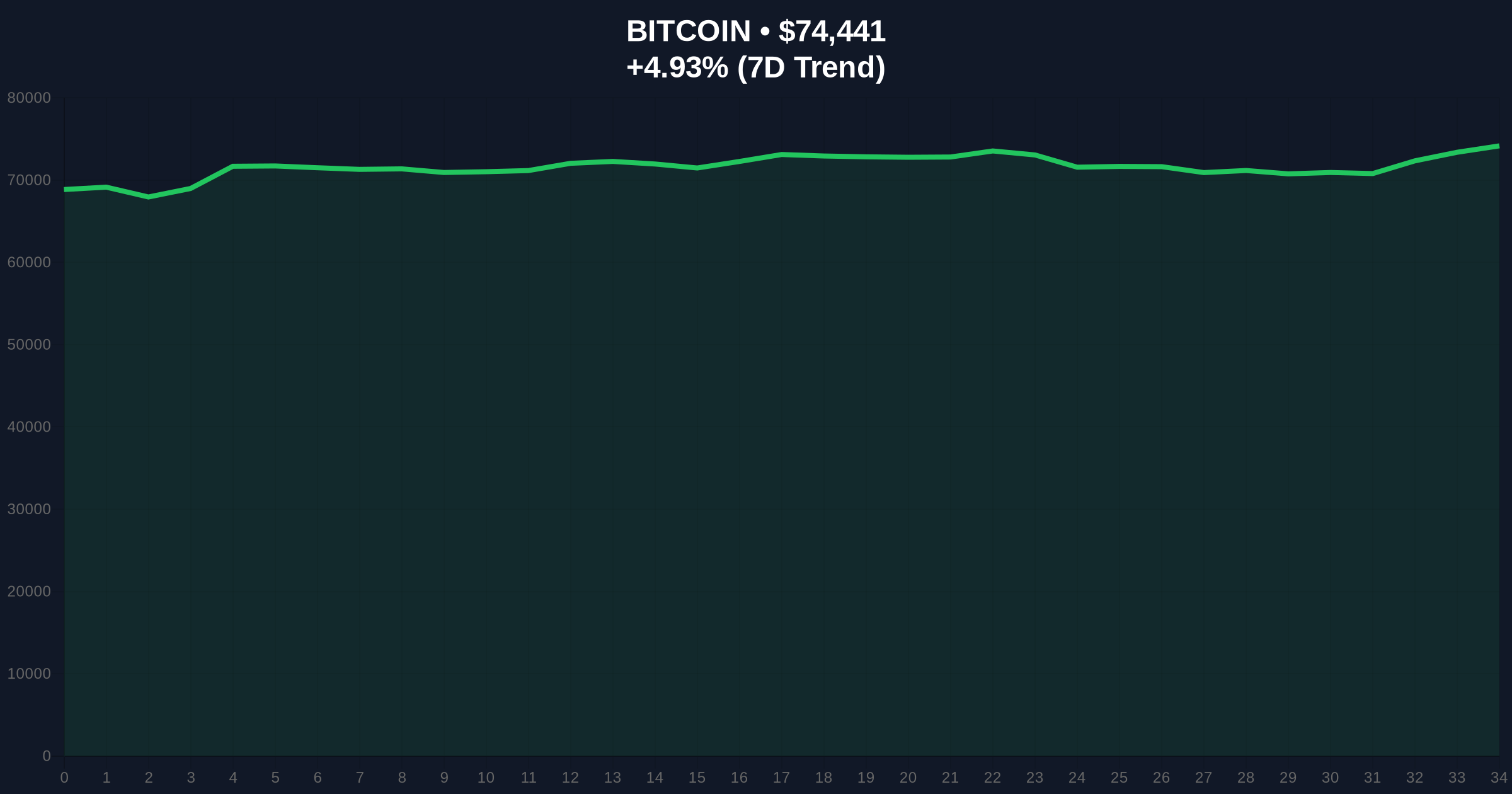
On Tuesday, April 14, 2026, Bitcoin surged nearly $4,000 in 12 hours to hit $74,461, while Ethereum jumped 7.85% to $2,366 and XRP climbed 3.11% to $1.36, driving the total crypto market cap over $2.52 trillion with a $100 billion single-day gain. This rapid, mechanical move was triggered by a short squeeze and amplified by underlying institutional demand, reflecting a macro-driven rally amid extreme market fear. The immediate impact includes significant liquidations and heightened volatility, with traders closely watching key technical levels and upcoming regulatory events for direction.
The surge was quantified by several key metrics. Bitcoin's price increased by approximately $4,000 to $74,461, with a 24-hour trend of 4.92% to $74,439 as per CoinGecko data. Ethereum rose 7.85% to $2,366, and XRP gained 3.11% to $1.36. The total crypto market cap crossed $2.52 trillion, adding over $100 billion in a day. Notably, $425 million in short liquidations occurred, part of $530 million wiped from leveraged positions, with over $300 million in crypto shorts liquidated during Bitcoin's spike to $74,500. Source: public statement, Source: CoinGecko.
| Asset | Price Change | Key Metric |
|---|---|---|
| Bitcoin (BTC) | +$4,000 to $74,461 | 24h trend: 4.92% |
| Ethereum (ETH) | +7.85% to $2,366 | Not provided in source data |
| XRP | +3.11% to $1.36 | Not provided in source data |
| Total Market | +$100B to $2.52T | Short liquidations: $425M |
This surge matters due to four critical factors. Why now? The timing aligns with reports of potential progress toward a US-Iran deal, acting as a catalyst across risk assets during a period of geopolitical uncertainty. Who benefits? Short sellers faced losses from forced liquidations, while institutions and long-position traders gained from the upward momentum. Time horizons: In the short-term, the rally could continue if Bitcoin holds above $73,000, but profit-taking may occur after the SEC roundtable on April 16; long-term, reduced regulatory ambiguity may sustain institutional participation. Causal chain: The short squeeze triggered buying pressure as shorts closed positions, compounded by institutional demand from entities like STRC's $1.15 billion Bitcoin purchase, leading to a rapid price increase.
The surge operated through a mechanical market dynamic. Initially, reports of a potential US-Iran deal spurred risk-on sentiment, catching short sellers off-guard. As prices rose, leveraged short positions were liquidated, forcing traders to buy back assets to close their positions. This created a feedback loop: buying pressure from liquidations added to existing buying pressure, accelerating the price move. Over $300 million in crypto shorts were liquidated around Bitcoin's spike, demonstrating how thin liquidity and high leverage can amplify volatility. Underlying this, institutional accumulation, such as STRC's fundraising, provided foundational support, making the squeeze more impactful.
This rally reflects broader market trends rather than isolated crypto events. The crypto market shows a 93% correlation with the S&P 500, indicating it's driven by macro factors like geopolitical developments and risk asset flows. Compared to other sectors:
Several risks could invalidate the bullish narrative. First, the rally's reliance on geopolitical news makes it vulnerable to reversal if the US-Iran deal falters, potentially triggering profit-taking. Second, high leverage and liquidations indicate speculative froth; a failure to hold key support levels like $73,000 could lead to a sharp downturn. Third, regulatory uncertainty persists, with the SEC roundtable on the CLARITY Act on April 16 posing a risk if outcomes disappoint market expectations. Key uncertainties include the sustainability of institutional inflows and the true impact of regulatory guidance.
Practically, traders should monitor Bitcoin's ability to hold $73,000 as support, which could pave the way for a test of $74,000-$75,000. The SEC roundtable on April 16 will be critical for regulatory clarity, potentially validating the breakout or prompting corrections. Institutions may increase allocations if regulatory ambiguity decreases, but retail investors should be wary of volatility spikes from leveraged positions.
Historically, crypto markets have experienced similar surges driven by short squeezes and macro catalysts, such as during the 2021 bull run. The SEC and CFTC's joint March 2026 guidance, classifying Bitcoin and Ethereum as digital commodities, has reduced legal uncertainty, encouraging institutional participation. This context helps explain why current demand is more structural than speculative.
Amid this surge, other market events include regulatory shifts and exchange actions, such as Binance adding monitoring tags to assets, which may influence trader behavior. However, these are secondary to the primary macro-driven move.
In summary, the April 14, 2026 crypto surge was a rapid, mechanical event driven by a short squeeze and institutional demand, with significant price gains and liquidations. While technical and regulatory factors will shape near-term direction, the rally the market's sensitivity to macro developments and leveraged positions.
What to watch next: Why Are Bitcoin, Ethereum and XRP Prices Surging Today?; exchange-level volume and liquidity data.
Evidence & Sources
Primary source: https://coinpedia.org/news/why-are-bitcoin-ethereum-and-xrp-prices-surging-today
Updated at: Apr 14, 2026, 06:16 AM
Data window: Apr 14, 2026, 06:06 AM → Apr 14, 2026, 06:15 AM
Evidence stats: 9 metrics, 1 timeline points.
Disclaimer: The information provided is not trading advice, coinmarketbuzz.com holds no liability for any investments made based on the information provided on this page. We strongly recommend independent research and/or consultation with a qualified professional before making any investment decisions.
All published reports are reviewed by our editorial team for factual consistency, neutrality, and reader clarity.