Loading News...
Loading...

Loading News...

VADODARA, April 20, 2026. The following report is based on currently available verified source material and market data.
On April 20, 2026, Bitcoin and other major cryptocurrencies experienced modest declines as renewed U.S.-Iran tensions triggered a sharp spike in oil prices and a drop in traditional equities. Bitcoin traded at $74,335, down 1.6% over 24 hours, while Brent crude jumped 5.7% to $95.50 a barrel. This event matters because it tests Bitcoin's evolving role as a potential geopolitical shock absorber, with the crypto market showing reduced sensitivity compared to earlier escalations, even as global risk sentiment shifts.
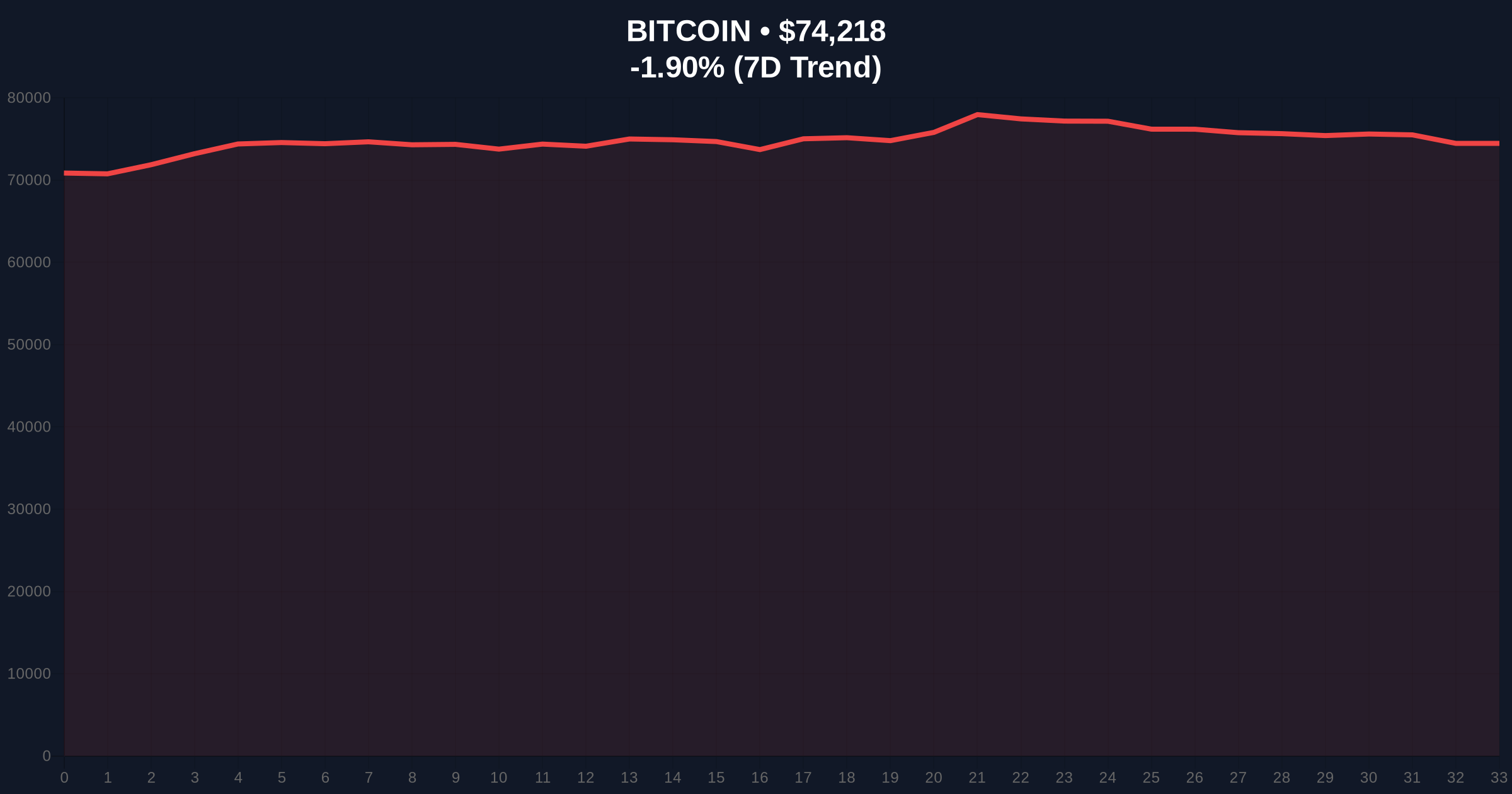
The immediate market reaction to the weekend flare-up reveals a divergence between crypto and traditional assets. Bitcoin's 1.6% pullback was modest compared to Brent crude's 5.7% surge and a 1.2% drop in European equity futures. Ether slipped 2.6% to $2,272, and Solana fell 1.5% to $84. Despite the decline, Bitcoin remained up 4.8% on the week, trading around key levels of $74,000 to $73,000 that traders are monitoring for confirmation of its resilience. Source: public statement. The broader crypto market sentiment registered as "Fear" with a score of 29/100, according to CoinGecko data, while Bitcoin's price was $74,216 with a 24-hour trend of -1.90%. Source: CoinGecko.
| Asset | Price/Value | 24h Change | Source |
|---|---|---|---|
| Bitcoin (BTC) | $74,216 | -1.90% | CoinGecko |
| Brent Crude | $95.50/barrel | +5.7% | public statement |
| Ether (ETH) | $2,272 | -2.6% | public statement |
| Global Crypto Sentiment | Fear (29/100) | N/A | CoinGecko |
This event is significant now because it represents the fourth major Iran-related risk event since the conflict began, with each successive flare-up showing a compressed crypto reaction. Why now? The market is at a critical juncture where Bitcoin's price hovers around $74,000, a level that could validate or break its emerging reputation as a geopolitical hedge. Who benefits? Long-term holders and institutional investors via spot ETF bids may gain if Bitcoin proves resilient, while short-term traders face volatility from headline-driven swings. Time horizons: In the short term, traders watch for breaks below $73,000 or holds above $74,000; longer-term, this could reinforce Bitcoin's role in diversified portfolios during crises. Causal chain: Geopolitical tension → increased oil prices and equity sell-offs → crypto market absorbs shock with smaller declines due to reduced selling pressure from already-exited holders or ETF support → potential confirmation of Bitcoin as a shock absorber.
The mechanism behind Bitcoin's relative resilience involves market structure and investor behavior. Initially, geopolitical events like Iran reimposing controls on the Strait of Hormuz trigger risk-off sentiment in traditional markets, leading to oil spikes and equity drops. In crypto, the effect is mediated by reduced sell-side liquidity: holders who would sell on Iran headlines may have already exited in earlier escalations, thinning the order book. Additionally, spot ETF inflows provide a mechanical floor, as institutional buying absorbs selling pressure more reliably than futures-driven gaps. This results in a smaller price impact compared to assets like oil, which reprices each headline fresh due to immediate supply-demand shocks.
Compared to other market sectors, crypto's reaction stands out for its muted response. While oil and equities show heightened volatility to geopolitical risks, Bitcoin's declining sell-off magnitude suggests it may be decoupling from traditional risk assets in such scenarios. However, this contrasts with ongoing vulnerabilities in decentralized finance (DeFi), where recent hacks like the $292 million Kelp exploit have triggered liquidity crises, indicating that crypto's internal risks remain high even as external shocks are absorbed.
The bullish narrative of Bitcoin as a geopolitical shock absorber faces several risks. First, the data relies on a limited sample of four Iran-related events; a more severe escalation could break the pattern and trigger a sharper crypto sell-off. Second, correlation with traditional markets might reassert itself if bond yields or the dollar strengthen, pulling Bitcoin lower through risk-parity channels. Third, the assumption that selling pressure has been exhausted is untested; new negative headlines could prompt fresh exits from retail or institutional holders.
Practically, if Bitcoin holds $74,000 through further Strait of Hormuz deterioration, it could solidify its role in risk-off portfolios, attracting more institutional interest. Conversely, a breakdown might lead to retests of lower supports, forcing a reevaluation of its hedge properties. Traders should monitor bond yields and dollar strength for early signals, as these could dictate short-term price action more than geopolitical headlines alone.
Historically, Bitcoin has experienced volatile reactions to geopolitical events, but recent trends show a pattern of diminishing impacts. This shift coincides with increased institutional adoption via spot ETFs, which may provide more stable buying pressure. The current conflict began with earlier escalations that produced sharper crypto drawdowns, suggesting market adaptation over time.
Amid this geopolitical tension, the crypto industry faces unrelated challenges, such as the $292 million Kelp DAO hack that has exposed structural risks in DeFi, leading to significant deposit withdrawals in protocols like Aave. These events highlight that while Bitcoin may be absorbing external shocks, internal vulnerabilities persist, requiring strengthened operational frameworks to combat hacking.
Bitcoin's modest decline amid renewed U.S.-Iran tensions suggests a growing resilience, but risks remain from macro correlations and untested selling pressure. The market's reaction provides a data point for its evolving role, yet traders must stay vigilant for breaks in key levels that could alter this narrative.
What to watch next: By Shaurya Malwa Apr 20, 2026, 5:36 a.m.; Earlier escalations produced sharper drawdowns in bitcoin than this one, with each successive flare-up compressing the magnitude of the crypto reaction even as oil and equities continue to price each headline fresh..
Evidence & Sources
Primary source: https://www.coindesk.com/markets/2026/04/20/bitcoin-ether-solana-slide-oil-jumps-on-renewed-u-s-iran-war-risks
Updated at: Apr 20, 2026, 07:40 AM
Data window: Apr 20, 2026, 07:36 AM → Apr 20, 2026, 07:39 AM
Evidence stats: 9 metrics, 4 timeline points.
Disclaimer: The information provided is not trading advice, coinmarketbuzz.com holds no liability for any investments made based on the information provided on this page. We strongly recommend independent research and/or consultation with a qualified professional before making any investment decisions.
All published reports are reviewed by our editorial team for factual consistency, neutrality, and reader clarity.