Loading News...
Loading...

Loading News...
VADODARA, April 3, 2026. The following report is based on currently available verified source material and market data.
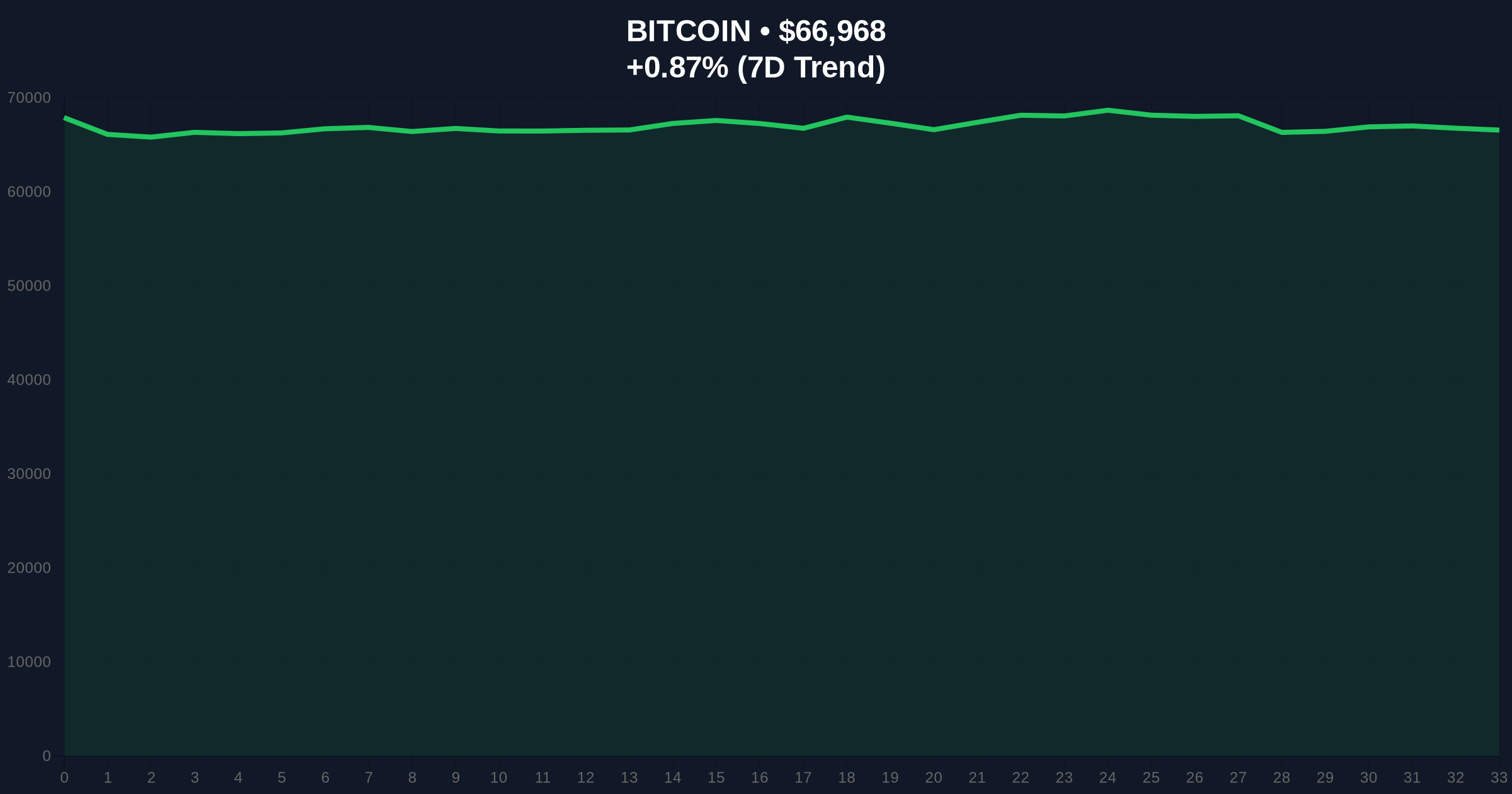
On April 3, 2026, an anonymous whale deposited 689.34 Bitcoin (BTC), valued at approximately $46.17 million, into the Binance exchange, as reported by on-chain analytics platform Onchain Lens. This event matters because large deposits to centralized exchanges are often interpreted as precursors to selling, potentially increasing sell-side pressure on Bitcoin's price. The move occurs against a backdrop of "Extreme Fear" in the broader crypto market, with Bitcoin trading at $66,972 and showing a modest 24-hour gain of 0.89%, raising questions about whether this whale action signals a local top or is merely routine portfolio management.
The deposit consisted of 689.34 BTC, worth $46.17 million at the time of the transaction. Source: exchange data. Bitcoin's current price is $66,972, with a 24-hour trend of +0.89%. Source: CoinGecko. The exact timing of the deposit within April 3, 2026, is not provided in source data. The global crypto sentiment is "Extreme Fear," scoring 9 out of 100, indicating widespread investor caution. Source: CoinGecko.
| Metric | Value | Source |
|---|---|---|
| BTC Deposited | 689.34 BTC | Exchange data |
| USD Value | $46.17 million | Exchange data |
| Bitcoin Price | $66,972 | CoinGecko |
| 24h Trend | +0.89% | CoinGecko |
| Market Sentiment | Extreme Fear (9/100) | CoinGecko |
Why now? The deposit arrives as Bitcoin hovers near $67,000 amid extreme market fear, a psychological level that often triggers profit-taking by large holders. If this whale intends to sell, it could test market resilience at a sensitive juncture.Who benefits? Short-term traders may benefit from increased liquidity and potential volatility, while other whales could face diluted holdings if selling pressure mounts. Retail investors risk being caught in a downdraft if the deposit triggers a broader sell-off.Time horizons: Short-term (days/weeks): Immediate price impact depends on whether the whale sells and how quickly. Long-term (months/years): The event may be forgotten unless it marks a trend of whale distribution.Causal chain: Whale deposits BTC to exchange → exchange wallets accumulate sellable supply → if sold, increased sell-side liquidity absorbs buy orders → price faces downward pressure → retail sentiment may worsen, reinforcing fear.
Whale deposits to exchanges mechanically increase the available supply on order books. When a whale moves assets from a private wallet to an exchange like Binance, those coins become readily accessible for market orders. If the whale places sell orders, they directly add to the sell-side liquidity. Given the size ($46.2M), even partial selling could absorb significant buy-side depth, potentially pushing the price down if demand doesn't match. This mechanism is amplified in thin markets or during low-volume periods, where large orders have outsized impact.
This whale move contrasts with broader market trends where Bitcoin shows slight gains despite extreme fear. Other altcoins and protocols face their own dynamics, but large BTC movements often set a tone for crypto at large.
The bullish narrative, that this deposit signals imminent selling and price decline, faces several uncertainties:
In the near term, traders should monitor Binance's order books for large sell orders matching this deposit size. If selling occurs, it could validate the bearish interpretation; if not, it may be a false alarm. Regulatory or macroeconomic shifts could overshadow this event, as seen in related geopolitical developments.
Whale movements are closely watched in crypto markets due to Bitcoin's relatively concentrated ownership. Large transfers to exchanges have historically preceded price corrections, but not always, highlighting the need for cautious interpretation. The "Extreme Fear" sentiment score of 9/100 suggests underlying market fragility that could amplify reactions to such events.
Recent market context includes:
The $46.2M BTC deposit to Binance is a notable on-chain event that warrants scrutiny but not panic. While it aligns with typical sell signals, the lack of confirmatory data and the market's current fear state mean its impact remains uncertain. Investors should weigh this against broader factors like geopolitical risks and exchange developments.
Q1: What does a whale deposit to an exchange usually mean?It often signals potential selling, as exchanges facilitate easy liquidation, but can also indicate other activities like borrowing or staking.Q2: How significant is $46.2M in the Bitcoin market?Relative to Bitcoin's multi-billion dollar daily volume, it's a small fraction, but in low-liquidity conditions, it can still impact price.Q3: Why is the market in "Extreme Fear"?Not provided in source data, but factors like price volatility, regulatory news, or macroeconomic events often drive such sentiment.Q4: Should I sell my Bitcoin because of this whale move?Not necessarily; individual decisions should consider overall portfolio strategy, not isolated events lacking full context.Q5: What other data should I watch?Monitor exchange order flows, subsequent whale actions, and broader market indicators like volume and sentiment shifts.Q6: How does this compare to past whale deposits?Not provided in source data; historical analysis would require additional on-chain data beyond this report.
Traders and analysts are now watching for follow-on transactions from the whale address 15HWQZ and any corresponding sell orders on Binance to confirm or refute the selling hypothesis.
Evidence & Sources
Primary source: https://coinness.com/news/1153541
Updated at: Apr 03, 2026, 11:06 AM
Data window: Apr 03, 2026, 11:04 AM → Apr 03, 2026, 11:05 AM
Evidence stats: 5 metrics, 0 timeline points.
Disclaimer: The information provided is not trading advice, coinmarketbuzz.com holds no liability for any investments made based on the information provided on this page. We strongly recommend independent research and/or consultation with a qualified professional before making any investment decisions.
All published reports are reviewed by our editorial team for factual consistency, neutrality, and reader clarity.