Loading News...
Loading...

Loading News...
VADODARA, April 7, 2026. The following report is based on currently available verified source material and market data.
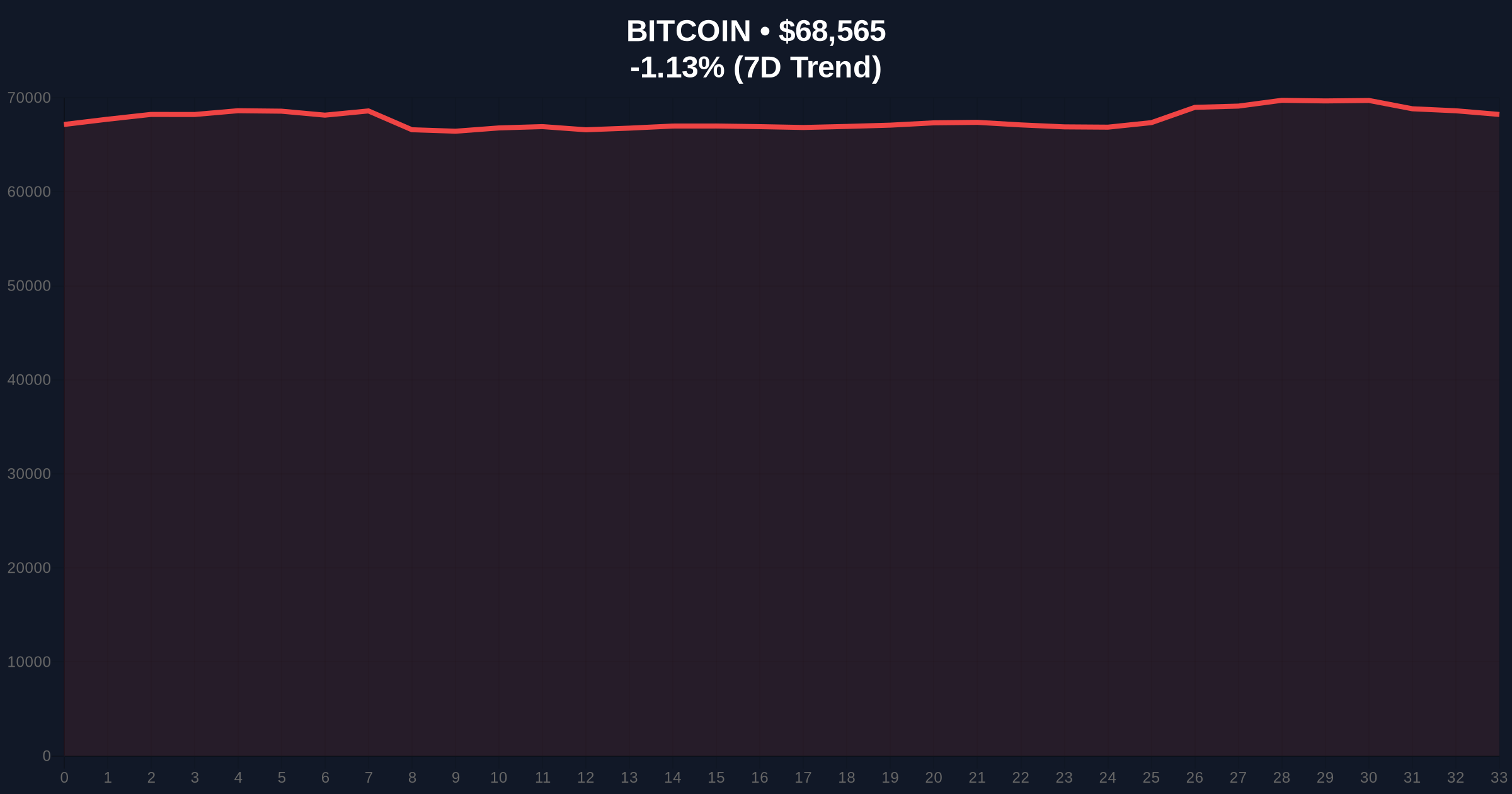
On April 7, 2026, former President Donald Trump declared a "total regime change" in Iran via Truth Social, setting an 8pm ET deadline, as Bitcoin traded at $68,355, down 1.61% on the day. This follows Iran's rejection of a 45-day ceasefire proposal on Monday, which had briefly pushed Bitcoin above $70,000. The event matters because it highlights Bitcoin's sensitivity to geopolitical tensions, with the cryptocurrency whipsawing in a $65,000-$70,000 band throughout the conflict, erasing gains built on peace signals and falling on escalations. Current market impact shows Bitcoin at $68,541, down 1.25% in 24 hours, amid "Extreme Fear" sentiment, raising questions about the sustainability of price movements driven by political rhetoric.
Bitcoin's price volatility is directly tied to geopolitical developments in the Iran conflict. Key metrics include a current price of $68,541 (Source: CoinGecko), a 24-hour decline of 1.25% (Source: CoinGecko), and a daily drop of 1.61% to $68,355 (Source: public statement). The cryptocurrency had previously surged above $70,000 on Monday due to ceasefire hopes, only to fall back as tensions escalated. Not provided in source data for trading volume or specific strike impacts. The following table summarizes critical data points:
| Metric | Value | Source |
|---|---|---|
| Bitcoin Current Price | $68,541 | CoinGecko |
| 24h Trend | -1.25% | CoinGecko |
| Price at Declaration | $68,355 | Public statement |
| Daily Decline | -1.61% | Public statement |
| Previous High | $70,000+ | Public statement |
| Trading Band | $65K-$70K | Public statement |
Why now? The significance stems from Bitcoin's position in a volatile $65,000-$70,000 range, where any geopolitical shift can trigger sharp price movements. With global crypto sentiment at "Extreme Fear" (Score: 11/100), the market is highly reactive to news, making Trump's declaration a critical trigger during a period of fragile stability. Who benefits? Short-term traders and whales may capitalize on volatility, while retail investors face increased risk of losses due to rapid price swings. Institutions monitoring geopolitical risks might adjust exposure, but the primary beneficiaries are those leveraging momentum trades. Time horizons: In the short-term (days/weeks), Bitcoin is likely to remain volatile, with prices reacting to each development in the conflict. Longer-term (months/years), repeated geopolitical shocks could undermine Bitcoin's narrative as a stable store of value if correlations with traditional risk assets intensify. Causal chain: The mechanism works as follows: geopolitical escalation (e.g., regime change declaration) → increased market uncertainty → risk-off sentiment among traders → selling pressure on Bitcoin → price decline. Conversely, peace signals → reduced uncertainty → buying pressure → price recovery. This pattern has been consistent, with Bitcoin rising on de-escalation hopes and falling on conflict news, as noted by QCP Capital.
The underlying mechanism involves market psychology and liquidity dynamics. When Trump posts on Truth Social about progress in ceasefire talks, it creates a perception of reduced geopolitical risk, leading traders to buy Bitcoin in anticipation of stability. This buying absorbs available sell-side liquidity, pushing prices higher, as seen when Bitcoin climbed to $67,800 on "great progress" posts. Conversely, when Iran rejects proposals or escalations are announced, fear triggers sell-offs, with thin buy-side liquidity exacerbating declines. For instance, Bitcoin fell 2.2% earlier today before the regime change post, per Bloomberg, indicating preemptive selling based on anticipated negative news. The "Iran Reverse Indicator" theory suggests that Iran's denials systematically reverse market gains from Trump's peace signals, creating a predictable but risky trading pattern. Mechanically, this relies on high-frequency traders and algorithms reacting to news feeds, amplifying price movements beyond fundamental valuations.
Bitcoin's reaction to geopolitical events contrasts with other crypto sectors, where developments may be more insulated. For example, while Bitcoin swings on Iran news, altcoins and DeFi projects might focus on technical upgrades or regulatory changes. However, heightened volatility often spills over, affecting overall market sentiment. Related developments in the crypto space include:
The bearish scenario questions whether Bitcoin's price movements are fundamentally justified or merely speculative reactions to headlines. Key risks include:
In the near term, traders should monitor the 8pm ET deadline for de-escalation or escalation, as Bitcoin will likely test support near $65,000 or resistance toward $70,000 based on the outcome. If strikes escalate as threatened by Defense Secretary Hegseth, Bitcoin could breach the lower band, potentially triggering stop-losses and increased selling. Conversely, a peaceful resolution might push prices back toward $70,000, but gains could be capped by residual fear. Practically, this event the need for risk management strategies, such as hedging with stablecoins or diversifying into less correlated assets, to mitigate geopolitical shocks.
Bitcoin has historically shown sensitivity to geopolitical events, but the Iran conflict has created a pronounced pattern since early 2026. The cryptocurrency's role as a "digital gold" is tested during such crises, with its price often moving inversely to traditional risk-off assets in the short term. Previous instances, like tensions in Ukraine, saw similar volatility, but the current scenario is unique due to direct social media influence from political figures and a defined trading band.
Cross-market reactions are limited in the source data, but the crypto industry's response includes platforms adapting to volatility. For instance, amid recent market swings, exchanges have implemented measures like Binance's trading guardrails to prevent abnormal executions, reflecting broader efforts to stabilize markets during geopolitical turmoil.
Trump's regime change declaration has intensified Bitcoin's volatility, highlighting its vulnerability to geopolitical headlines. While patterns of rising on peace signals and falling on escalations have held, skepticism is warranted regarding the sustainability of these movements. Traders must weigh the risks of overreaction against the potential for abrupt shifts as the Iran conflict evolves.
What to watch next: Tehran said it wants a permanent end to the war, not a 45-day pause, and that “negotiations are entirely incompatible with ultimatums.” Trump called the proposal “a significant step but not good enough.” Defense Secretary Hegseth told reporters: “Today will be the largest volume of strikes since day one.; Tomorrow, even more than today.” Bitcoin’s Iran Pattern: Every Peace Signal, Every Dump This whipsaw is not new..
Evidence & Sources
Primary source: https://coinpedia.org/news/breaking-trump-declares-total-regime-change-in-iran-bitcoin-at-68k-and-falling
Updated at: Apr 07, 2026, 03:28 PM
Data window: Apr 07, 2026, 02:57 PM → Apr 07, 2026, 03:17 PM
Evidence stats: 9 metrics, 3 timeline points.
Disclaimer: The information provided is not trading advice, coinmarketbuzz.com holds no liability for any investments made based on the information provided on this page. We strongly recommend independent research and/or consultation with a qualified professional before making any investment decisions.
All published reports are reviewed by our editorial team for factual consistency, neutrality, and reader clarity.