Loading News...
Loading...

Loading News...

VADODARA, April 12, 2026. The following report is based on currently available verified source material and market data.
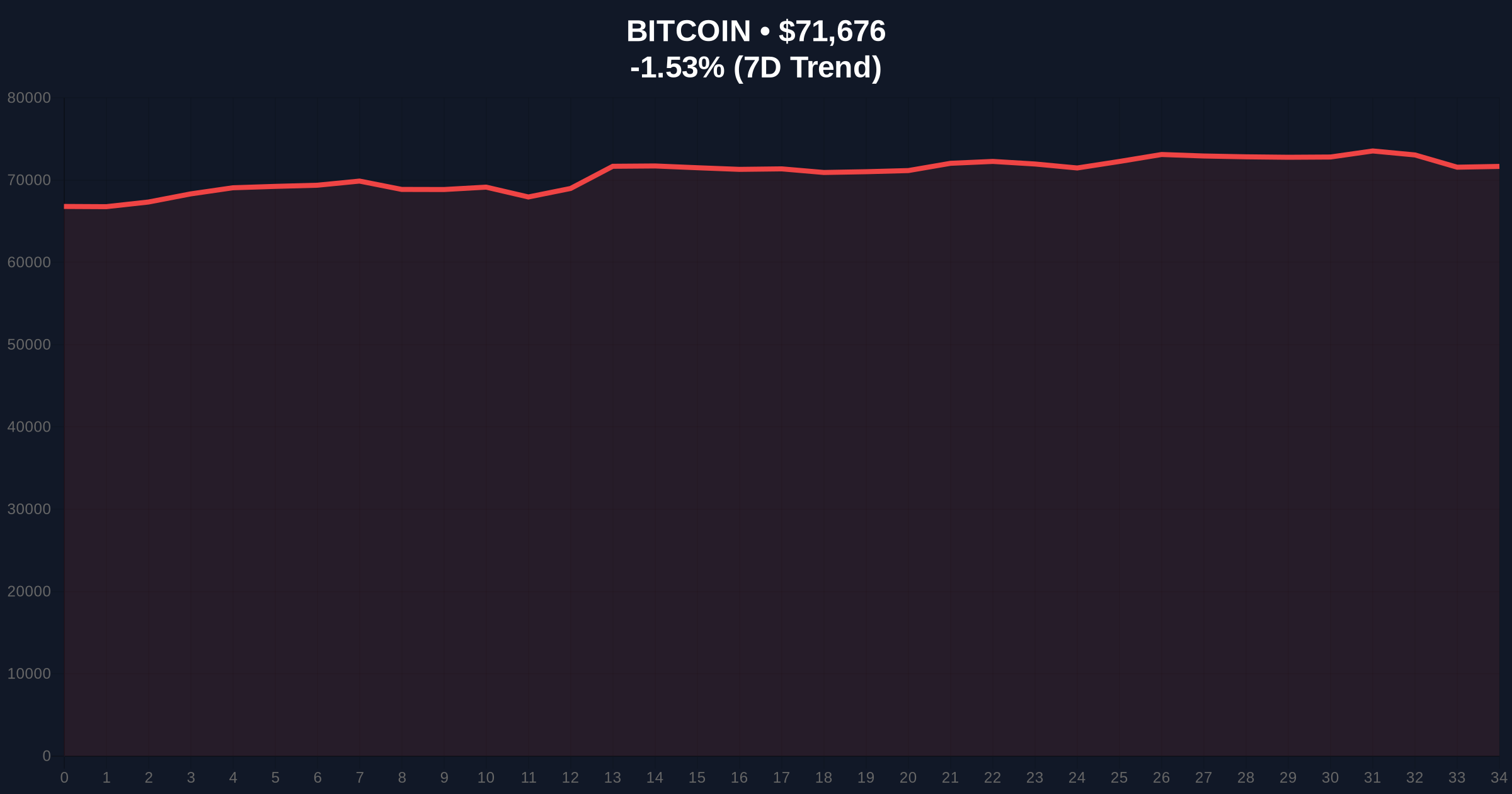
Bitcoin and other major cryptocurrencies fell sharply late Saturday evening U.S. hours on April 12, 2026, after U.S. Vice President J.D. Vance announced that negotiations with Iran had failed to reach an extended ceasefire. The immediate market reaction saw prices drop between 1.5% and 2%, with Bitcoin trading around $71,600 and the broader CoinDesk 20 index falling to 1,188.52. This development matters because geopolitical instability is driving risk-off sentiment across crypto markets, amplifying existing volatility and testing key support levels.
The market response was swift and broad-based following the announcement. Bitcoin fell from approximately $71,682.38 to around $71,600, representing a decline of just under 2%. Ether dropped to about $2,200, XRP slid to $1.33, and the CoinDesk 20 index fell to 1,188.52, all showing similar percentage losses. According to CoinGecko data, Bitcoin's current price stands at $71,669 with a 24-hour trend of -1.54%, while global crypto sentiment registers as "Extreme Fear" with a score of 16/100.
| Asset | Price After Announcement | Approximate Decline | Source |
|---|---|---|---|
| Bitcoin (BTC) | $71,600 | ~2% | Source: public statement |
| Ether (ETH) | $2,200 | ~2% | Source: public statement |
| XRP | $1.33 | ~2% | Source: public statement |
| CoinDesk 20 Index | 1,188.52 | ~2% | Source: public statement |
| Bitcoin 24h Trend | -1.54% | Not provided in source data | Source: CoinGecko |
Why now? The timing is significant because crypto markets were already experiencing heightened volatility amid ongoing geopolitical tensions. The failure to reach a ceasefire after a daylong session in Pakistan represents a breakdown in diplomatic efforts that markets had been monitoring closely.
Who benefits? Short-term bears and risk-averse traders benefit from the downward momentum, while long-term holders face immediate paper losses. Market makers and arbitrageurs may capitalize on increased volatility, but retail investors typically bear the brunt of rapid price swings.
Time horizons: In the short term (days/weeks), the failure reinforces bearish sentiment and could lead to further testing of support levels. Longer-term (months/years), the impact depends on whether geopolitical tensions escalate or de-escalate, potentially affecting crypto's correlation with traditional risk assets.
Causal chain: The announcement triggered a risk-off reaction → algorithmic and institutional selling pressure increased → liquidity drained from order books → prices fell across major cryptocurrencies → fear sentiment amplified the downward move.
The market mechanism here involves geopolitical news flow directly impacting risk sentiment. When Vice President Vance announced the negotiation failure, algorithmic trading systems likely detected the negative headline and executed sell orders. This initial selling pressure hit thin weekend liquidity, causing disproportionate price moves. The cascade effect occurred as stop-loss orders were triggered and margin positions faced liquidation pressure, particularly in leveraged perpetual markets. The "Extreme Fear" sentiment reading of 16/100 indicates that market participants were already positioned defensively, making them more likely to sell on negative news.
This geopolitical-driven selloff contrasts with recent market movements driven by fundamental factors:
The bearish scenario could deepen if several conditions materialize:
Uncertainty remains about the actual negotiation details and whether diplomatic channels remain open. The failure condition for the bearish narrative would be a rapid de-escalation of tensions or unexpected positive developments in subsequent negotiations.
Practically, traders should monitor several near-term developments. First, watch for follow-through selling on Monday when traditional markets reopen and liquidity typically improves. Second, observe whether Bitcoin holds key support levels around $71,000-$71,500, which could determine the short-term trend direction. Third, monitor correlation with traditional risk assets like equities, which may provide clues about whether this is an isolated crypto move or part of broader risk aversion.
The negotiations followed the U.S.'s nearly six-week long campaign against Iran, with sticking points including nuclear weapon development, the Strait of Hormuz, war reparations, sanctions relief, and ending regional hostilities. Iranian spokesperson Esmaeil Baqaei noted that "numerous messages and texts have been exchanged" and discussions covered "various dimensions of the main negotiation topics" in the past 24 hours.
This geopolitical selloff occurs alongside several other market-moving developments:
The failed U.S.-Iran ceasefire negotiations triggered an immediate 2% decline across major cryptocurrencies, demonstrating crypto's continued sensitivity to geopolitical risk events. While the short-term impact reflects classic risk-off behavior, longer-term implications depend on whether diplomatic efforts resume or tensions escalate further.
Q1: How much did Bitcoin fall after the announcement?Bitcoin fell approximately 2%, trading around $71,600 after the announcement compared to approximately $71,682.38 before.
Q2: What were the sticking points in the negotiations?According to Vice President Vance, sticking points included Iran's nuclear program, with the U.S. insisting Iran "not seek a nuclear weapon and they will not seek the tools that would enable them to quickly achieve a nuclear weapon."
Q3: How did other cryptocurrencies perform?Ether fell to about $2,200, XRP slid to $1.33, and the CoinDesk 20 index dropped to 1,188.52, all showing similar percentage declines of just under 2%.
Q4: What is the current market sentiment?Global crypto sentiment registers as "Extreme Fear" with a score of 16/100 according to CoinGecko data.
Q5: Where did the negotiations take place?The daylong session occurred in Pakistan on Saturday, April 12, 2026.
Q6: What happens next in the diplomatic process?Not provided in source data. Both sides have indicated discussions occurred but haven't reached agreement, leaving future diplomatic steps uncertain.
Traders are now watching whether Bitcoin can hold key support levels and how traditional markets react when they reopen on Monday, as well as any further developments in U.S.-Iran diplomatic channels.
Evidence & Sources
Primary source: https://www.coindesk.com/markets/2026/04/11/bitcoin-and-other-cryptos-fall-as-u-s-iranian-negotiators-fail-to-reach-war-resolution
Updated at: Apr 12, 2026, 10:18 AM
Data window: Apr 12, 2026, 04:05 AM → Apr 12, 2026, 10:17 AM
Evidence stats: 9 metrics, 6 timeline points.
Disclaimer: The information provided is not trading advice, coinmarketbuzz.com holds no liability for any investments made based on the information provided on this page. We strongly recommend independent research and/or consultation with a qualified professional before making any investment decisions.
All published reports are reviewed by our editorial team for factual consistency, neutrality, and reader clarity.