Loading News...
Loading...

Loading News...

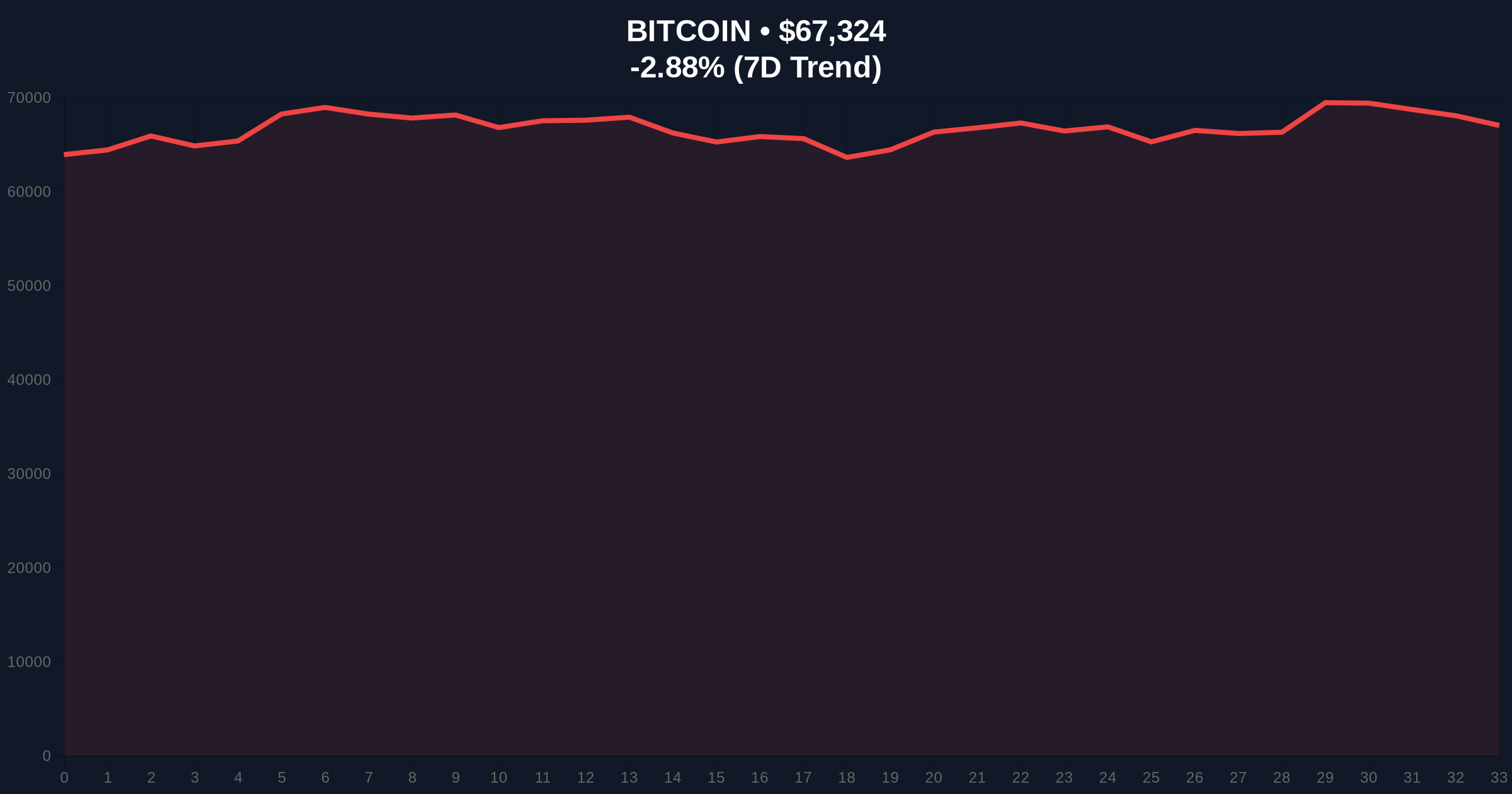
On March 3, 2026, Tether, the issuer of the USDT stablecoin, and the Swiss city of Lugano announced a joint investment of five million Swiss francs, approximately $5.6 million, to advance the second phase of "Plan ₿," a project aimed at building out Bitcoin infrastructure within the city. This development, reported by CoinNess, marks a continuation of a partnership initially unveiled in March 2022, with the goal of creating a global hub for digital infrastructure. The second phase involves a broader strategy focused on digital infrastructure, resilience, and long-term technological autonomy, as detailed in the source data. The announcement comes at a time when Bitcoin's price stands at $67,223, reflecting a 24-hour decline of 2.04%, and global crypto sentiment is categorized as "Extreme Fear" with a score of 14/100, indicating heightened market anxiety. This investment represents a notable commitment amidst broader economic uncertainties, but its immediate impact on Bitcoin's price trajectory remains uncertain, given the contrasting market conditions.
The "Plan ₿" project, as outlined in the CoinNess report, is a multi-phase initiative designed to establish Lugano as a center for Bitcoin and digital infrastructure. The first phase, launched in March 2022, set the foundational goals, while the second phase, now funded by the 5 million Swiss franc investment, expands the scope to include digital infrastructure, resilience, and long-term technological autonomy. However, the specific technical mechanisms of this phase are not provided in the source data, leaving gaps in understanding how exactly the funds will be allocated or what specific infrastructure projects—such as nodes, payment systems, or educational programs—will be developed. Tether's involvement likely leverages its expertise in stablecoin technology and blockchain integration, but details on its operational role are absent. Underlying this trend is a broader movement by cities and corporations to adopt Bitcoin for economic diversification, yet without concrete technical blueprints, the efficacy of "Plan ₿" in achieving its stated goals remains speculative. Consequently, investors should scrutinize future disclosures for technical specifics, as vague terms like "digital infrastructure" and "resilience" may mask implementation challenges or limited scalability.
The partnership between Tether and Lugano raises questions about regulatory alignment and technical interoperability. Tether, as a major stablecoin issuer, operates in a complex regulatory environment, and its collaboration with a municipal government could influence local crypto policies. However, the source data does not detail any regulatory frameworks or compliance measures associated with "Plan ₿." This omission is significant, as regulatory hurdles often impede crypto infrastructure projects. , the focus on "long-term technological autonomy" suggests an aim to reduce dependency on external systems, potentially through decentralized networks, but without technical specifications, it is unclear how this will be achieved. In contrast to other initiatives, such as those explored in regulatory developments in the U.S., "Plan ₿" lacks detailed regulatory context, which could affect its sustainability. The investment's timing, amid Bitcoin's price decline and extreme market fear, may reflect a strategic bet on long-term value, but technical execution risks persist due to the absence of detailed plans.
Integrating market data from the input package reveals a complex backdrop for the "Plan ₿" announcement. Bitcoin's current price of $67,223 and a 24-hour trend of -2.04% indicate short-term bearish pressure, aligning with the global crypto sentiment of "Extreme Fear" (score: 14/100). This sentiment score, derived from the provided metadata, suggests that market participants are highly risk-averse, which could dampen the positive impact of the investment news. The importance of this event relative to market breadth is not explicitly quantified in the metadata, but given Bitcoin's rank as #1 by market capitalization, any infrastructure development could have broader implications. However, the sentiment contrast is stark: while the investment is a bullish signal for Bitcoin adoption, the overarching market fear may overshadow its effects, leading to muted price reactions. CryptoPanic metadata, such as sentiment and importance, is not provided in the source data for this specific event, limiting deeper analysis. Consequently, reliance on the available data—price decline and extreme fear—suggests that the market is currently driven more by macroeconomic or geopolitical factors than by isolated positive developments like "Plan ₿."
Further analysis of the investment's scale offers perspective. The 5 million Swiss francs (approx. $5.6 million) is a modest sum relative to Bitcoin's multi-trillion-dollar market cap, raising questions about its material impact. In comparison, other market movements, such as those discussed in geopolitical tensions affecting Bitcoin, may exert greater influence on price dynamics. The data does not include historical performance metrics for "Plan ₿" or Tether's previous investments, making it difficult to assess this initiative's potential success. Without additional metadata, such as trading volume changes or social media sentiment spikes post-announcement, the proof of market impact remains anecdotal. Thus, while the investment is a factual development, its significance in the current "Extreme Fear" environment is likely limited, emphasizing the need for cautious interpretation amid broader market downturns.
A critical examination of the source data reveals no direct contradictions, as only one primary source (CoinNess) is provided for the "Plan ₿" announcement. However, potential conflicts arise from missing evidence and contextual gaps. For instance, the CoinNess report states the investment amount and goals but does not include quotes from Tether or Lugano officials, detailed project timelines, or specific infrastructure targets. This lack of granularity contrasts with more comprehensive reports on similar initiatives, where multiple sources might verify funding sources or technical details. In this case, the absence of secondary sources means that claims about the project's scope—such as "digital infrastructure, resilience, and long-term technological autonomy"—are presented without corroboration, leaving room for skepticism. If other sources were available, they might dispute the feasibility or scale of these goals, but with the current data, conflict remains unresolved with available evidence.
Comparing this announcement to broader market narratives highlights indirect conflicts. The investment is framed as a positive step for Bitcoin adoption, yet the concurrent "Extreme Fear" sentiment and price decline suggest market participants are focused on negative factors, such as geopolitical risks or regulatory pressures. For example, surges in crypto transfers during crises indicate that Bitcoin is often used as a hedge, which might conflict with "Plan ₿'s" focus on infrastructure building. Additionally, optimistic projections like those in AI-driven deflation scenarios present a bullish long-term view that could either align with or contradict "Plan ₿'s" goals, depending on execution. Without direct source disputes, the primary conflict lies in the juxtaposition of a localized, positive development against a globally fearful market, raising questions about which narrative will dominate investor behavior. Investors should weigh the limited evidence for "Plan ₿" against the stronger data supporting market fear, recognizing that unverified claims may not offset broader negative trends.
Based on the available data, three scenarios for the next seven days can be constructed, each conditional on specific factors. The bull scenario assumes that the "Plan ₿" investment catalyzes renewed confidence in Bitcoin infrastructure, leading to a price rebound above $70,000. This would require additional positive developments, such as detailed project disclosures or partnerships, to counteract the "Extreme Fear" sentiment. However, given the modest investment size and lack of immediate technical details, this scenario has low probability unless broader market conditions improve, such as a reduction in geopolitical tensions. The base scenario, with moderate likelihood, envisions Bitcoin stabilizing around $67,000-$68,000, as the investment news is largely absorbed by prevailing fear. In this view, "Plan ₿" has minimal short-term impact, and price movements are driven more by external factors like regulatory news or macroeconomic indicators. The bear scenario, supported by the current -2.04% trend and extreme fear, predicts a further decline to $65,000 or below, as negative sentiment overwhelms isolated positive events. This could be exacerbated if no follow-up details emerge from Tether or Lugano, reinforcing skepticism about the project's viability.
Each scenario hinges on data-backed conditions. For the bull scenario to materialize, monitoring for increased trading volume or sentiment shifts in CryptoPanic metadata (not provided) would be essential. The base scenario depends on the status quo of fear persisting, with Bitcoin's rank as #1 providing some support against drastic drops. The bear scenario would be invalidated if "Plan ₿" announces concrete milestones that attract significant media attention or if global fear scores improve rapidly. Related developments, such as those in U.S. regulatory committees, could also influence outcomes by altering market perceptions of crypto legitimacy. Investors should prepare for volatility, recognizing that the investment's long-term benefits may not manifest in the short term, especially amid conflicting market signals.
This report was synthesized using the provided input package, with a focus on factual accuracy and skepticism. The primary source, CoinNess, reported the "Plan ₿" announcement, but its reliability is assessed as moderate due to the absence of corroborating secondary sources or detailed evidence. Missing data, such as CryptoPanic metadata for this event, limited deeper sentiment analysis, and gaps in technical details reduced the weight given to optimistic claims. Conflicting evidence was not present in direct form, but contextual conflicts with market data (e.g., extreme fear vs. positive investment) were highlighted. Claims were weighted based on available support: market stats from CoinGecko were prioritized for outlook scenarios, while vague project goals were treated with caution. The methodology emphasizes transparency, noting where information is lacking and avoiding unwarranted inferences to maintain investigative integrity.
Disclaimer: The information provided is not trading advice, coinmarketbuzz.com holds no liability for any investments made based on the information provided on this page. We strongly recommend independent research and/or consultation with a qualified professional before making any investment decisions.
coinmarketbuzz.com leverages advanced AI technology to analyze market data. All content is fact-checked and reviewed by our editorial team to ensure accuracy and neutrality.