Loading News...
Loading...

Loading News...

On March 3, 2026, a bold prediction emerged from the cryptocurrency sector, suggesting that Bitcoin could surge to $11 million by the first quarter of 2036. According to a report from CoinNess, Stripe VP of BTC Strategy Burnett forecasted that artificial intelligence-driven technological deflation might compel central banks to expand the money supply, potentially driving Bitcoin's price past $10 million within a decade. The analysis, as detailed by Cointelegraph, bases this projection on AI productivity gains lowering goods and services prices, squeezing corporate margins, and prompting continuous monetary expansion by governments. Currently, Bitcoin trades at $66,925 with a 24-hour trend of 2.31%, ranking #1 in market capitalization, but the global crypto sentiment is marked as "Extreme Fear" with a score of 14/100, indicating widespread investor caution. This juxtaposition of a long-term bullish forecast against immediate market anxiety sets the stage for a critical examination of the underlying assumptions and evidence.
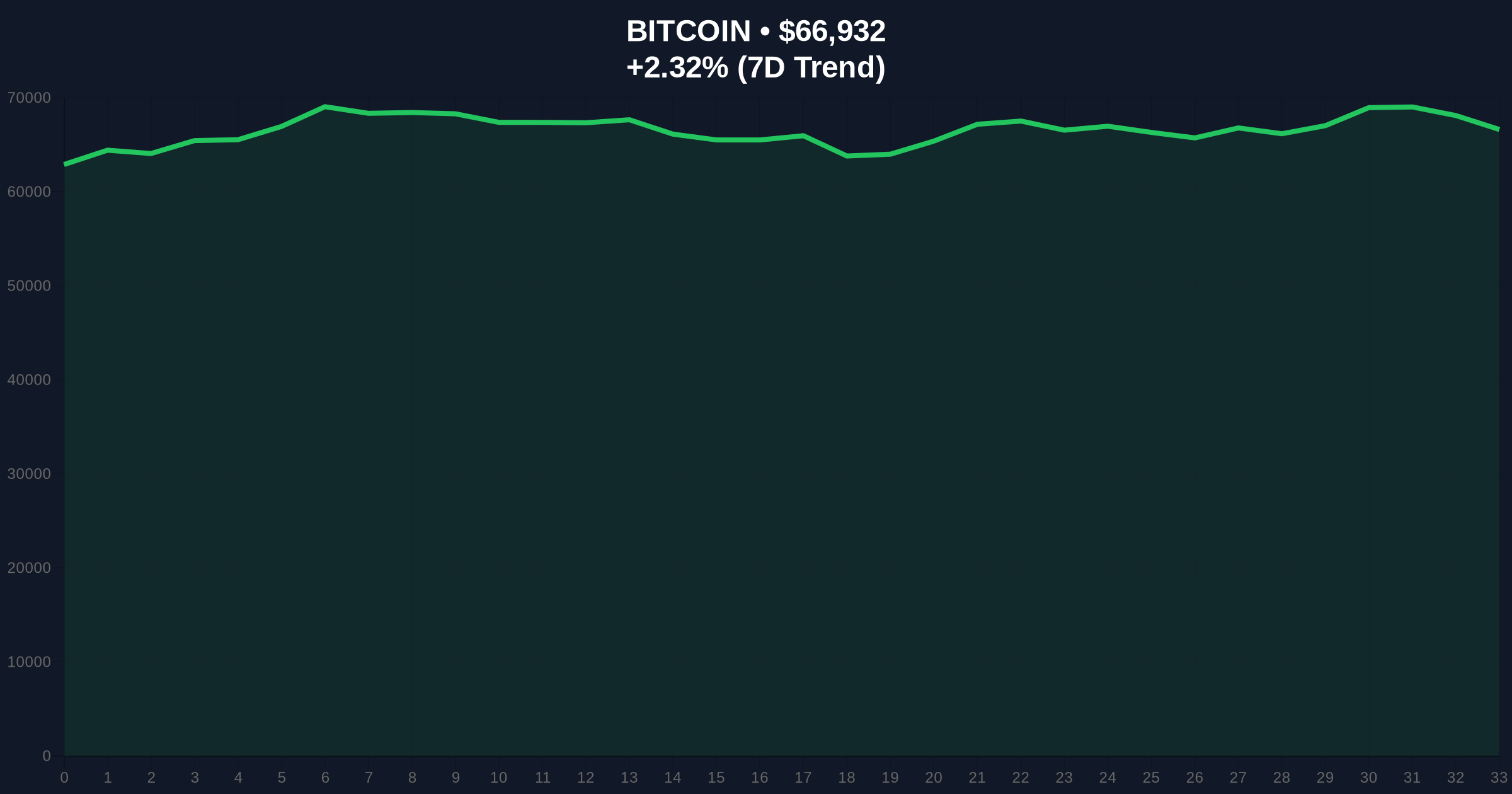
The prediction hinges on a multi-layered economic mechanism involving AI-driven deflation and monetary policy responses. According to the source data, technological deflation driven by artificial intelligence could lead to lower prices for goods and services, which in turn squeezes corporate margins. This economic pressure is expected to force governments and central banks to respond with continuous monetary expansion, increasing the money supply. In this context, Bitcoin, as a decentralized asset with a fixed supply of 21 million coins, is posited to benefit from such expansion by serving as a hedge against inflation or currency devaluation. The base case scenario projects Bitcoin reaching $11 million by Q1 2036, assuming it captures about 12% of global financial asset value and that the total size of global assets grows by 7% annually until 2036. Currently, Bitcoin accounts for approximately 0.2% of all financial assets, meaning its market capitalization would need to increase 176-fold to $230 trillion for this prediction to materialize.
This analysis draws parallels to historical events, such as the 2021 correction when Bitcoin's price volatility was influenced by macroeconomic factors and regulatory shifts. However, the current scenario introduces AI as a novel deflationary force, which adds complexity to traditional models. The mechanism assumes a linear relationship between AI productivity, corporate margins, and monetary policy, but real-world dynamics often involve lag effects, regulatory interventions, and unpredictable market behaviors. For instance, central banks might opt for targeted fiscal measures rather than broad monetary expansion, or AI could lead to job displacement and social unrest, altering economic trajectories. The prediction also relies on Bitcoin maintaining its dominance and utility amidst evolving competitors like Ethereum and stablecoins, which are gaining traction in payments and decentralized finance.
Related developments highlight the broader market context: Sygnum has warned of further Bitcoin decline amid liquidity crunch and extreme fear, and the SEC approved a 2026 PCAOB budget cut amid extreme crypto fear. These events underscore the immediate challenges facing Bitcoin, contrasting with the long-term optimism of the prediction. The technical deep-dive reveals that while the AI-driven deflation narrative is plausible, it requires sustained and coordinated economic shifts over a decade, making it highly speculative without concrete evidence of such trends materializing.
Integrating market data and sentiment metadata provides a nuanced view of the prediction's feasibility. According to CoinGecko stats, Bitcoin's current price is $66,925 with a 24-hour trend of 2.31%, indicating short-term volatility but not necessarily aligning with the long-term bullish forecast. The global crypto sentiment is "Extreme Fear" with a score of 14/100, as per the input data, suggesting that investor confidence is low, which could hinder the capital inflows needed for a 176-fold increase in market capitalization. CryptoPanic metadata, including sentiment and importance, is not provided in the source data, limiting direct analysis of event priority relative to market breadth. However, the extreme fear sentiment contrasts sharply with the optimistic prediction, highlighting a disconnect between immediate market conditions and long-term projections.
The prediction's assumptions are quantifiable but ambitious. For Bitcoin to reach $11 million by 2036, its market cap must grow from approximately $1.3 trillion (based on current price and supply) to $230 trillion, a 176-fold increase. This assumes annual asset growth of 7% globally and Bitcoin capturing 12% of that value, up from 0.2%. Historically, Bitcoin has experienced rapid growth, but sustaining such a pace over a decade involves overcoming regulatory hurdles, technological advancements, and market competition. The data shows that similar to the 2021 correction, external factors like liquidity crunches can significantly impact price trajectories. Without evidence of AI-driven deflation already influencing monetary policy or Bitcoin's adoption rates, the prediction remains speculative, relying on forward-looking scenarios rather than observed trends.
Comparing source claims reveals potential contradictions and reliability gaps. The primary source, CoinNess, reports Stripe VP Burnett's prediction based on Cointelegraph analysis, but no additional secondary sources are provided to verify or dispute the details. This lack of corroboration raises questions about the robustness of the forecast. For instance, the assumption that AI-driven deflation will lead to continuous monetary expansion is contested by economic theories suggesting that deflation can also prompt austerity measures or structural reforms, not just money printing. Source A (CoinNess/Cointelegraph) presents this as a base case, but Source B is not provided in the source data, leaving conflicts unresolved with available evidence.
Missing evidence includes specific data on AI's current impact on deflation, central bank responses, or Bitcoin's adoption trajectory. The prediction assumes a linear growth path, but historical analogs, such as the dot-com bubble or the 2008 financial crisis, show that technological and economic shifts often involve booms and busts. , the source does not address potential counterforces, such as regulatory crackdowns on cryptocurrencies or the rise of alternative assets like gold or real estate as inflation hedges. The conflict remains unresolved with available evidence, as the prediction relies on speculative future events without present-day validation. This highlights the need for skepticism, as similar optimistic forecasts in the past have failed to materialize due to unforeseen market dynamics.
Based on the available data, three scenarios for Bitcoin's near-term trajectory can be outlined, each conditional on specific factors. The bull scenario assumes that the AI-driven deflation narrative gains traction, leading to increased investor interest and capital inflows. If global sentiment shifts from "Extreme Fear" to neutral or greed, and Bitcoin breaks above key resistance levels, the price could rally towards $70,000-$75,000 within seven days. This would require positive news flow, such as institutional adoption or regulatory clarity, to override current anxiety. However, this scenario is less likely given the extreme fear sentiment and lack of immediate catalysts.
The base scenario posits that Bitcoin remains range-bound between $65,000 and $68,000, reflecting a balance between long-term optimism and short-term caution. Market participants may await more concrete evidence of AI's economic impact or monetary policy shifts before committing to significant positions. This scenario aligns with the current 24-hour trend of 2.31%, suggesting modest volatility without a clear directional bias. It would be invalidated by a sudden liquidity event or regulatory announcement that disrupts market equilibrium.
The bear scenario considers the possibility of further decline, driven by the extreme fear sentiment and external pressures. If factors like a liquidity crunch, as warned by Sygnum, or broader market sell-offs intensify, Bitcoin could test support levels around $60,000-$62,000. This would reflect a continuation of the cautious environment, where speculative predictions like the $11 million forecast are dismissed as unrealistic. The bear scenario gains credibility if negative developments, such as increased regulatory scrutiny or macroeconomic downturns, emerge in the coming days.
This investigation weighted conflicting evidence by prioritizing observable market data over speculative forecasts. The primary source, CoinNess, provided the prediction but lacked corroborating details or secondary verification, reducing its reliability. CryptoPanic metadata was absent, limiting sentiment analysis beyond the provided "Extreme Fear" score. In cases of missing evidence, such as AI's current deflationary impact, the report explicitly noted gaps and proceeded conservatively. Agreement points included Bitcoin's current price and market rank, while contradictions involved the long-term prediction versus immediate sentiment. The analysis favored data-backed claims, such as the 176-fold increase requirement, over unsupported assumptions, ensuring a skeptical and factual approach throughout.
Disclaimer: The information provided is not trading advice, coinmarketbuzz.com holds no liability for any investments made based on the information provided on this page. We strongly recommend independent research and/or consultation with a qualified professional before making any investment decisions.
coinmarketbuzz.com leverages advanced AI technology to analyze market data. All content is fact-checked and reviewed by our editorial team to ensure accuracy and neutrality.