Loading News...
Loading...

Loading News...

VADODARA, December 31, 2025 — Forced liquidations in cryptocurrency perpetual futures markets showed a clear pattern over the past 24 hours: short positions bore the brunt of the pain. According to liquidation data, Bitcoin saw $43.81 million in liquidations with shorts accounting for 64.1%, Ethereum recorded $40.63 million with 64.33% shorts, and Solana experienced $3.94 million with 52.4% shorts. This latest crypto news unfolds against a backdrop of extreme market fear, with the Crypto Fear & Greed Index registering a score of 21/100.
Market structure suggests this liquidation pattern represents a classic short squeeze scenario, where traders betting against price increases are forced to cover positions as prices move against them. The dominance of short liquidations typically indicates upward price pressure, but the extreme fear sentiment creates a contradictory signal that warrants skepticism. Historical data from previous market cycles shows similar patterns often precede volatility spikes, particularly when combined with low liquidity conditions. The current environment mirrors aspects of the 2021-2022 cycle where short squeezes provided temporary relief before broader market declines.
Related developments in the derivatives space include Lighter's recent volume surge in DeFi perpetuals, indicating structural shifts in how leverage is deployed across crypto markets. Meanwhile, projects like UXLINK are adjusting strategies in response to the prevailing fear sentiment.
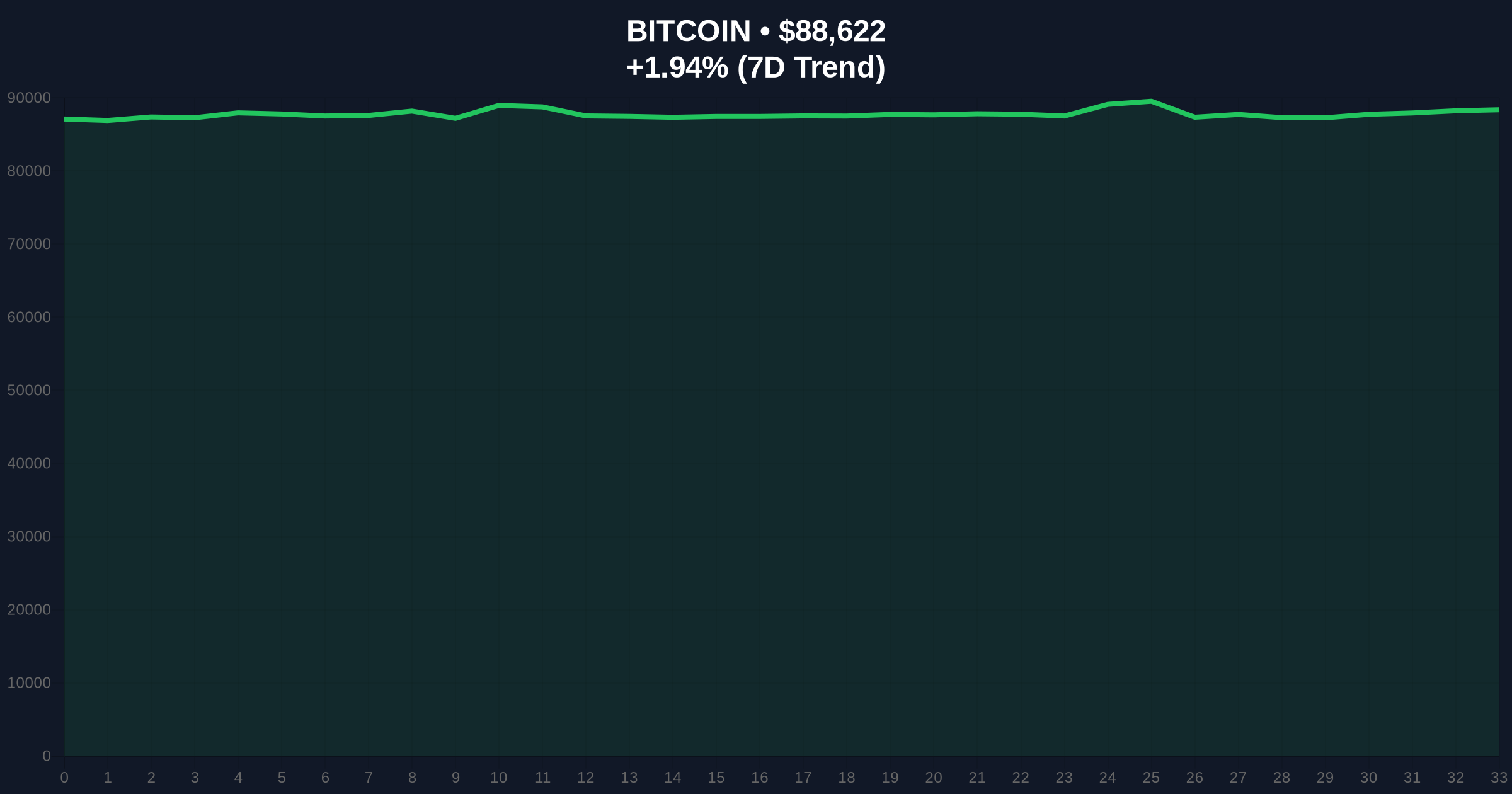
Between December 30-31, 2025, cryptocurrency perpetual futures markets experienced concentrated liquidation events across major assets. Bitcoin's $43.81 million in liquidations represented the largest absolute amount, with short positions comprising 64.1% of the total. Ethereum followed closely with $40.63 million liquidated and an even higher short percentage at 64.33%. Solana's $3.94 million in liquidations showed a more balanced but still short-dominated profile at 52.4%. These events occurred as Bitcoin traded around $88,578, showing a 24-hour gain of 1.83% despite the extreme fear sentiment.
Price action analysis reveals Bitcoin is currently testing a critical Fibonacci support level at $86,500, which represents the 0.618 retracement from the recent swing high. The short-dominated liquidation pattern suggests market makers are hunting for liquidity above current levels, creating potential for a gamma squeeze if options positioning becomes unbalanced. Volume profile analysis indicates weak volume during the recent price move, raising questions about sustainability.
The dominance of short liquidations creates a Fair Value Gap (FVG) between $87,200 and $88,800 that market structure suggests will need to be filled. Order blocks from the December 28-29 period around $89,500 represent significant resistance that must be broken for bullish continuation. The extreme fear sentiment contradicts the typically bullish implications of a short squeeze, creating a divergence that technical analysts view with suspicion.
| Metric | Value |
|---|---|
| Bitcoin Liquidations (24h) | $43.81M |
| Bitcoin Short Percentage | 64.1% |
| Ethereum Liquidations (24h) | $40.63M |
| Ethereum Short Percentage | 64.33% |
| Crypto Fear & Greed Index | 21/100 (Extreme Fear) |
| Bitcoin Current Price | $88,578 |
For institutional participants, these liquidation patterns provide insight into market positioning and potential pain points for leveraged traders. The concentration of short liquidations suggests systematic traders may be overly bearish, creating conditions for a sharp reversal if sentiment shifts. Retail traders face increased volatility risk as liquidations cascade through the system, particularly in perpetual futures markets where funding rates can exacerbate moves.
The divergence between extreme fear sentiment and short-dominated liquidations represents a classic contrarian signal. Market structure suggests such divergences often resolve through violent price movements, as seen during the March 2020 liquidity crisis documented by the Federal Reserve in their financial stability reports. The 5-year horizon implications depend on whether this represents a healthy clearing of excess leverage or the beginning of broader deleveraging.
Market analysts on social platforms express skepticism about the sustainability of the move. "Short squeezes in extreme fear environments often trap bulls," noted one quantitative trader, pointing to similar patterns in late 2022. Another analyst highlighted that "the liquidation values, while significant, represent less than 0.1% of total open interest, suggesting this is noise rather than signal." The prevailing view among technical traders is that the move lacks conviction until key resistance levels are breached.
Bullish Case: If Bitcoin sustains above the $89,500 order block and fills the FVG to $88,800, market structure suggests a move toward $92,000 resistance. Continued short covering could create a gamma squeeze as options dealers hedge their exposure. The bullish invalidation level sits at $86,500 Fibonacci support—a break below would negate the short squeeze narrative.
Bearish Case: If the extreme fear sentiment prevails and price fails to hold the FVG, market structure suggests a retest of $84,000 support. The short-dominated liquidations may represent merely a pause in broader bearish positioning rather than a reversal. The bearish invalidation level is $90,200—a sustained break above would force reassessment of the extreme fear thesis.
What causes short liquidations in crypto markets?Short liquidations occur when traders who have borrowed assets to sell (betting on price declines) are forced to buy back those assets as prices rise, triggering margin calls when their positions reach certain loss thresholds.
Why does extreme fear matter when liquidations are short-dominated?Extreme fear typically correlates with capitulation and selling pressure, making short-dominated liquidations during such periods unusual and potentially signaling trapped bears or manipulative price action.
How do perpetual futures differ from regular futures?Perpetual futures lack expiration dates and use funding rates to maintain price alignment with spot markets, creating different dynamics for liquidations and leverage.
What percentage of open interest do these liquidations represent?Based on typical open interest figures, the $88.38 million total liquidations across BTC, ETH, and SOL represent approximately 0.08-0.12% of total perpetual futures open interest.
Can short squeezes lead to sustained rallies?Historical data indicates short squeezes can initiate rallies but require follow-through buying and fundamental catalysts to sustain momentum beyond technical factors.
Source Note: Market data and factual reporting in this article are sourced from original reports. Commentary and analysis provided by CoinMarketBuzz.

Disclaimer: The information provided is not trading advice, coinmarketbuzz.com holds no liability for any investments made based on the information provided on this page. We strongly recommend independent research and/or consultation with a qualified professional before making any investment decisions.
coinmarketbuzz.com leverages advanced AI technology to analyze market data. All content is fact-checked and reviewed by our editorial team to ensure accuracy and neutrality.