Loading News...
Loading...

Loading News...

VADODARA, April 14, 2026. The following report is based on currently available verified source material and market data.
On April 14, 2026, Ripple CEO Brad Garlinghouse delivered a pointed critique of traditional finance infrastructure, arguing that XRP represents an "internet moment for money" and directly targeting SWIFT's outdated systems. This statement comes as global crypto sentiment sits at "Extreme Fear" with a score of 21/100, highlighting a critical juncture where Ripple's vision for instant, low-cost cross-border payments contrasts sharply with current market anxiety. The impact centers on Ripple's ongoing push to disrupt legacy financial networks, positioning XRP as a potential solution to slow, expensive international transfers that still rely on decades-old technology.
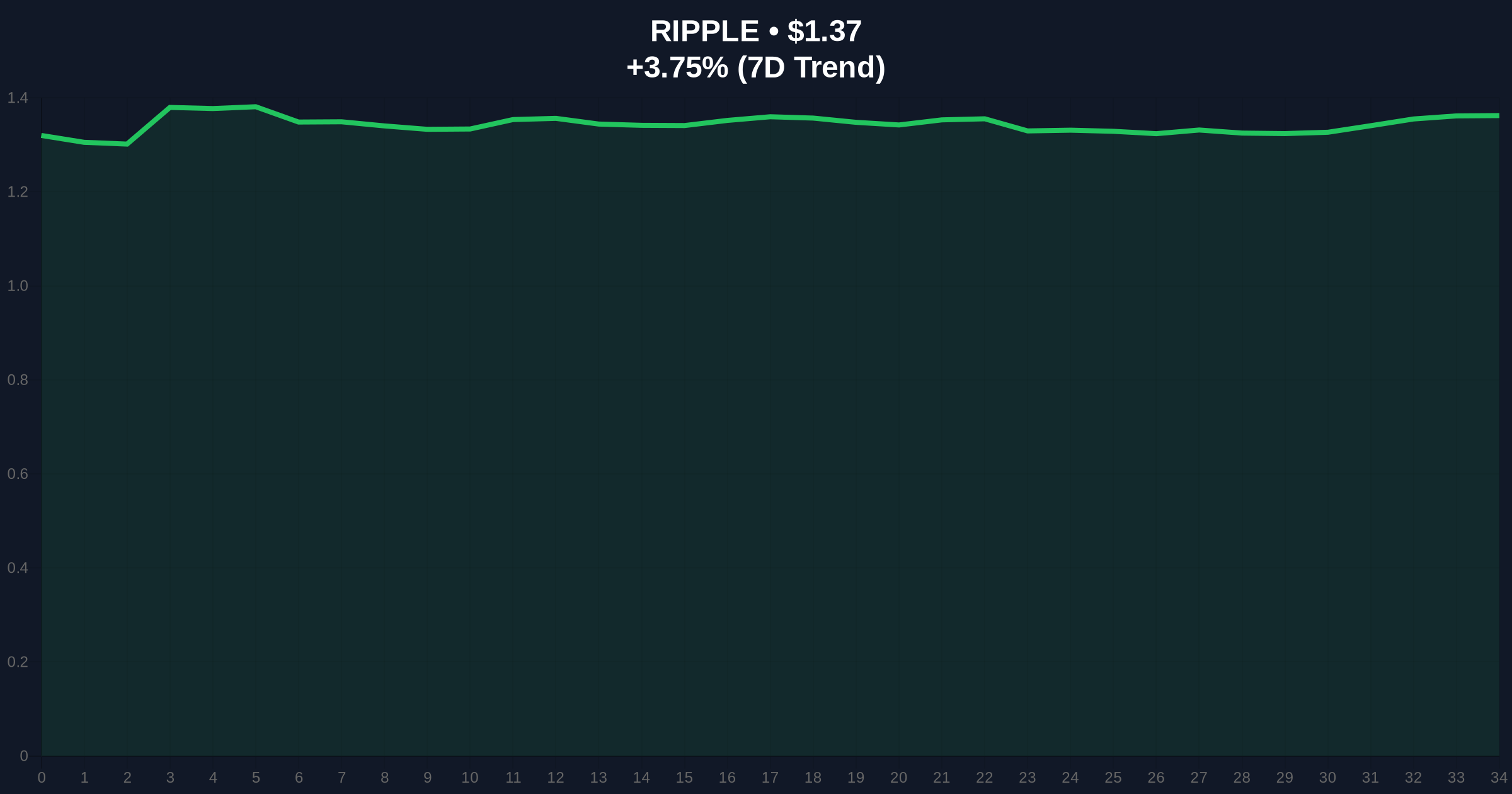
Garlinghouse's comments align with XRP's current market performance, which shows resilience despite broader fear. According to CoinGecko data, XRP is trading at $1.37, up 3.76% in the last 24 hours, and holds the #5 rank by market capitalization. The "Extreme Fear" sentiment score of 21/100 indicates widespread investor caution, making Ripple's ambitious claims a focal point for evaluating long-term utility versus short-term volatility. Source: CoinGecko.
| Metric | Value | Source |
|---|---|---|
| XRP Price | $1.37 | CoinGecko |
| 24h Trend | +3.76% | CoinGecko |
| Market Rank | #5 | CoinGecko |
| Global Sentiment | Extreme Fear (21/100) | Market Intelligence |
Why now? In a market gripped by "Extreme Fear," Garlinghouse's emphasis on XRP's real-world utility shifts focus from speculative trading to foundational infrastructure gaps, similar to how early internet pioneers highlighted interoperability issues before widespread adoption. Who benefits? If successful, Ripple and XRP holders could gain from increased adoption in cross-border payments, while traditional banks and SWIFT face disruption; retail investors may see long-term value, but short-term traders face volatility amid sentiment swings. Time horizons: Short-term, the statement may boost XRP's narrative resilience, but longer-term impact depends on regulatory clarity and adoption by financial institutions. Causal chain: Garlinghouse's critique → highlights SWIFT's inefficiencies (days-long transfers, high fees) → positions XRP as a faster, cheaper alternative → increased developer and institutional interest → potential price support if adoption materializes.
Garlinghouse's analogy to early internet platforms like AOL and CompuServe explains the core mechanism: just as those systems were closed ecosystems unable to communicate, today's payment networks are fragmented and lack interoperability. Ripple uses XRP as a bridge asset to facilitate instant settlement between different currencies and financial institutions, bypassing the multi-day delays and intermediary fees of SWIFT. This works by leveraging blockchain technology to move value similarly to how data moves online, securely and in real-time, potentially reducing transaction costs and increasing efficiency for cross-border payments.
Ripple's focus on payments contrasts with broader crypto trends, such as Bitcoin's institutional adoption or Ethereum's DeFi ecosystem. While other projects target store of value or decentralized finance, XRP aims specifically at remittance and banking infrastructure, a niche with high regulatory scrutiny but massive market potential. Related developments include:
The bearish scenario for XRP includes several key risks:
Practically, Garlinghouse's statements may accelerate partnerships with banks and payment providers, but near-term implications depend on regulatory resolutions and technological integration. If Ripple succeeds, it could set a precedent for blockchain-based cross-border solutions, influencing other projects to target similar use cases. However, failure to gain traction could reinforce skepticism about crypto's real-world utility, especially in a fearful market.
Ripple has long positioned XRP as a solution for international payments, with Garlinghouse's latest comments building on years of advocacy against legacy systems like SWIFT. Historically, this aligns with crypto's broader evolution from speculative assets to infrastructure tools, reminiscent of early internet battles for open standards versus closed networks.
Cross-market reactions show a complex : while XRP focuses on payments, other areas like NFTs face volatility, as seen with celebrity exits amid plunging values. Additionally, macroeconomic factors, such as central bank policies, influence broader crypto sentiment, creating a backdrop where Ripple's utility narrative must compete with fear-driven market movements.
Garlinghouse's critique of SWIFT and framing of XRP as an "internet moment for money" highlights Ripple's ambitious vision amid a fearful market. While metrics show short-term resilience, long-term success hinges on overcoming regulatory and adoption barriers, making this a critical watchpoint for investors and industry observers.
What to watch next: Yes… but at the core, what Ripple’s trying to do, we’re trying to let value move the way information moves today.” Right now, sending money internationally can take days, involve multiple intermediaries, and cost significant fees.; The Early Internet Analogy That Explains Everything To simplify it, Garlinghouse compared today’s financial system to the early days of the internet: “I had a Prodigy account, I had an AOL account… there was also CompuServe.” And here’s the main limitation: “You couldn’t email between CompuServe and AOL… that was not possible.” Back then, platforms were closed ecosystems..
Evidence & Sources
Primary source: https://coinpedia.org/news/brad-garlinghouse-says-ripple-is-going-after-swift-argues-xrp-is-an-internet-moment-for-money
Updated at: Apr 14, 2026, 10:48 AM
Data window: Apr 14, 2026, 10:40 AM → Apr 14, 2026, 10:47 AM
Evidence stats: 2 metrics, 3 timeline points.
Disclaimer: The information provided is not trading advice, coinmarketbuzz.com holds no liability for any investments made based on the information provided on this page. We strongly recommend independent research and/or consultation with a qualified professional before making any investment decisions.
All published reports are reviewed by our editorial team for factual consistency, neutrality, and reader clarity.