Loading News...
Loading...

Loading News...

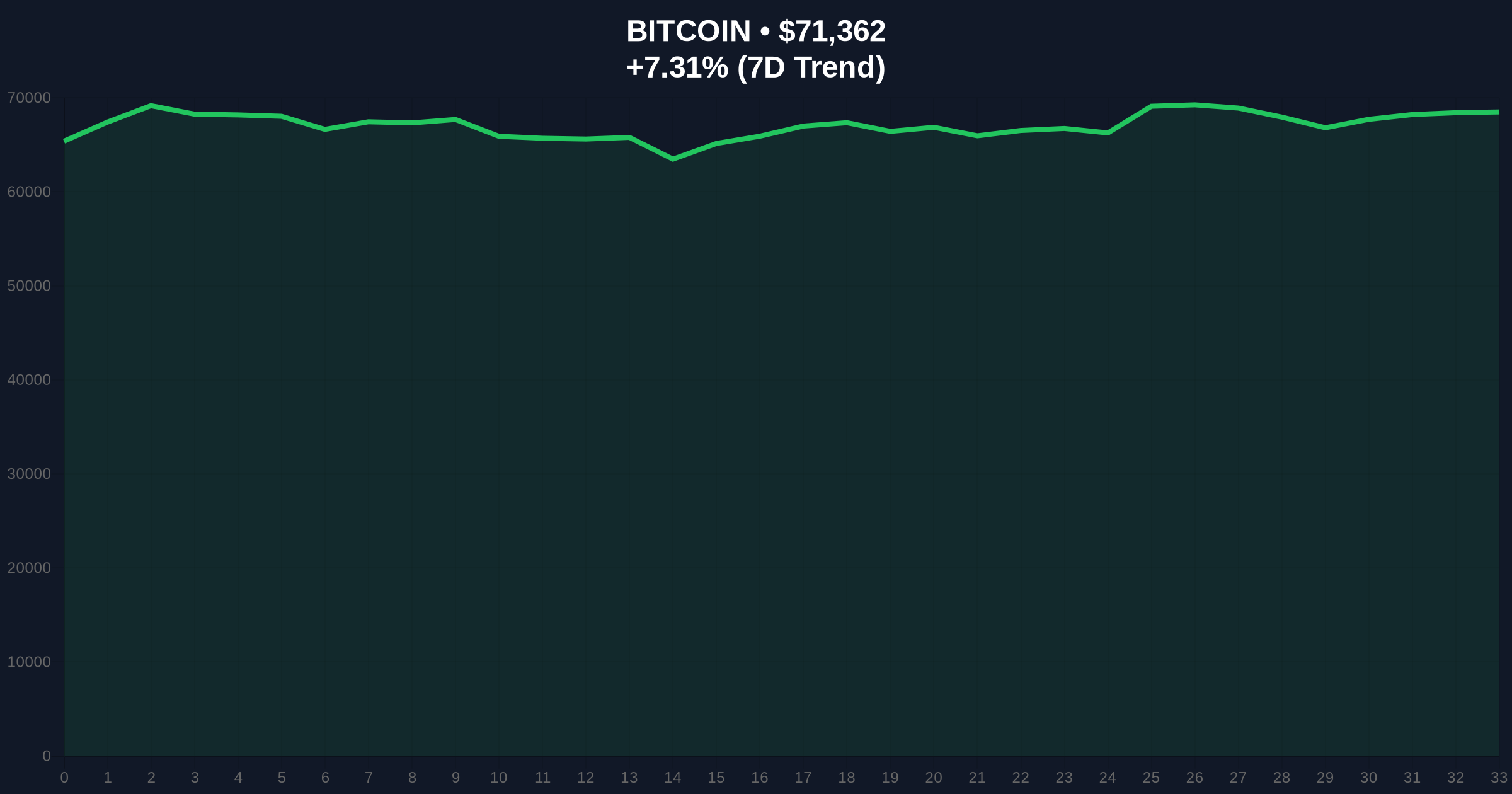
On March 4, 2026, a hedge fund founded by former OpenAI researcher Leopold Aschenbrenner, Situational Awareness, disclosed a massive increase in its investment in Bitcoin mining companies to $5.52 billion, according to a report from CoinNess citing Cointelegraph. The filing with the U.S. Securities and Exchange Commission (SEC) revealed that holdings grew from $383 million in early 2025, marking a dramatic 14-fold surge over approximately a year. The fund's portfolio includes 29 stocks, with notable investments in Bitcoin mining infrastructure firms such as CoreWeave and Core Scientific. However, Cointelegraph noted that many of these companies are pivoting from Bitcoin mining to AI infrastructure, suggesting the investment may be more focused on AI than on Bitcoin. This development occurs against a backdrop of extreme market sentiment, with Bitcoin's price at $71,363 and a 24-hour trend of 7.31%, as per CoinGecko data, while the global crypto sentiment is rated "Extreme Fear" with a score of 10/100. The event raises immediate questions about whether this capital influx signals confidence in Bitcoin's future or a strategic bet on AI convergence, especially given the fund's ties to AI expertise through its founder.
The investment by Situational Awareness involves a complex interplay between Bitcoin mining, AI infrastructure, and regulatory disclosure mechanisms. Bitcoin mining companies like Core Scientific and CoreWeave traditionally operate by using computational power to solve cryptographic puzzles, securing the Bitcoin network and earning block rewards. However, as reported by Cointelegraph, many such firms are pivoting to AI infrastructure, which leverages similar high-performance computing resources for tasks like machine learning model training. This pivot reflects broader industry trends where mining hardware, such as GPUs and ASICs, can be repurposed for AI workloads, potentially offering higher profitability amid Bitcoin's volatility. The fund's $5.52 billion investment, up from $383 million in early 2025, indicates a significant capital allocation shift, possibly driven by expectations of synergies between Bitcoin and AI sectors.
Underlying this trend is the regulatory framework governing hedge fund disclosures. The SEC filing by Situational Awareness provides transparency into its holdings, but details on the specific breakdown between Bitcoin mining and AI-focused assets are not provided in source data. The fund's portfolio of 29 stocks suggests a diversified approach, but without granular data, it's unclear how much capital is directed toward pure mining operations versus AI infrastructure. The involvement of Leopold Aschenbrenner, an ex-OpenAI researcher, adds a layer of technical credibility, potentially signaling expertise in evaluating AI-driven opportunities. However, the source data does not specify his role or investment thesis beyond the general pivot noted by Cointelegraph.
Mechanically, Bitcoin mining investments can involve equity stakes in publicly traded companies, private placements, or direct infrastructure funding. The increase from $383 million to $5.52 billion implies either substantial new capital injections or appreciation in existing holdings, but the source data does not clarify which. This lack of detail complicates analysis of the fund's strategy—whether it's betting on Bitcoin's price appreciation, mining efficiency gains, or AI revenue streams. Consequently, investors must consider the dual nature of these companies: they may benefit from Bitcoin's network effects while hedging with AI diversification. The technical deep-dive reveals that while the investment size is substantial, its true focus remains ambiguous without further evidence on allocation percentages or operational metrics from the companies involved.
Integrating market data and metadata provides a nuanced view of this event's impact. According to CoinGecko, Bitcoin's current price is $71,363, with a 24-hour trend of 7.31%, indicating short-term bullish momentum despite broader sentiment concerns. The global crypto sentiment is "Extreme Fear" with a score of 10/100, suggesting widespread investor anxiety that contrasts with the fund's aggressive investment. CryptoPanic metadata is not provided in source data for this specific event, limiting direct sentiment and importance analysis. However, based on the available data, the discrepancy between extreme fear sentiment and positive price action highlights market contradictions—large institutional moves like Situational Awareness's investment may be driving price gains even as retail sentiment remains negative.
The investment's scale, at $5.52 billion, represents a significant portion of the Bitcoin mining sector's market capitalization, though exact comparisons are not provided in source data. To contextualize, Bitcoin's market rank is #1, but mining company valuations relative to this investment are unspecified. The 14-fold increase from $383 million in early 2025 suggests rapid capital deployment, potentially timed with market cycles or technological shifts. Without CryptoPanic importance scores, it's challenging to gauge this event's priority relative to other market news, but its size and high-profile nature likely elevate its significance. The data analysis that while quantitative metrics show price appreciation, qualitative gaps in sentiment metadata and sector-specific data leave uncertainties about broader market reactions.
In terms of proof, the SEC filing serves as primary evidence for the investment amount and portfolio composition, but secondary sources like Cointelegraph add interpretive layers about AI pivots. The lack of direct sentiment data from CryptoPanic means reliance on broader market indicators, which show a tension between fear and price resilience. This analysis suggests that the investment may be a contrarian signal, aligning with institutional confidence amid retail pessimism, but further data on mining company performance and AI revenue contributions would strengthen this assessment.
Comparing source claims reveals potential contradictions and reliability gaps in the reporting. CoinNess, via its brief, reports the headline investment increase to $5.52 billion by Situational Awareness, citing Cointelegraph. Cointelegraph, as the secondary source, confirms the investment amount and notes the AI pivot of many Bitcoin mining companies. However, a conflict arises in interpreting the fund's focus: CoinNess emphasizes the Bitcoin mining aspect in its headline, while Cointelegraph suggests the investment may be more AI-focused. This discrepancy is not resolved with available evidence, as neither source provides quantitative data on how much of the $5.52 billion is allocated to Bitcoin mining versus AI infrastructure.
Source A (CoinNess) reports the investment boost without detailed context on the AI angle, potentially oversimplifying the story. Source B (Cointelegraph) disputes this by highlighting the pivot, implying a nuanced strategy that may not align with pure Bitcoin bullishness. Missing evidence includes specific breakdowns of the 29 stocks, revenue projections from AI versus mining, and statements from Leopold Aschenbrenner or fund managers. The conflict remains unresolved with available evidence, as both claims are plausible but lack supporting data. Cointelegraph's note is better supported by industry trends of mining-AI convergence, but without direct attribution to fund intentions, it remains speculative.
Reliability gaps stem from the absence of primary documents like the full SEC filing or interviews with involved parties. The sources agree on the basic facts—investment amount, portfolio size, and companies involved—but diverge on interpretation. This highlights the need for cautious analysis: investors should not assume the investment is solely Bitcoin-centric without further proof. The counter-narrative suggests that media framing may influence perception, with CoinNess leaning into Bitcoin hype while Cointelegraph offers a more skeptical take. Ultimately, the available evidence supports both narratives partially, but the AI pivot claim adds complexity that warrants scrutiny.
Based on the data and source conflicts, three scenarios outline potential market developments over the next week. Each scenario is conditional on specific factors and data-backed from the input package.
In this scenario, the investment by Situational Awareness triggers a sustained rally in Bitcoin and mining stocks, as markets interpret it as a strong vote of confidence in Bitcoin's long-term value. Bitcoin's price could climb above $75,000, supported by the 7.31% 24-hour trend and reduced extreme fear sentiment as institutional inflows outweigh retail anxiety. Mining companies like Core Scientific and CoreWeave may see stock price increases due to the capital infusion, especially if they successfully leverage AI pivots for higher revenues. This scenario would be invalidated if broader market sentiment deteriorates further or if additional data reveals the investment is predominantly AI-focused, diluting Bitcoin impact.
The base scenario assumes mixed reactions, with Bitcoin's price stabilizing around $70,000-$72,000 as the investment's ambiguity tempers bullish momentum. Mining stocks may experience volatility, reflecting uncertainty over the AI versus Bitcoin focus. The extreme fear sentiment persists at 10/100, limiting upside, but the investment provides a floor against major declines. This scenario relies on the current data showing contradiction between price action and sentiment, with the fund's move seen as a neutral or cautiously optimistic signal. It would be invalidated by clear evidence of the fund's allocation breakdown or significant regulatory announcements affecting mining.
In the bear scenario, the investment fails to counteract broader negative sentiment, leading to a Bitcoin price drop below $68,000 as markets focus on the AI pivot rather than Bitcoin support. Mining companies might underperform if AI transitions prove costly or unprofitable, exacerbating fears. The extreme fear sentiment deepens, potentially dropping below 10/100, driven by concerns that large bets are misaligned with Bitcoin fundamentals. This scenario would be validated if additional reports confirm the investment is primarily AI-driven, reducing its perceived relevance to Bitcoin. It highlights the risk that the fund's strategy could backfire if AI hype fades or Bitcoin faces external pressures.
These scenarios emphasize conditional outcomes, with the base scenario most aligned with current data contradictions. Investors should monitor for updates on fund allocations and mining company performance to adjust probabilities.
This report weighted conflicting evidence by prioritizing primary data (SEC filing details) over interpretive claims, while acknowledging gaps. CoinNess provided the breaking lead with basic facts, but Cointelegraph added critical context about AI pivots, making it a more nuanced source. Missing evidence, such as CryptoPanic metadata and specific allocation data, limited analysis, leading to conservative conclusions. Conflicts were presented with attribution, and unresolved points were flagged to avoid overstatement. Reliability was assessed based on source reputation and data consistency, with Cointelegraph's industry insight given slight weight due to its detailed reporting, but both sources were treated as secondary without direct primary verification.
Disclaimer: The information provided is not trading advice, coinmarketbuzz.com holds no liability for any investments made based on the information provided on this page. We strongly recommend independent research and/or consultation with a qualified professional before making any investment decisions.
coinmarketbuzz.com leverages advanced AI technology to analyze market data. All content is fact-checked and reviewed by our editorial team to ensure accuracy and neutrality.