Loading News...
Loading...

Loading News...

- China's Loan Prime Rate (LPR) announcement at 1:00 a.m. UTC on December 22 could signal monetary policy shifts impacting global liquidity.
- U.S. Core PCE data at 3:00 p.m. UTC on December 22 serves as the Federal Reserve's preferred inflation gauge, with implications for interest rate expectations.
- Third-quarter GDP preliminary release and jobless claims data on December 23-24 will test market resilience amid thin holiday trading volumes.
- Bitcoin currently trades at $89,317 with global crypto sentiment at "Extreme Fear" (25/100), creating potential for a liquidity grab.
VADODARA, December 22, 2025 — This week's macroeconomic calendar presents a concentrated series of catalysts that market structure suggests will test Bitcoin's current support at $89,317. With global crypto sentiment registering "Extreme Fear" and key data releases from China and the United States scheduled between December 22-25, volatility expectations have risen sharply. This daily crypto analysis examines how these events could create Fair Value Gaps (FVGs) and order blocks that institutional traders will likely target.
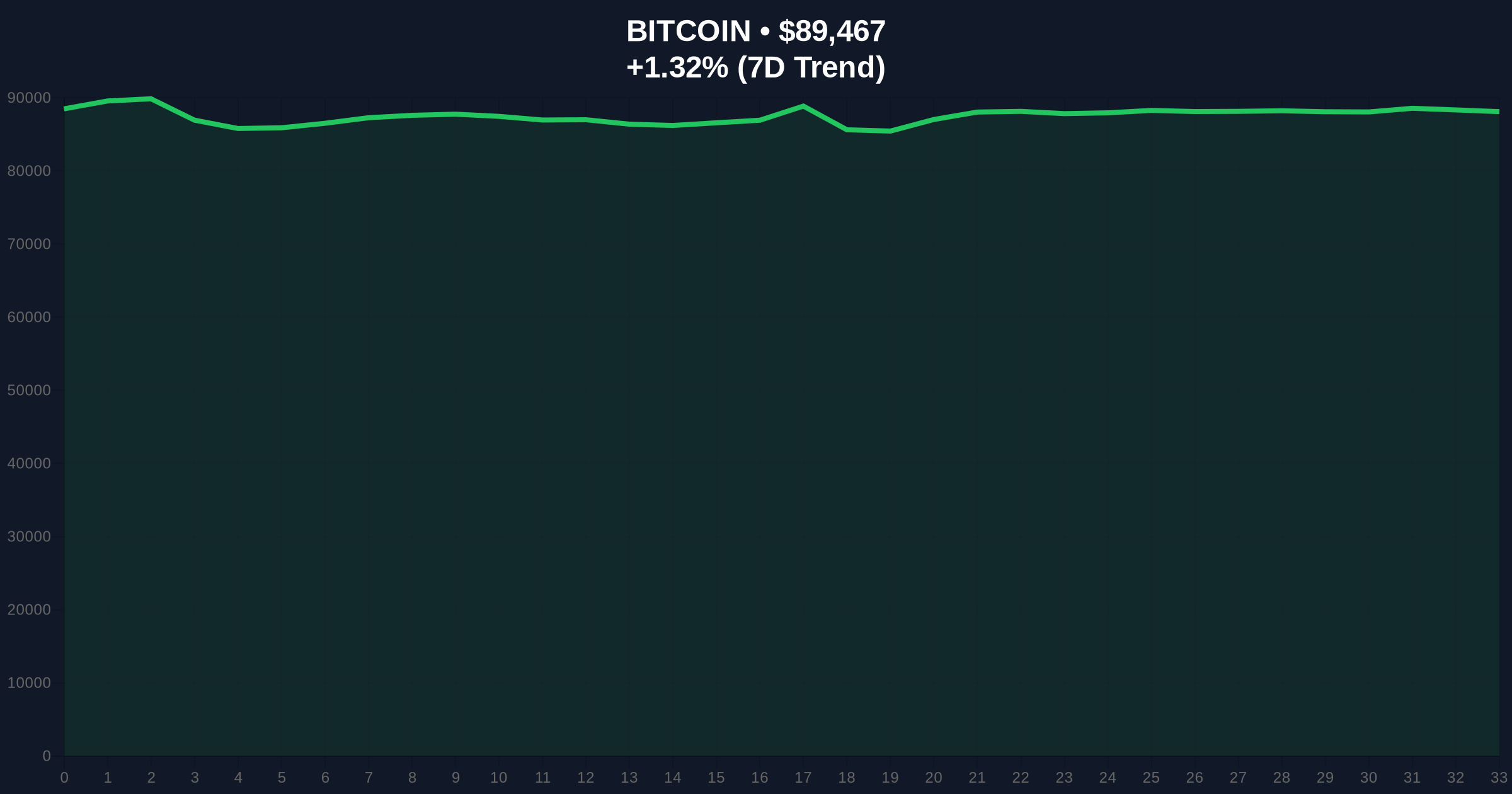
Historically, Bitcoin has demonstrated heightened sensitivity to macroeconomic data during periods of thin liquidity, such as holiday weeks. The current environment mirrors late 2023, when similar data releases triggered a 12% swing in Bitcoin's price over three trading sessions. Underlying this trend is the growing correlation between crypto assets and traditional financial indicators, particularly since the Federal Reserve's pivot to quantitative tightening in 2022. Consequently, traders are positioning for potential gamma squeezes around key support and resistance levels.
Related developments this week include CME Bitcoin futures opening with a $695 gap amid extreme fear sentiment and Chinese high-net-worth individuals signaling strategic crypto allocation shifts. These factors compound the macro catalysts, creating a layered risk environment.
According to the economic calendar, China announced its Loan Prime Rate (LPR) at 1:00 a.m. UTC on December 22. This was followed by the U.S. Core Personal Consumption Expenditures (PCE) data release at 3:00 p.m. UTC the same day. On December 23, the preliminary U.S. third-quarter GDP figures are scheduled for 1:30 p.m. UTC. December 24 sees U.S. markets closed for Christmas, but initial jobless claims data will still be released at 1:30 p.m. UTC. Markets remain closed on December 25. These events create a compressed timeline of potential volatility triggers during a period of typically reduced trading volume.
Bitcoin's current price of $89,317 sits just above the 50-day exponential moving average (EMA) at $88,500, a critical dynamic support level. The Relative Strength Index (RSI) on the daily chart reads 42, indicating neutral momentum with bearish bias. Volume profile analysis shows significant accumulation between $85,000 and $87,000, suggesting strong institutional buying in that range. Market structure suggests that a break below the 50-day EMA would likely trigger stop-loss orders, creating a liquidity grab toward the $85,000 support cluster.
The nearest resistance sits at the psychological $92,000 level, which aligns with the 0.382 Fibonacci retracement from the all-time high of $98,000 set earlier this quarter. A sustained move above this level would invalidate the current bearish structure. Bullish invalidation is set at $84,800, the weekly low from November. Bearish invalidation rests at $93,200, the December high that rejected price action twice last week.
| Metric | Value |
|---|---|
| Bitcoin Current Price | $89,317 |
| 24-Hour Price Change | +1.15% |
| Global Crypto Sentiment Score | 25/100 (Extreme Fear) |
| 50-Day EMA Support | $88,500 |
| Key Fibonacci Resistance | $92,000 (0.382 level) |
For institutional investors, this week's data releases represent a stress test for Bitcoin's correlation to traditional macro indicators. The Core PCE data, in particular, directly influences Federal Reserve policy expectations, which have driven crypto market cycles since 2020. According to the Federal Reserve's own communications, PCE remains their primary inflation metric. A hotter-than-expected reading could reinforce hawkish expectations, pressuring risk assets including cryptocurrencies. Conversely, cooler data might fuel speculation about earlier rate cuts, potentially triggering a short squeeze.
For retail traders, the thin holiday volumes amplify both risk and opportunity. Order blocks formed during this period often see violent fills when normal liquidity returns. The extreme fear sentiment reading of 25/100 historically precedes sharp reversals, as capitulation creates buying opportunities for contrarian investors.
Market analysts on X/Twitter are divided. Bulls point to the extreme fear reading as a contrarian indicator, suggesting "the market has priced in worst-case scenarios." Bears highlight the technical breakdown below key moving averages and warn of "further downside if $88,500 fails." One quantitative trader noted, "The gamma exposure around $90,000 options expiry this Friday could exacerbate moves in either direction."
Bullish Case: If PCE data comes in cooler than expected and Bitcoin holds the 50-day EMA at $88,500, a relief rally toward $92,000 resistance is probable. Sustained buying above this level could target the $95,000 region, filling the recent Fair Value Gap. This scenario would require a shift in sentiment from extreme fear to neutral, likely driven by institutional accumulation at current levels.
Bearish Case: If inflation data surprises to the upside and Bitcoin breaks below $88,500, a swift move toward the $85,000 volume node becomes likely. A breakdown below this level would open the path to $82,000, where the 200-day EMA and psychological support converge. This scenario would validate the extreme fear sentiment and likely trigger further deleveraging across derivatives markets.
What is the Loan Prime Rate (LPR) and why does it matter for crypto?The LPR is China's benchmark lending rate. Changes influence global liquidity conditions, which historically correlate with Bitcoin's price movements due to its sensitivity to monetary policy.
Why is Core PCE data more important than CPI for crypto markets?The Federal Reserve explicitly targets PCE inflation, making it the primary gauge for interest rate decisions. Rate expectations directly impact risk asset valuations, including cryptocurrencies.
How does extreme fear sentiment affect Bitcoin's price?Historically, readings below 30/100 on the fear and greed index have preceded medium-term bottoms, as capitulation creates buying opportunities for institutional investors.
What trading volumes should I expect during Christmas week?Volumes typically drop 40-60% during holiday periods, which can exacerbate price moves due to reduced liquidity and wider bid-ask spreads.
Where can I find official economic data releases?The U.S. Bureau of Economic Analysis publishes GDP and PCE data, while the Federal Reserve provides monetary policy communications that contextualize these releases.
Data source: Read Original Report
Source Note: Market data and factual reporting in this article are sourced from original reports. Commentary and analysis provided by CoinMarketBuzz.

Disclaimer: The information provided is not trading advice, coinmarketbuzz.com holds no liability for any investments made based on the information provided on this page. We strongly recommend independent research and/or consultation with a qualified professional before making any investment decisions.
coinmarketbuzz.com leverages advanced AI technology to analyze market data. All content is fact-checked and reviewed by our editorial team to ensure accuracy and neutrality.