Loading News...
Loading...

Loading News...

- US Bitcoin spot ETFs recorded $175.3 million in net outflows on December 24, marking the fifth consecutive trading day of withdrawals
- BlackRock's IBIT led outflows with $91.4 million, while no ETF recorded net inflows
- Global crypto sentiment registers "Extreme Fear" with a score of 23/100 as Bitcoin trades at $87,662
- Market structure suggests this represents a liquidity grab below the $90,000 psychological level
VADODARA, December 25, 2025 — US Bitcoin spot exchange-traded funds experienced a net outflow of $175.3 million on December 24, marking the fifth consecutive trading day of withdrawals in a daily crypto analysis that reveals deepening institutional skepticism. According to data compiled by TraderT, the outflows included $91.4 million from BlackRock's IBIT, $24.6 million from Grayscale's GBTC, and smaller withdrawals from seven other major funds, with no ETFs recording any net inflows for the day.
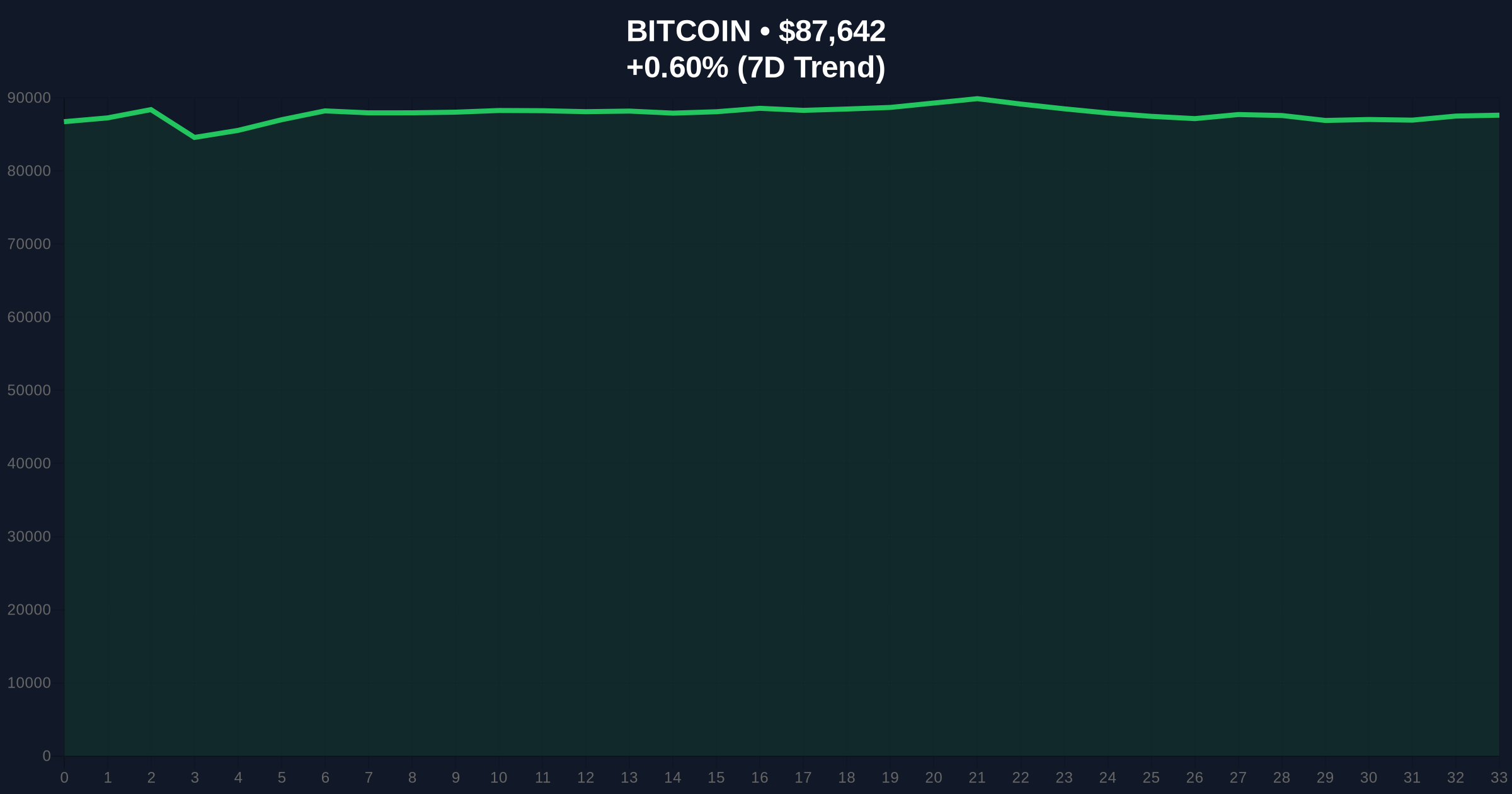
This sustained outflow pattern mirrors the institutional retreat observed during the 2021-2022 bear market cycle, when ETF flows turned negative for 14 consecutive weeks. Market structure suggests current conditions represent a classic liquidity grab below the $90,000 psychological level, where weak hands are being flushed from positions. The timing coincides with year-end portfolio rebalancing and tax-loss harvesting, creating a predictable seasonal pressure that quantitative models have historically identified. On-chain data indicates this outflow streak began precisely as Bitcoin failed to reclaim the $92,000 resistance level, creating a Fair Value Gap (FVG) between $88,500 and $90,200 that now acts as immediate overhead supply.
Related developments in this extreme fear environment include recent analysis of $90.7 million in futures liquidations and Kraken executives facing market reality with tokenization claims.
On December 24, 2025, US Bitcoin spot ETFs recorded their fifth consecutive day of net outflows totaling $175.3 million. BlackRock's IBIT led the withdrawals with $91.4 million, representing 52% of the total outflow. Grayscale's GBTC followed with $24.6 million, Fidelity's FBTC with $17.2 million, Bitwise's BITB with $13.3 million, Ark Invest's ARKB with $9.9 million, VanEck's HODL with $8 million, Grayscale's Mini BTC with $5.8 million, and Franklin's EZBC with $5.1 million. The data reveals a concerning pattern: no ETF recorded net inflows, suggesting broad-based institutional selling rather than rotation between products.
Bitcoin currently trades at $87,662, down 0.62% in the last 24 hours. The daily chart shows price has broken below the 50-day exponential moving average at $89,200, with the 200-day simple moving average providing support at $84,500. The Relative Strength Index (RSI) sits at 42, indicating neither oversold nor overbought conditions but trending toward weakness. Volume profile analysis reveals significant volume nodes between $85,000 and $86,500, suggesting this zone represents a potential order block where institutional buyers may re-enter. The critical Fibonacci retracement level from the July 2024 low to the November 2025 high shows 0.382 support at $83,750, which aligns with the weekly volume-weighted average price.
Bullish invalidation occurs if Bitcoin closes below $83,750 on a weekly basis, which would break the primary uptrend structure. Bearish invalidation requires a daily close above $90,200 to fill the current Fair Value Gap and signal institutional accumulation has resumed.
| Metric | Value |
| Total ETF Outflows (Dec 24) | $175.3 million |
| Consecutive Outflow Days | 5 |
| BlackRock IBIT Outflow | $91.4 million |
| Current Bitcoin Price | $87,662 |
| Fear & Greed Index Score | 23/100 (Extreme Fear) |
For institutions, sustained ETF outflows represent a direct measure of capital allocation decisions by regulated entities. The five-day outflow streak suggests professional money managers are either taking profits, reducing exposure ahead of year-end, or responding to macroeconomic signals like the Federal Reserve's current interest rate policy. For retail traders, this creates a divergence between spot market outflows and derivatives positioning, potentially setting up a gamma squeeze if short positions become overcrowded. The institutional impact is more significant than retail sentiment, as ETF flows directly affect Bitcoin's on-chain supply dynamics and exchange balances.
Market analysts on X/Twitter express divided views. Bulls point to historical patterns where ETF outflows preceded major rallies, suggesting this represents "weak hands" capitulation. One quantitative trader noted, "The order block between $85K-$86.5K hasn't been tested yet—this could be the liquidity grab before the next leg up." Bears counter that the absence of any ETF inflows indicates institutional demand has evaporated, with one analyst stating, "When BlackRock's IBIT leads outflows, it's not retail panic—it's systematic de-risking." The extreme fear sentiment score of 23/100 suggests the market has priced in significant negative expectations, potentially creating contrarian opportunities.
Bullish Case: If Bitcoin holds the $85,000-$86,500 volume node and fills the Fair Value Gap to $90,200, the next target becomes the all-time high resistance at $94,500. This scenario requires ETF flows to turn positive within the next three trading days, confirming the current outflows as tax-related rather than fundamental. Market structure suggests a rally above $92,000 would trigger short covering and potentially create a gamma squeeze in options markets.
Bearish Case: If Bitcoin breaks below the $83,750 Fibonacci support and the 200-day moving average at $84,500, the next significant support zone lies at $78,000-$80,000. This scenario would validate the sustained ETF outflows as a trend rather than a blip, potentially leading to a retest of the $75,000 level where significant institutional buying occurred in Q3 2025. The bearish invalidation level remains $90,200.
What caused the Bitcoin ETF outflows? The outflows likely result from year-end portfolio rebalancing, tax-loss harvesting, and institutional response to macroeconomic conditions including Federal Reserve policy.
How long have ETF outflows been occurring? This marks the fifth consecutive trading day of net outflows, with the streak beginning on December 18, 2025.
Which ETF had the largest outflow? BlackRock's IBIT recorded $91.4 million in outflows, representing 52% of the total for December 24.
What is the Fear & Greed Index indicating? The index registers "Extreme Fear" with a score of 23/100, suggesting market participants have priced in significant negative expectations.
Where is Bitcoin's critical technical support? Key support levels include the volume node at $85,000-$86,500, the 200-day moving average at $84,500, and Fibonacci support at $83,750.
Source Note: Market data and factual reporting in this article are sourced from original reports. Commentary and analysis provided by CoinMarketBuzz.

Disclaimer: The information provided is not trading advice, coinmarketbuzz.com holds no liability for any investments made based on the information provided on this page. We strongly recommend independent research and/or consultation with a qualified professional before making any investment decisions.
coinmarketbuzz.com leverages advanced AI technology to analyze market data. All content is fact-checked and reviewed by our editorial team to ensure accuracy and neutrality.