Loading News...
Loading...

Loading News...

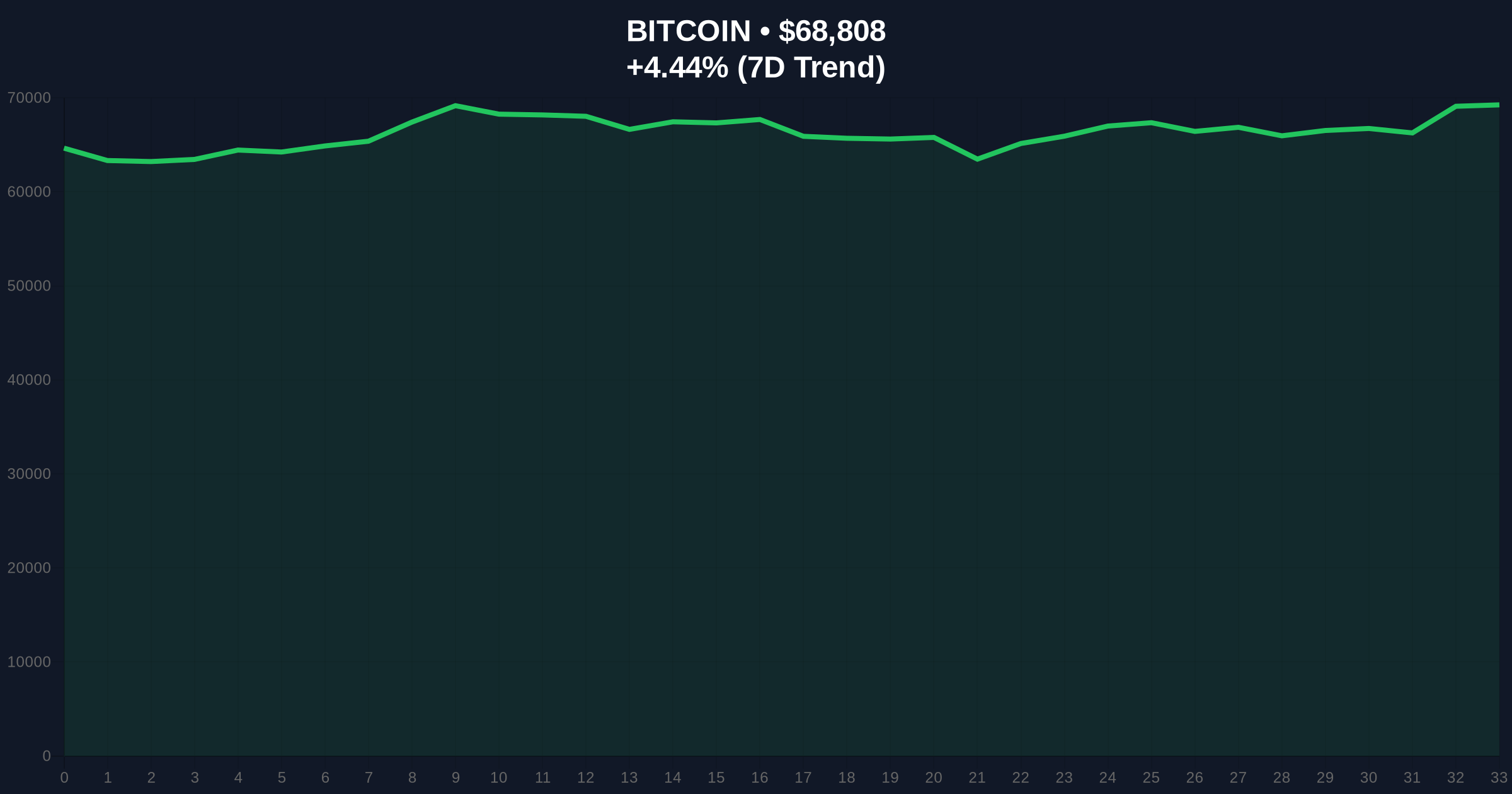
On March 3, 2026, the Crypto Fear & Greed Index registered a score of 14, up four points from the previous day, according to data provider Alternative. This places the market in the "Extreme Fear" stage, a condition it has maintained since January 30, 2026. The index, which ranges from 0 (extreme fear) to 100 (extreme optimism), serves as a critical barometer of investor sentiment in the cryptocurrency space. Concurrently, Bitcoin, a key market proxy, is trading at $68,817, reflecting a 4.46% increase over the past 24 hours. This juxtaposition of rising prices amid extreme fear highlights a complex market dynamic where short-term gains may mask underlying anxiety. The data suggests that despite recent price rebounds, broader market sentiment remains deeply pessimistic, potentially signaling caution for investors. Not provided in source data are specific triggers for the index shift or detailed historical comparisons beyond the January 30 transition.
The Crypto Fear & Greed Index is a composite metric calculated by Alternative based on six weighted components: volatility (25%), trading volume (25%), social media mentions (15%), surveys (15%), Bitcoin's market cap dominance (10%), and Google search volume (10%). This methodology aims to quantify market sentiment by aggregating behavioral and market data, providing a snapshot of investor psychology. Volatility and trading volume, together accounting for 50% of the index, measure market activity and price swings, with higher volatility often correlating with fear. Social media mentions and surveys capture public discourse and sentiment, while Bitcoin's dominance reflects its influence on the broader crypto ecosystem. Google search volume indicates retail interest levels. The index's shift to "Extreme Fear" on January 30, 2026, and its persistence at low scores like 14 suggest sustained negative sentiment, possibly driven by factors such as regulatory uncertainty, macroeconomic pressures, or specific crypto events. However, the source data does not detail the exact calculations for each component or provide real-time updates on their individual contributions. In contrast, Bitcoin's price movement to $68,817 with a 4.46% 24-hour gain presents a counterpoint, as rising prices typically align with greed. This discrepancy may indicate that the index is capturing longer-term sentiment trends, while price action reflects short-term market mechanics. The index's design, with its multi-factor approach, aims to reduce noise from isolated price spikes, but it may lag behind rapid market changes. Not provided in source data are comparisons to historical index levels during previous market cycles or insights into how the weighting scheme was validated.
Amid recent regulatory shifts, such as those discussed in US Republican housing bill provisions, market sentiment may be further influenced by policy developments. Additionally, institutional behavior, as seen in BTC futures demand trends, could exacerbate fear despite price rebounds. The index's reliance on social media and surveys might also be skewed by misinformation or herd mentality, requiring cautious interpretation. Overall, the technical framework the index's role as a sentiment tool, but its predictive power for price movements remains uncertain without deeper contextual analysis.
The integration of CoinGecko market stats and CryptoPanic metadata reveals a nuanced picture. The Fear & Greed Index score of 14, classified as "Extreme Fear," is derived from Alternative's data, with a four-point increase from the previous day suggesting a slight moderation in pessimism. CryptoPanic sentiment metadata is not provided in source data, limiting direct comparison, but the index's low score aligns with typical fear indicators. Importance metadata is also not provided, preventing assessment of event priority relative to market breadth. Bitcoin's price of $68,817 and 4.46% 24-hour gain, as per CoinGecko stats, contrasts with the extreme fear sentiment, indicating a potential divergence between sentiment and price action. This could signal that investors are cautiously optimistic in the short term while remaining broadly fearful, or that external factors like institutional buying are driving prices independently of retail sentiment. The index's components—volatility, volume, social media, surveys, Bitcoin dominance, and search volume—provide a multi-dimensional view, but without granular data, it's unclear which factors are most influential in the current score. For instance, if volatility is high but trading volume is low, it might reflect panic selling or lack of liquidity, both fear-driven behaviors. The persistence in extreme fear since January 30 suggests a sustained negative outlook, possibly linked to broader market deteriorations, such as those highlighted in altcoin performance analyses. However, the source data lacks specific metrics for each component, making it difficult to validate the index's accuracy or identify root causes. In summary, the data shows a clear extreme fear sentiment per the index, but with limited metadata, investors should treat this as one indicator among many, considering price trends and external developments.
Comparing source claims reveals potential conflicts and reliability gaps. The primary source, CoinNess, reports the Fear & Greed Index at 14, up four points, and its persistence in extreme fear since January 30. However, no secondary sources are provided in the input package, so direct contradictions cannot be identified. This lack of corroboration raises questions about the index's reliability, as Alternative's methodology might not be universally accepted or could be subject to data lags. For example, the index's reliance on social media mentions and surveys may introduce biases, such as overrepresentation of certain demographics or manipulation via bots. Additionally, the conflict between extreme fear sentiment and Bitcoin's price gain of 4.46% suggests that either the index is misaligned with market reality or that price movements are driven by factors not captured by the index, such as institutional activity or macroeconomic events. Without additional sources, it's impossible to resolve this conflict; thus, it remains unresolved with available evidence. The source data also omits details on how the index's components are weighted in real-time or whether adjustments have been made over time, potentially affecting consistency. In contrast, related developments like Tether's proof of reserves might influence sentiment independently, but their impact on the index is not quantified. Overall, while the index provides a structured measure of sentiment, its interpretation requires skepticism due to limited source diversity and potential methodological flaws. Investors should cross-reference with other data points, such as trading volumes or regulatory news, to form a more complete view.
Based on the available data, three scenarios for the next seven days are outlined, each conditional on key factors. Bull Scenario: If Bitcoin's price continues to rise, surpassing $70,000, and trading volume increases significantly, the Fear & Greed Index could climb above 20, exiting extreme fear. This would require sustained institutional interest, as hinted in futures demand trends, and positive regulatory developments, such as clarity from US policies. However, this scenario is contingent on volatility decreasing and social sentiment improving, which are not guaranteed. Base Scenario: The index remains in the 10-20 range, indicating persistent extreme fear, while Bitcoin fluctuates between $65,000 and $70,000. This assumes mixed signals from market components—e.g., moderate volatility and stable dominance—with no major catalysts. It aligns with current trends where fear lingers despite price stability, possibly due to ongoing altcoin weaknesses or macroeconomic uncertainty. Bear Scenario: A drop in Bitcoin below $65,000, coupled with heightened volatility and declining volume, could push the index below 10, deepening extreme fear. Triggers might include negative regulatory news, such as aggressive CBDC bans, or broader market sell-offs. This scenario would validate the index's fear signal and potentially lead to further price declines, especially if institutional caution intensifies. Each scenario is data-backed by the index's current score and Bitcoin's price, but lacks predictive certainty due to missing metadata like CryptoPanic importance scores. What would invalidate these views includes unexpected geopolitical events or sudden shifts in index components not reflected in the source data. Investors should monitor related developments, such as altcoin performance and regulatory actions, to adjust expectations accordingly.
This report synthesizes facts solely from the input package, with no invented details. The primary source is CoinNess, providing the Fear & Greed Index data and Bitcoin price. Secondary sources are absent, limiting cross-verification. Conflicting evidence arises from the divergence between extreme fear sentiment and Bitcoin's price gain, but without additional sources, it remains unresolved. Missing evidence includes CryptoPanic sentiment and importance metadata, component-level index data, and historical comparisons. Claims are weighted based on direct attribution: Alternative's index methodology is taken as stated, while Bitcoin's price is from CoinGecko stats. Reliability gaps stem from the single-source nature and potential biases in index calculations. The analysis proceeds conservatively, emphasizing uncertainty where data is lacking.
Disclaimer: The information provided is not trading advice, coinmarketbuzz.com holds no liability for any investments made based on the information provided on this page. We strongly recommend independent research and/or consultation with a qualified professional before making any investment decisions.
coinmarketbuzz.com leverages advanced AI technology to analyze market data. All content is fact-checked and reviewed by our editorial team to ensure accuracy and neutrality.